
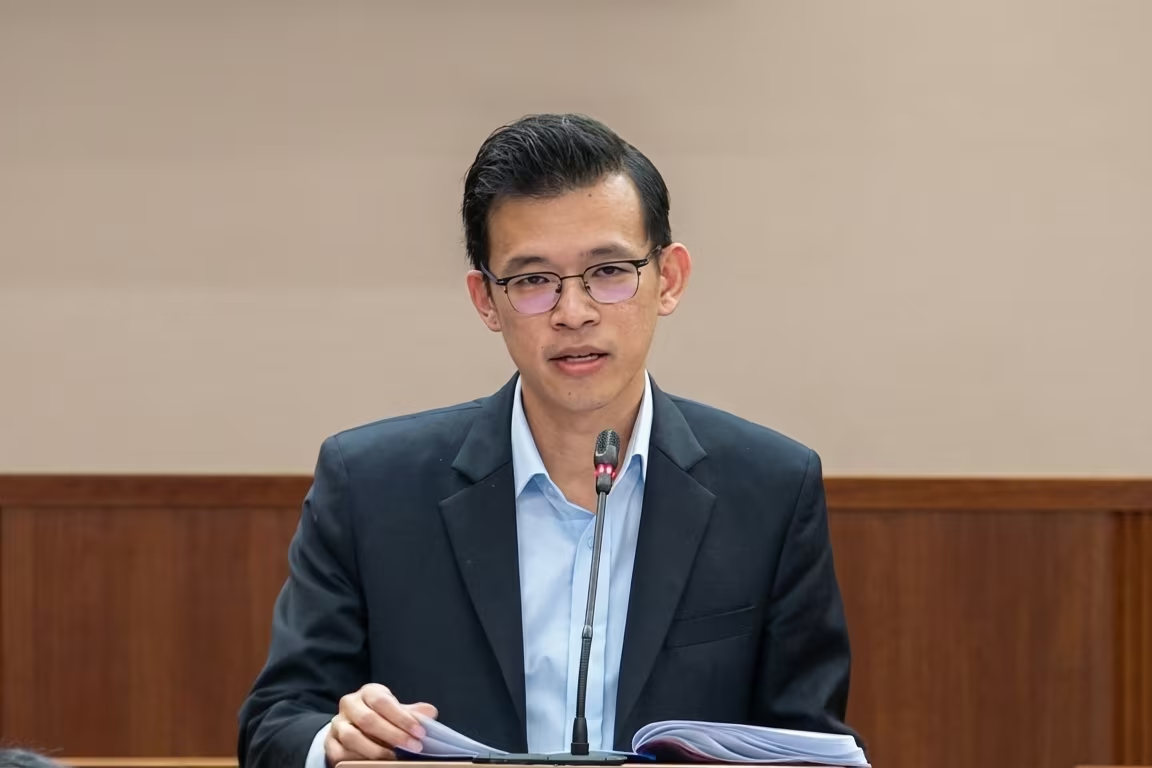

Mr Speaker, I move, "That this House, notwithstanding the suggestions in the Economic Strategy Review on the future Singapore economy, believes:
(a) in a more equal and inclusive economy, with opportunities for entrepreneurs to experiment, households and businesses to succeed, workers to thrive, and ideas and innovation to flourish; and
(b) in an economic engine driven by dynamic local companies, healthy domestic demand, and Singaporeans and Singaporean capital venturing abroad."
Why this motion? Why now?
- Singaporeans face a uniquely challenging set of circumstances
- The major model of Singaporeans getting on the economic ladder has been jobs
- Without a job, you're not able to afford renting a place, or buying a HDB flat
- Without your own place, it is difficult to think about having children
- And for these children, few dream of becoming entrepreneurs, with nine in ten working here becoming someone's employee. For almost all of us, the jobs ladder is the main route up, with not many Singaporeans becoming entrepreneurs.
- The reasons given are variously these:
- That the market is small and the cost of business daunting.
- That they lack social safety nets for risk taking
- That not enough true growth capital exists, for all the private wealth attracted here.
- That the biggest competitor to Singaporean startups and SMEs, are the Singaporean GLCs
- These, we have the power to influence.
- The reasons given are variously these:
- Property has been a lottery ticket to many Singaporeans, but with asset prices as high as they are, it is highly questionable if a new generation can follow this model without parental support, given initial conditions of wages lagging asset prices, and declining employment prospects.
- The persistence of property as a wealth vehicle breeds a rentier mindset. One generation's ideology hardens into the next generation's psychology.
- And as inter-generational transfers come to dominate socio-economic status, they threaten to entrench inequity.
- Let me recap why our jobs structure is threatened, though I suspect this is not news to many.
- Our jobs structure rests on being the best place in the region for foreign companies to base themselves.
- We host many large companies, but build few of them.
- Singapore has three companies in the Fortune Global 500. All three are commodity traders. Two were founded elsewhere and moved here.
- Korea has thirteen. Taiwan has six. Theirs make semiconductors and ships.
- Theirs were built by their own people, Ours came here, and can as easily go.
- At the high-value end, tariffs are pulling production home and to friendly countries, reducing the supply of marginal new investment available for Singapore.
- And less of what moves can be won on tax competition. For an increasing number of R&D and manufacturing jobs, speed of iteration, equipping and supply, are decisive factors.
- At the cost-sensitive end, high business costs and slow manpower approvals accelerate offshoring to regional centres based in countries like Malaysia and Vietnam. The examples are not unfamiliar to this House.
- H&M moved its Southeast Asia regional HQ from Singapore to KL.
- Tiger beer has been brewed here since 1932. By the end of next year it will not be — Heineken is winding down brewing at Tuas and moving production to Malaysia and Vietnam, and about a hundred and thirty jobs go with it.
- For our younger generation, they face a changed playbook.
- The high-paying entry-level tech jobs that many aspired to have largely dried up.
- Many entry-level roles have been offshored due to the high cost of business.
- And capable AI agents and models are said to reduce the need for entry-level hiring.
- But whatever the cause, it is undeniably hard for a young Singaporean to find a job today. What follows is adaptation: entrepreneurship by necessity rather than by choice, second and third jobs, structural underemployment.
- In a high-cost economy, the work most likely to stay is work that cannot be done more cheaply somewhere else. The standard answer for advanced economies has been R&D - build what others cannot easily copy, so that firms come here in spite of our costs.
- But after decades and tens of billions, not one local R&D champion has emerged worth more than a billion dollars.
- Of course, we should continue to invest.
- But the upshot is that our R&D complex is sadly not ready to be our growth engine.
- And as individual Chinese provinces and groups thereof become increasingly fiercely competitive ecosystems, every economy will need to reckon with the necessary scale, energy availability, and cost required to compete. Alone, it is difficult.
- That is why I believe we must have greater industrial coordination between Southeast Asian countries, and engage in transnational industrial policy, as I elaborated in both my maiden speech last September and my adjournment motion this July.
- These are structural challenges to the industrial underpinning of jobs.
- We host many large companies, but build few of them.
- I acknowledge the Government continues to do its best under these circumstances.
- investment into Singapore is holding up. EDB committed 14.2 billion dollars of fixed asset investment last year, up from 13.5 the year before, and 12.7 the year before that. So three years rising.
- But for it, we get the opposite trend in jobs. In 2023, 20000 jobs. In 2024, 18700 jobs. Last year, 15700 jobs. The value-added expected went from 26.7 billion dollars, to 23.5, to 18.
- So even on official statistics, the engine of investment to jobs is faltering.
Faced with such a panoply of problems, what can and should we hope for?
- First, we need an updated growth model that cares not only about the headline GDP growth figure, but the structure of growth.
- If we truly believe this is a "changed world", then our policies must change with it.
- The structure of growth matters, and growth and distribution are not two things to be done in sequence.
- It is acceptable as an exigency to grow first, and then redistribute by vouchers and rebates; but over the medium and long-term we should be building an economy where a fair distribution is produced by the growth itself, rather than repaired afterwards out of the proceeds.
- "Predistribution", over redistribution.
- It is acceptable as an exigency to grow first, and then redistribute by vouchers and rebates; but over the medium and long-term we should be building an economy where a fair distribution is produced by the growth itself, rather than repaired afterwards out of the proceeds.
- That is why we need an economic engine driven by dynamic local companies, healthy domestic demand, and Singaporeans and Singaporean capital venturing abroad.
- Only when Singaporeans thrive, and believe the ladders of opportunity are fair to all, can this country be open.
- Second, we need honest measurement and prioritisation of what matters from growth.
- Let me offer three North Stars for the distributional aspect of growth
- A. The indigenous share of national income, which captures the contribution to national income of Singaporeans as workers, owners and entrepreneurs. Its internationally comparable cousin is the labour share: how much of what stays in Singapore goes to the people who work here. Ours, at around forty per cent, lags most advanced economies. We should resurrect the indigenous income series, and measure the whole of what Singaporeans contribute.
- B. Real income growth that keeps pace with productivity, not lag it.
- Overall labour productivity has grown by 2.5% per year from 2016-2024, but over the same period, real mean income only grew at 1.3% per year.
- Singaporeans have always been model workers. From 2016-2024, according to the ILO, Singapore's output per worker grew 2.3% per year, outstripping major economies such as the US at 1.6%, Israel at 1.6%, HK at 1.3%, Korea at 1.3%, Switzerland at 1.1%
- We need to repair this lag. Singaporean workers have kept their end of the bargain. Their compensation has not kept up with it.
- C. Whether Singaporeans can still afford the city they built. Not how much we produce, but how much variety ordinary Singaporeans on an ordinary wage can enjoy. The diversity of services available, how much they can afford, and the leisure they can afford to take. The independent kitchen, the second-hand bookshop. We cannot in one breath lose our heritage businesses and our arts spaces, and in the next tell Singaporeans that the city is thriving.
- Cities compete on the variety of things there are to consume, not only on what they produce, and high-amenity cities grow faster.
- So we should measure it. How varied the choices are, and how many choices an ordinary wage can afford.
- A. The indigenous share of national income, which captures the contribution to national income of Singaporeans as workers, owners and entrepreneurs. Its internationally comparable cousin is the labour share: how much of what stays in Singapore goes to the people who work here. Ours, at around forty per cent, lags most advanced economies. We should resurrect the indigenous income series, and measure the whole of what Singaporeans contribute.
- These three North Stars point us towards a more equal and inclusive economy, with opportunities for entrepreneurs to experiment, households and businesses to succeed, workers to thrive, and ideas and innovation to flourish.
- Let me offer three North Stars for the distributional aspect of growth
Mr Speaker, the various Members of Parliament of the Workers' Party will touch on 8 questions to answer the challenges I have laid out:
- First, I will discuss innovation under constraint: how do we foster a dynamic enterprise and innovation system that maximises value regardless of high business costs and physical constraints?
- Second, my colleague Jamus Lim will discuss dynamic local firms: how can we create a business climate in which dynamic local firms emerge as drivers of innovation and become the future cornerstones of the economy?
- Third, my colleague Louis Chua will discuss land and the roof over the household: how do we ensure that attractive, affordable housing is available for every Singaporean household?
- Fourth, my colleague Andre Low will discuss the start of a working life, and ask how we ensure our tertiary students and young workers find meaningful opportunities and good jobs in a challenging economy.
- Fifth, my colleague Gerald Giam will discuss pathways to a middle-class livelihood. Taking tradespersons as his exemplar, he will ask how we create accessible pathways for them to earn a decent middle-class livelihood.
- Sixth, my colleague Fadli Fawzi will discuss displacement and re-entry, and ask whether our system of continuing education actually works — the journey, the destination, and the proof.
- We close the Workers’ Party contributions with our two most expansive views of the economic model.
- Seventh, my colleague He Ting Ru will discuss the lesser-measured parts of our economy, in the domestically-oriented sectors, and ask what parts of this economy our national statistics fail to capture.
- Eighth, my colleague Eileen Chong will discuss venturing abroad: how do we empower Singaporeans to seize opportunities in the region and beyond?
- Mr Speaker, beyond these questions there is really one question.
What does it mean to take a changed world seriously?
- If we mean to rebuild the ladder of opportunity in this generation, the answers to these problems must be the centrepiece of our evolved economic model.
- In these speeches, my colleagues and I will lay out in 8 steps, structural solutions to structural problems.
- Today, the problem I will tackle, is enterprise and innovation under constraint.
The Special Zone — enterprise and innovation under constraint
Investing in our own success
- For two generations we have been good at bringing other people's companies here. We have been slow to put the same land — which we own — behind our own people building their own.
- Why do we take a high land price as a law like gravity?
- Universal land pricing is a coherent and convenient accounting ideology, but in the last accounting, the people of Singapore need to decide if this ideology still serves them.
- Families already know this. Tuition is expensive and no tutor can promise a good job twenty years out. We pay anyway. Investments require outlays; we do not ask a child for an immediate payoff.
- So the proposition: Singapore should stop treating market land value as the natural price of every socially productive use of land.
- And the test: a university-centred special zone where State land is priced at development cost rather than market scarcity value.
- What is our offer to our young?
- We should remake the system with the young as the first consideration rather than the last adjustment.
- Today we tweak: a discount on a co-living room, a grant, a priority band in a ballot — adjustments at the edge of a system designed around somebody else, in a different decade. Treating the young as a first-order principle means the opposite. We design for the twenty-something-year-old foremost.
- This is a supply-side problem of policy. "Before we can remake society TO BE young, we must remake society FOR THE young."
- The bargain has four parts:
- A place to live, near where the work and the research happen, at a price a starting salary can carry.
- In service of something the country needs, more local enterprise and R&D.
- With the upside staying with the risk-takers.
- And a say in the rules.
- What we should create:
- A special zone surrounding NTU where the State land is charged at cost-recovery, rather than market scarcity value, and takes its return in the companies that grow there instead of in rent.
- This experiment will span land-rates for both residential and commercial space, spanning co-living, local enterprise and R&D.
- It must be centred around an existing core, a university, because one cannot rustle up a cluster from nothing; but one can take one that exists and play to its strengths.
- It will be zoned for organic messiness.
- A district that is both pro-worker and pro-business, built around the needs of young people and young companies.
- And this experiment is reversible. If it does not work, we can revert to the masterplan. But surely today's Singaporeans should have as much say over scarce land as the masterplanners of decades ago.
- A special zone surrounding NTU where the State land is charged at cost-recovery, rather than market scarcity value, and takes its return in the companies that grow there instead of in rent.
- Let me take the argument in this order:
- land,
- our tertiary institutions,
- and then governance and money.
Land — the input we have never tested
- First, land.
- Thirty years, tens of billions into R&D, and more again on fostering entrepreneurship. Both R&D and the ladder of growing local giants have underperformed. We are world-class at marshalling inputs, but commercial outcomes in terms of Singaporean-grown companies have not appeared at the rate the spending implies.
- On talent, we want to attract the very best to work alongside a strong local core.
- On capital, we disagree about design, but not ideology. But there is a serious methodological point. The State runs on taxpayers' money; prudence is its duty. Innovation requires the opposite — calibrated risk-taking. Which is why risk capital belongs in a policy investment bank rather than inside Government, as the Prime Minister proposes: a prudence-first posture is difficult to unlearn.
- Where we do have an ideological disagreement is the price of land. My colleague Mr Louis Chua will also speak about this later.
- The ESR organises itself around the inputs to production — capital, labour, productivity. But land, an input distinct from capital, is discussed as revenue and not as a cost: a constraint to live within, not as a lever to change.
- And it is not a small cost. In December 2022 the Government put the development cost of that year's 13,506 completed flats at $396,000 each: $234,000 of land against $154,000 of construction. Land was fifty-nine per cent of the cost of a flat.
- But of course we can test and change this cost.
- We have been here before. The Centre for Liveable Cities, the Government's own urban-research arm, records what happened when one-north was planned:
- (quote) "the idea of providing residential uses in the form of affordable housing was put forth… However, it was difficult for the HDB to change its public housing policies for a single project like one-north. Therefore, the JTC approached the private sector." (end quote)
- National policy then could not bend for one-north. It should have.
- What we need for R&D and entrepreneurship matters more than dogmatic inflexibility.
- A high price homogenises — it prices out the independent kitchen and the lab with no revenue yet, and leaves whatever can pay the rent: chains and franchises.
- It also programmes space. A market scarcity rate selects for what can be proven in advance - and nothing new can be proven in advance. By definition, the novel has no track record. Thus the experimental messiness of life is competed out.
- A zone of lower commercial pressure is a zone for messiness — a zone where land is cheap enough for the young to make their own places, and their own future, organically. The first variable, not an accommodation.
- If land pricing is an unnecessary drag on the young, on enterprise, on an R&D cluster — how do we test it?
- There is a formidable constraint. Singaporeans need land prices low — to start something, to live somewhere. And we need them high, because many of our savings sit in HDB flats and the State leans on land revenue.
- To have both high land pricing and low land pricing simultaneously, we must do away with the constraint of universal land pricing.
- There are at least three ways to vary a price.
- First, across time — the island-wide price itself.
- Second, across a policy-targeted group, as the BTO does for young parents.
- Third, across a geographic boundary: fence one area, change the pricing function inside, in service of agglomeration and enterprise — people and firms packed close enough to make each other more productive.
- I believe that the third is the least disruptive theory-of-change, if one believes that our land pricing assumptions need to be tested.
- And then the question becomes where to test such a zone.
- For the young.
- For the R&D economy.
- For an entrepreneurial spirit.
- It belongs around our tertiary institutions — and looking at the map, NTU is the obvious candidate.
Our tertiary institutions — why NTU, and why now
- Now, why NTU?
- The research cluster is already there — a large number of labs are sited on campus. And unlike NUS, whose Kent Ridge and one-north districts have little room left, NTU can still expand.
- And yet what is planned for Bahar and CleanTech Park — 116 hectares, adjoining NTU — is another industrial park. The same answer the party opposite has given again and again.
- If we are to clear scarce greenery, the use must be distinctive enough to be worth the sacrifice. Ours is. Another industrial park is not — that is something priceless and irreversible traded for something cookie-cutter.
- Take Punggol Digital District — fifty hectares, JTC-developed, anchored on SIT's campus. It proves the Government will build a district around a university. But it is more of the same we have done - a business park with a campus in it, on market terms.
- If one accepts the first-principles case for the special zone — then two empirical facts must be dealt with.
- First, the Jurong Region Line is being dug into NTU, with campus stations arriving at the end of the decade. Tengah's flats are rising beside it. Kept as separate plans, they make one more park that people commute into.
- And the Jurong Innovation District — 620 hectares, one landlord — holds in Bahar the next greenfield precinct: already zoned, with the environmental assessment underway.
- The better bargain is a district for living, working and playing — for enterprise. And this new district around NTU is perhaps our last chance to run this sort of experiment: whatever we settle on this Bahar parcel becomes how we price the ground beside every campus after it.
- Second, the Johor zone agreement was signed in January 2025. It is an experiment we must make succeed. But for all our hopes on foreign economic policy, it sits in another country, and carries the risk that comes with that. We can and should run these experiments for ourselves, by ourselves, if we can. And we can!
- If we want to re-orient our culture —
- Toward the spirit of independent living,
- Toward the spirit of risk-taking,
- Toward the spirit of collaboration,
- Then we must provide the conditions for this spirit to flourish.
- We should not be distracted by procedural arguments — that Bahar and Jurong are already zoned in a masterplan. The experiment can be run as things stand. The question is whether we will.
- First, the Jurong Region Line is being dug into NTU, with campus stations arriving at the end of the decade. Tengah's flats are rising beside it. Kept as separate plans, they make one more park that people commute into.
The price — what cost-recovery actually means
- So: NTU at the centre of a live-work-build district, distinguished by charging land for housing at cost recovery.
- By cost I mean cost in its ordinary sense, with all scarcity value excluded — the actual cost of constructing, financing, servicing, maintaining and renewing the buildings. Not the hypothetical market value of the ground beneath them.
- What would that come to? We have a few indications
- At NTU this academic year, a non-air-conditioned double costs about $412 a month, and an air-conditioned single about $657. At NUS, a double in Hall runs about $494.
- Under the co-living scheme announced late July this year under the SG Youth Plan, a room starts at about $1,800 a month at 1925 Quarters, $1,950 at Coliwoo Boon Lay, and $2,000 at Coliwoo Lutheran, before utilities and deposits — roughly thirty per cent below the usual rate, with the operators absorbing the difference.
- The one at Boon Lay is about four kilometres from NTU, and costs roughly five times what the university charges its own students.
- Is it affordable? I do not think it is.
- The median fresh graduate from our six autonomous universities earned $4,500 a month last year. After CPF, about $3,600 in hand. The Boon Lay rate plus its fixed utility charge takes sixty per cent of it — after the discount.
- This is not treating the young as a first-order consideration.
- Our young want space of their own and financial autonomy as a precondition for life, not as a byproduct of marriage.
- And "thirty per cent below market" is measured against the scarcity market. Before the discount, the same room took more than three-quarters of a graduate's take-home pay. Affordability must be benchmarked against what a young Singaporean actually has to spend rather than "market-rate discounts."
- So what can we offer with a different basis?
- On a cost-recovery basis, a room comes to well under half the going rate — closer to a third.
- Take one calculation that owes nothing to a university subsidy. A five-hundred-square-foot unit at two hundred dollars a square foot — above the construction cost implied by the Government's own 2022 figures, so a conservative assumption and not a hopeful one — put three people in it, and amortise over ten years at five per cent. It comes to about $1,061 a month, or $2.12 a square foot: roughly $380 a head, with a sinking fund in. Stretch the amortisation to twenty years and it is $1.32 a square foot.
- Other calculations land in the same place. The universities' own rates, annualised over twelve months rather than the thirty-five weeks a term actually runs, comes out to between about $478 and $549 for a room. The universities are already housing people at close to cost.
- So we can arrive at a figure between $350 and $550 a month for a room.
- On a cost-recovery basis, a room comes to well under half the going rate — closer to a third.
The reserves objection, and the answer
- I know the reply this will draw. All State land forms part of the reserves; land must be sold at fair market value; otherwise the reserves are depleted.
- So let us look at practice and not just theory.
- Start with an instrument we have already written. The Land Betterment Charge (Concessionary Relief) Order 2022 waives the betterment charge on State-leased university land put to educational and institutional use, and it defines "university" as the National University of Singapore and Nanyang Technological University.
- So concessions already exist for the universities.
- Nor is that the only place the State prices by decision. Land for a place of worship or a civic and community institution is already valued at half of full land value; on the Land Betterment Charge table effective this March, that is about a tenth of what residential land in the same sector is assessed at.
- That rate line is not only for places of worship. Educational and institutional use sits in the same group, and it is charged at three rates for the whole island, while every residential and commercial rate moves across a hundred and eighteen sectors. For one class of use the State already sets the price by decision rather than by location.
- And in 2023 the Government moved places of worship from competitive tender to a fixed-price ballot, precisely because bidding had driven prices to levels that distracted religious bodies into fundraising. Prices fell. Apparently, nobody raided the reserves.
- What can we surmise? For the party opposite, fair market value is already a function of the interest granted.
- It is not a single number attached to a plot.
- Change the use class and the fair market value changes with it, lawfully, with the Chief Valuer still doing the valuing.
- The Government identified that a market mechanism was pricing a use out of its own purpose, replaced it with an administered price, got a lower number, and the Chief Valuer still called it fair market value.
- So let's use the rules as they are.
- Let's create a use category for non-tradeable, restricted-tenure mixed housing and enterprise land, and let the Chief Valuer value that restricted interest.
- A clear valuation, to build productive capacity for the next generation, is not a raid on the reserves; it is the outlay side of an investment. It is what every family who pays for tuition for better economic prospects for their kids already knows. It is long-term economic foresight over short-term economic thinking.
- How would the zone work if demand exceeds supply?
- We could ballot. Once in, the rent stays low while you are part of the zone — studying, working, building or serving it. Leaving is built in: a firm gets a fixed term and option to renew, then graduates out on success; a person who loses a job, or whose startup dies, gets a year's grace before the rent resets. And the housing is rented, never sold. It never becomes an asset to be traded.
Governance and money
- Mr Speaker, the price of land matters greatly, but it is not sufficient on its own. We must get the other conditions right too.
The rulebook, and who writes it
- On Governance, an innovation district is a place where things are tried and most of them fail. That requires us to tolerate some untidiness.
- Most of what I am asking needs no new legislation. JTC lets its land on contracts it writes itself. Rent formulas, renewal tests, quotas, carve-outs, occupancy covenants — these are lease terms, not statutes, and the latitude is already there.
- We should lift URA's planning circular capping non-academic use of a campus at five per cent of floor area or 30,000 square metres. We can hasten visa decisions for deep-tech researchers and for the people the enterprises need. And aim to have every major decision in the zone made within two weeks.
- We should aim to devolve operational decisions to the zone's own board. Small and nimble, with the anchor university on it, able to make bundled decisions on space, pilots, housing allocation, visas and procurement. And the board should be responsive to the people living in the zone, who should have a say in how it is run.
The money, and where the upside goes
- On Money, we should give this zone the ability to back its founders and enterprises. Lower rent is part of the draw. The bigger draw should be growth capital — the zone taking a stake in the enterprises that grow inside it.
- Singapore and China established Suzhou Industrial Park in 1994. The zone grew its own investment arm: Oriza Holdings, state-owned, controlled by the Park's Administration Committee, incorporated 2001, with around US$14 billion under management today.
- So while we're not involved in Oriza, a zone-based financing body is not unknown to us.
- Many financial innovations have come from zones. China's New Third Board — its national over-the-counter equity market for unlisted small companies — began in 2006 as the Zhongguancun Science Park share-transfer pilot and went nationwide in 2013.
- So we should capitalise a zone authority that can invest in while providing optimal conditions for its startups and enterprises to succeed, taking a capped equity or revenue stake.
- And allow it to appropriate a portion of the funds it generates to further develop the zone.
- A zone of lower immediate commercial pressure for these enterprises is a place where experimentation and diversity can flourish.
A direction for the young
- Speaker, the zone is one bounded, reversible way to try: on available land, at a price that takes nothing from the reserves, with land prices outside the zone exactly the way they were. A way to make more Singaporeans involved in enterprise and R&D, and not only employees.
- So the ask is threefold.
- A zone around NTU
- A new use category for restricted-tenure, non-tradeable, mixed housing and enterprise land, valued as the restricted interest it is.
- And a zone authority that runs its own operations and takes stakes in the enterprises it grows.
- It is a controlled experiment in whether Singapore's land-pricing regime is suppressing agglomeration, entrepreneurship and indigenous capital formation.
- If there is a Singaporean secret sauce that inheres beyond the cost pressures of land and wages, then a zone here, alongside the one in Johor, will tell us.
- It is a test we should run for our younger generation.
- We have spent thirty years making this country a good place for other people's companies to succeed.
- I am asking that we spend the next thirty making it a place where our own can. Not just a better deal for the young — a country which is built categorically for the young.
Conclusion
- Speaker, in closing.
- There has been much talk that the world has changed and is not changing back.
- We can all feel it. So here is the test of whether we are serious.
- We must reform significant parts of our present economic structure to deal with a changed world.
- To pursue growth that distributes more fairly.
- And to measure what makes that growth worth having: a fair share of national income, real income growth in line with productivity, a widening range of what an ordinary wage can afford.
- Many of these changes must come at the national level.
- But some are assumptions, long in the tooth, that must be tested. Universal market land pricing is one, and a policy laboratory at a real scale is how we test it.
- The zone is one part. In this Motion, each of my honourable Friends will bring another - structural solutions to structural problems.
- Singaporeans deserve serious answers. And serious answers are what the Workers' Party will provide.
- That is why we have moved this Motion, to create An Economy of the Future That Works for All.
- Sir, I beg to move.

