


Written Answers to WP's Oral Questions
Mr Kenneth Tiong Boon Kiat
Children Of Unwed Mothers Excluded From Baby Bonus Cash Gift And Working Mother's Child Relief
Mr Kenneth Tiong Boon Kiat asked the Prime Minister and Minister for Finance (a) how many children of unwed mothers were excluded from Baby Bonus Cash Gift and Working Mother's Child Relief in each of the past five years; (b) what would extending both benefits to these children cost annually; and (c) whether the Ministry has compared this cost against downstream expenditure on alternative support pathways including ComCare, ComLink+, KidSTART, and public housing for these families.
Ms Indranee Rajah: From 2020 to 2024, there were on average, about 745 non marital live births per year to Singapore citizen mothers in Singapore. The Baby Bonus Cash Gift and Working Mother’s Child Relief were designed to encourage parenthood within marriage. Hence, they were not extended to single unwed parents. It is not an issue of cost. Therefore, we do not track how much it would have cost to extend these benefits to unwed parents, nor do we compare this against expenditure on other programmes that may support these families.
Nevertheless, single unwed parents are eligible for Government benefits that support the growth and development of their children. These include leave provisions, as well as subsidies for infant care, childcare, education and healthcare. They are also
eligible for the Migrant Domestic Worker Levy Concession, and the Child Development Account (CDA) benefits, which include the CDA First Step Grant and Government Co-matching.
Single unwed parents who require additional support can apply for financial assistance via the SupportGoWhere portal, and approach family service centres for holistic support which may include help through programmes like ComCare and KidSTART.
Government Support Provided To Sino-Singapore Jilin Food Zone Under Bilateral Cooperation Framework
Mr Kenneth Tiong Boon Kiat asked the Minister for Sustainability and the Environment (a) what forms of Government support have been provided to the Sino Singapore Jilin Food Zone under the bilateral cooperation framework since its inception in 2008; (b) what food security outcomes Singapore has achieved from this project; and (c) whether the Ministry will provide an update on the project's current operational status.
Ms Grace Fu Hai Yien: The Sino-Singapore Jilin Food Zone (JFZ) was established in 2008 as a private sector-led project. As part of bilateral cooperation to support the JFZ, then-Agri-Food & Veterinary Authority (AVA) had provided technical assistance and training for food safety and animal health matters. This included supporting the initiative to establish and maintain a Foot-and-Mouth Disease Free Zone for meat production. We do not have further updates given JFZ remains a private sector-led project.
Total Amount Paid To Foreign University Partners On Curriculum Development And Licensing In Past 25 Years
Mr Kenneth Tiong Boon Kiat asked the Minister for Education (a) what is the total amount of Government spending to foreign university partners for curriculum development and licensing across all international university partnerships in the past 25 years; (b) what metrics are used to evaluate success beyond initial curriculum transfers for such spendings; and (c) whether the Ministry has conducted cost-benefit analysis comparing maintained partnerships like Duke-NUS versus terminated ones like Yale-NUS.
Mr Desmond Lee: Our Autonomous Universities (AUs) collaborate with a wide range of international partners in education and research. This allows our AUs and students to benefit from the experiences of reputable universities around the world, while also contributing to knowledge creation in areas of mutual benefit. Over time, these collaborations progress, evolve, and mature. In some cases, they come to a natural end when both parties no longer find it mutually beneficial.
Some collaborations have associated costs, to pay for the resources committed by overseas university partners towards such efforts. The AUs and the Ministry of Education (MOE) are mindful that the amount of funding required by AUs to enter into such partnerships should be commensurate with the value obtained, including developing in Singapore capabilities or opportunities that had not previously existed, and positioning our AUs well for the future.
Mr Abdul Muhaimin Abdul Malik
Proportion Of Muslim Couples Attending Marriage Preparation Programme
Mr Abdul Muhaimin Abdul Malik asked the Acting Minister-in-charge of Muslim Affairs (a) since 2021, what proportion of first-time newlywed Muslim couples have attended the Cinta Abadi Marriage Preparation Programme; and (b) whether MUIS offers additional fee waivers or rebates for couples who are in full time education.
Assoc Prof Dr Muhammad Faishal Ibrahim: On average, about 1 in 7 first-time Muslim couples attended the Cinta Abadi Marriage Preparation Programme. The Ministry of Social and Family Development provides a rebate of $170 for eligible Singaporean couples who are attending their first approved marriage preparation programme. Full fee subsidies are also available for eligible couples from low-income households, regardless of their education status.
Extent Of Gen AI Use Among Muslims To Obtain Religious Information And Instruction
Mr Abdul Muhaimin Abdul Malik asked the Acting Minister-in-charge of Muslim Affairs (a) what is the MUIS’s assessment of the extent and nature of generative AI use among Muslims in Singapore to obtain religious information and instruction; and (b) whether MUIS (i) intends to develop a proprietary generative AI platform for religious information and (ii) intends to fund or support the development of such platforms by external technology providers.
Assoc Prof Dr Muhammad Faishal Ibrahim: Generative AI (GenAI) offers benefits and convenience to users, such as ease of access. However, there are risks when it is relied upon as the primary source of religious guidance. In particular, complex Islamic religious matters may require additional contextual understanding and scholarly interpretation. For these issues, our qualified asatizah remain essential to deliver sound religious guidance to help our Muslim community navigate contemporary, real-life challenges. The MuslimSG platform also continues to be a trusted resource for the community to seek religious guidance.
The Islamic Religious Council of Singapore (MUIS) therefore adopts GenAI judiciously, after putting in place the appropriate safeguards. For instance, IftaSG, an initiative under MUIS’ “Fatwa Lab”, utilises prompt engineering and curated datasets
to tailor a Large Language Model that enhances the accuracy, depth and speed of Fatwa research that is suited for Singapore. At the same time, our asatizah continue to maintain oversight on final religious rulings. MUIS will review its learnings and glean learning points and insights from the initiative.
As the use of GenAI grows, equipping the Muslim community to use AI tools wisely and confidently remains a priority. In recent years, MUIS has stepped up capability and capacity building in AI and digital literacy across mosques and madrasahs, which include training programmes for staff and volunteers. Mosques have organised programmes that support initiatives, such as "Langkah Digital” by MENDAKI, to enhance AI and digital literacy standards, and enable the community to be discerning in the use of GenAI. To enhance learning, madrasahs are also exploring the use of AI to supplement efforts to teach Arabic, aid student assessment and learning support, and streamline lesson planning processes.
Assoc Prof Jamus Jerome Lim
Take-Up Rate For LPA Since August 2025 And Proposed Extension Of Fee Waiver
Assoc Prof Jamus Jerome Lim asked the Minister for Social and Family Development (a) whether the take-up rate for the Lasting Power of Attorney (LPA) has increased since August 2025; and (b) whether the Government will consider extending the deadline for the fee waiver for registration of LPA Form 1 applications.
Mr Masagos Zulkifli B M M: The number of Lasting Power of Attorney (LPA) made increased from 350,000 in August 2025 to 410,000 in January 2026. MSF has no updates at the moment on a further extension of the waiver of LPA Form 1 fees. We encourage all Singaporeans to make their LPA as soon as possible, to take advantage of the waiver before it expires on 31 Mar 2026.
Reason For Change In Government's Definition Of Household Income In Key Household Income Trends Report
Assoc Prof Jamus Jerome Lim asked the Deputy Prime Minister and Minister for Trade and Industry with regard to the redefinition of household income in the recently published Key Household Income Trends report (a) what motivated the change; (b) how this definition compares with practices of major national statistical agencies internationally; and (c) whether the revised methodology was applied retrospectively to ensure time-series comparability.
Mr Gan Kim Yong: The changes to the KHIT report were made partly in response to Singapore’s changing demographics. With our ageing population, there is a growing proportion of retiree households who do not have employment income, but may have income from non-employment sources such as annuities (including from CPF), rental, investments and regular allowances from their children. Expanding the household income definition and household coverage ensures a more complete representation of resident households and their income trends.
The changes made to the household income definition and coverage in the KHIT report are now aligned with international practices and follow longstanding efforts to improve data on non-employment income, which can be challenging to measure. In particular, DOS took reference from the Canberra Group Handbook on Household Income Statistics, an international guidance manual for the compilation of household income statistics that is widely used by other major national statistical agencies.
For better comparability in the KHIT 2025 report, the revised household income definition and coverage have been applied retrospectively to annual household income statistics from 2015 onwards.
LPA Form 1 Applications Aborted Due To OPG’s Online Portal Issues
Assoc Prof Jamus Jerome Lim asked the Minister for Social and Family Development (a) how many Lasting Power of Attorney Form 1 applications were aborted or unsuccessful due to issues with the Office of the Public Guardian’s online portal or SingPass; and (b) what measures have been or will be implemented to ensure such issues do not prevent applications before the fee waiver expires on 31 March 2026.
Mr Masagos Zulkifli B M M: The Office of the Public Guardian (OPG) is unable to track the number of aborted or unsuccessful Lasting Power of Attorney (LPA) Form 1 applications. Members of public may not report to OPG when they abort an application or encounter technical problems. If the OPG Online system (OPGO) is unavailable for prolonged periods, donors can submit a hardcopy LPA application. If needed, they can seek help in filling up the forms at ServiceSG centres.
To improve system resilience, OPG has implemented measures such as building OPGO on the Government Commercial Cloud and increasing database capacity in anticipation of surges in application volume before the fee waiver expiry. We will continue to explore measures to improve system resilience as needed.
Mr Dennis Tan Lip Fong
Adjusting Labour And Urban Planning Policies To Mitigate Heat-Related Productivity Losses
Mr Dennis Tan Lip Fong asked the Minister for Manpower given projections in a study by National University of Singapore that heat-related productivity losses could reach $2.22 billion by 2035 (a) what specific labour and urban planning policies have been adjusted based on these models; and (b) whether the Ministry will transition from providing heat stress advisories to imposing mandatory work-rest cycles for indoor and outdoor sectors identified as high-risk under future climate scenarios.
Dr Tan See Leng: The Ministry of Manpower (MOM) is committed to protecting workers from heat-related risks, while supporting business continuity and productivity. In consultation with tripartite partners and industry, MOM updated the heat stress management framework in September 2024 to ensure outdoor workers are adequately protected. The revised framework is not just an advisory – it includes specific mandatory measures that are essential for mitigating the risk of heat stress at different temperatures, including work-rest cycles where necessary. For example, when the Wet Bulb Globe Temperature reaches 32°C and above, workers performing heavy physical work activity outdoors must be given hourly rest breaks of at least 10 minutes. Beyond these mandatory requirements, the Workplace Safety and Health Council (WSHC)’s WSH Guidelines on Managing Heat Stress in the Workplace provide guidance on mitigating heat-related risks for both outdoor and indoor workers, including scheduling of work and rest periods.
Under the WSH Act, it is also mandatory for employers to report work-related heat illnesses to MOM. From 2021 to 2025, there were no fatalities and a total of 24 non-fatal cases were reported, ranging from 1 to 13 cases annually. Out of the 24 cases, 22 cases relate to outdoor work. Less than half of the 24 cases resulted in hospitalisation, and less than half resulted in medical leave exceeding three days.
MOM will review and enhance our measures as part of the Government’s ongoing approach to tackle heat stress through a proactive and science-based heat resilience strategy. This includes heat mitigation measures, such as environmental modelling to identify wind corridors and planting trees to provide shade along key
pedestrian routes and public spaces. It also includes adaptation measures to strengthen community resilience to heat, such as the Heat Stress Advisory which provides the public with information on how they can minimise the risk of heat stress and heat related illnesses. These are supported by ongoing Research and Development efforts to better understand the impacts of heat and develop new cooling solutions.
Cost-Benefit Analysis For Transitioning From Incinerating Recyclables To Smart-Bin System
Mr Dennis Tan Lip Fong asked the Minister for Sustainability and the Environment given that 40% of the items in blue recycling bins are contaminated (a) whether the Ministry has conducted a cost-benefit analysis comparing the high operational costs of smart bins against the current financial losses from incinerating contaminated recyclables; and (b) what specific logistical benchmarks must be met before transitioning the National Recycling Programme to a segregated smart-bin system.
Ms Grace Fu Hai Yien: The National Environment Agency (NEA) has introduced various source-segregated recycling schemes to encourage the aggregation of clean-stream recyclables.
This includes deploying smart bins as part of our Public Waste Collection contracts and extended producer responsibility schemes for e-waste and beverage containers, where producers are responsible for collecting and recycling their products at their end-of-life.
These efforts complement the blue bin system, encourage proper recycling behaviour, and, combined with public education initiatives, help to reduce contamination in recycling bins.
We will continue to explore ways to enhance our recycling ecosystem, including partnering with the community on localised solutions to collect more clean-stream recyclables over time.
Ms He Ting Ru
Proportion And Career Progression Of Female Foreign Service Officers, And Request For Publication Of Gender Disaggregated Appointment Data
Ms He Ting Ru asked the Minister for Foreign Affairs in each year since 2022 (a) how many Ministry of Foreign Affairs officers have been women; (b) how many percent of officers at superscale grades have been female; and (c) at which career stage does the sharpest gender divergence occur.
20 Ms He Ting Ru asked the Minister for Foreign Affairs (a) in view of previous statements that overseas postings are especially disruptive for women officers, what specific changes to posting and appointment processes have resulted from the Ministry’s reviews; (b) whether selection criteria such as willingness of a diplomat’s spouse to relocate have been assessed for gender impact; and (c) whether the Ministry will publish annual gender-disaggregated appointment data.
Dr Vivian Balakrishnan: Since 2022, about half of the Ministry of Foreign Affairs (MFA) employees are women. The proportion of women in senior appointments has remained stable at about a quarter.
We recognise that overseas postings are disruptive for officers with families, especially female officers who bear greater caregiving responsibilities. The Ministry regularly reviews HR policies to better support officers' career aspirations and family
obligations, including considering personal circumstances for overseas postings and providing support for spouse and children accompanying officers overseas. All new hires are fully aware that an MFA career involves periodic relocations.
The Ministry selects and deploys the best candidate for each position based on merit. We remain committed to fostering an inclusive workplace that provides equal opportunities for all officers.
Government's Assessment Of Social Media's Efforts To Detect Child Sexual Exploitation And Abuse In Livestreams
Ms He Ting Ru asked the Minister for Digital Development and Information (a) what is IMDA’s assessment of social media platforms’ efforts and capabilities to detect child sexual exploitation and abuse in livestreams, which are known to be more difficult to detect than in uploaded material; and (b) what measures are being taken currently to address this risk.
Mrs Josephine Teo: The Government has put in place measures to address child sexual exploitation and abuse online. Under the Broadcasting Act and Online Criminal Harms Act, the Government can issue directions to social media services or internet service providers to disable Singapore users’ access to child sexual exploitation and abuse material published online.
Under the Code of Practice for Online Safety – Social Media Services, designated Social Media Services are required to minimise Singapore users’ exposure to child sexual exploitation and abuse material on their services, including livestreams. The designated two services must put in place technologies and processes to proactively detect and swiftly remove such material. They must also take steps to protect users from child exploitation and abuse activity, such as online grooming. The Code additionally requires designated services to submit annual online safety reports to IMDA, which detail their measures to combat harmful content, including child sexual exploitation and abuse material, and improve users’ safety. The reports are published on IMDA’s website, alongside IMDA’s assessment on each designated service’s performance.
Mr Fadli Fawzi
Show Of Proof Of Vaccination Against Diseases By S Pass Holders
Mr Fadli Fawzi asked the Coordinating Minister for Social Policies and Minister for Health whether the Government will consider making it compulsory for all Pass holders to show proof of vaccination against diseases listed in the Fourth Schedule of the Infectious Diseases Act 1976.
Mr Ong Ye Kung: Under section 46 of the Infectious Diseases Act, the parent or guardian of every child in Singapore must ensure that the child is vaccinated against diphtheria and measles.
Foreign-born children aged 12 years and below who are applying for long-term immigration passes in Singapore are also required to submit documented proof of vaccination or evidence of immunity for diphtheria and measles to the National Immunisation Registry for verification.
Ensuring Increase In Goods Vehicle Permit Fees For Foreign-Registered Goods Vehicles Is Not Passed To Consumers And Producers
Mr Fadli Fawzi asked the Acting Minister for Transport (a) whether the Ministry has assessed if the increase in Goods Vehicle Permit fees for foreign registered goods vehicles from 1 January 2027 is likely to borne by consumers or producers; and (b) whether the Government will take any steps to prevent retailers from opportunistically passing any increase in cost to their consumers.
Mr Jeffrey Siow: The increase in the Goods Vehicle Permit (GVP) fee is intended to narrow the cost difference between the Singapore-registered and foreign registered goods vehicles due to ownership and usage costs in Singapore. We periodically review the fees for foreign-registered vehicles entering Singapore to account for changes in ownership and usage costs of Singapore-registered vehicles. Whether companies bear the increase in the GVP fee or pass this on to their end users is a commercial decision.
Proportion Of Advanced Practice Nurses In Workforce And Plans For Their Development
Mr Fadli Fawzi asked the Coordinating Minister for Social Policies and Minister for Health (a) what is the current number and percentage of Advanced Practice Nurses in the workforce; (b) what targets have been set for their development over the next 10 years; and (c) whether new clinical specialties and roles are being considered for Advanced Practice Nurse certification.
Mr Ong Ye Kung: APNs are at the apex of the clinical nursing track, having post-graduate training, empowered to make certain clinical decisions, and work collaboratively with doctors and other healthcare professionals to provide complex nursing care.
As of 31 December 2025, there were 419 Advance Practice Nurses (APNs) in active practice, which works out to 1% of the nursing workforce in Singapore. The Ministry of Health aims to train 700 APNs by 2030.
With the transformation of the healthcare system to shift more care to the community and non-hospital settings, APNs can lead or play a major role in the delivery of a broad spectrum of care in diverse settings, including acute and community hospitals, mental health services, primary care, community health posts, home care and in nursing homes.
Mr Gerald Giam Yean Song
Assessment Of Progress In Placement Of Fresh Graduates Under Graduate Industry Traineeships Scheme
Mr Gerald Giam Yean Song asked the Minister for Manpower (a) whether the placement of 350 fresh graduates under the Graduate Industry Traineeships (GRIT) scheme as of February 2026 is in line with the Government’s original projections; (b) when all 800 available places are expected to be filled; and (c) what percentage of these 350 placements are with small and medium enterprises.
Dr Tan See Leng : The Member may refer to the reply to Ms He Ting Ru’s written PQ on GRIT for the sitting on 25thFeb 2026 which also addressed this question.
Written Questions
Ms He Ting Ru
Timeline Of Hydrogen-Ready Power Plant Adoption And Resulting Impact On Household And Business Electricity Tariffs
Ms He Ting Ru asked the Deputy Prime Minister and Minister for Trade and Industry based on the current carbon tax trajectory and the Ministry’s engagement with local power producers (a) when will it be cost-competitive for Singapore’s first hydrogen-ready power plants to begin adopting hydrogen as a fuel for electricity production; and (b) what is the anticipated impact to consumers, in particular, the projected impact on average household and business electricity tariffs.
Mr Gan Kim Yong: Hydrogen is not viable as a substitute for natural gas for electricity production in the near term, due to its high costs of production and transportation.
We will continue to monitor global hydrogen market developments, before making any decision to adopt hydrogen for electricity production.
Data On Premature Work Permit Cancellations In Last Five Years
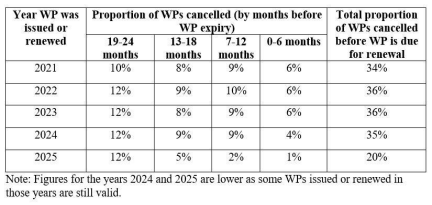
Ms He Ting Ru asked the Minister for Manpower in each of the last five years (a) what is the percentage of work permits that have been cancelled before their expiry dates, as a proportion of total work permits issued or valid in that year; and (b) of these premature cancellations, what are the percentages of premature cancellations as broken down by six-month bands before expiry.
Dr Tan See Leng: Work Permits (WPs) are valid for up to 24 months upon issuance or renewal. Employers may cancel WPs before they expire for various reasons, such as if the worker is found to be unsuitable, or if the worker needs to return home for personal reasons. The breakdown of WPs that are cancelled before they are due for renewal, as a proportion of total WPs issued or renewed between 2021 and 2025, is shown in the table below. About one third of WPs are cancelled before they are due for renewal.
Mr Kenneth Tiong Boon Kiat
Annual Report Publication Of Non-Profit Healthcare Clusters For Public Access
Mr Kenneth Tiong Boon Kiat asked the Coordinating Minister for Social Policies and Minister for Health given that the financial results of the public healthcare clusters are no longer made public since the early 2010s (a) whether the Ministry will work with the clusters to again publish revenue and expenditure details in their annual reports; and (b) how the public can currently verify the Ministry's position that public healthcare institutions operate on a non-profit basis.
Mr Ong Ye Kung: Public healthcare clusters have always operated on a not-for profit basis. They incur substantial deficits to provide subsidised healthcare services to Singaporeans. The deficits are then covered by Government grants. Post grant, they may breakeven or have a slight surplus, which will be ploughed back to improve the healthcare system, such as through infrastructure and service improvements. While the accounts are not published, the public may obtain the financial reports of public healthcare clusters through the Accounting and Corporate Regulatory Authority (ACRA) website.
Review Of Alternative Pathways And Bridging Nursing Programmes For Qualified Singaporean Applicants
Mr Kenneth Tiong Boon Kiat asked the Coordinating Minister for Social Policies and Minister for Health (a) whether stringent academic criteria for nursing diplomas have resulted in otherwise qualified Singaporeans with strong interest in nursing being denied places; and (b) whether the Ministry will review these criteria and provide alternative pathways, such as bridging programmes, to meet healthcare needs.
Mr Ong Ye Kung: Having the passion to serve in healthcare is always the topmost criteria for nursing education programmes. At the same time, we need to ensure that nursing students are able to cope with the rigour of the programme. The current entry requirements try to ensure that, without being too stringent. The O-level cut-off point for the polytechnic nursing diploma programmes is ELR2B2 aggregate of 28 points. Through the Early Admissions Exercise, the polytechnics also take in applicants primarily based on their aptitude, motivation and a strong interest in nursing. There are also alternate pathways, such as going to ITE to be trained as an Enrolled Nurse, before working and upgrading to become a Registered Nurse; or mid career switches, through our skills redevelopment programmes.
Assoc Prof Jamus Jerome Lim
NIE's Bachelor Programmes Acceptance Rate And Safeguarding Subject-Specific Teacher Supply Shortages
Assoc Prof Jamus Jerome Lim asked the Minister for Education (a) what has been the average acceptance rate, by decade, for applicants to the National Institute of Education’s Bachelor of Arts and Bachelor of Science programmes; (b) whether current selection criteria adequately balance teaching quality and teacher supply; and (c) what safeguards exist to prevent subject-specific teacher shortages.
Mr Desmond Lee: The Bachelor of Arts/Science (BABSc) programme at the National Institute of Education (NIE) is one of the avenues for teacher recruitment. Over the past five years, the percentage of applicants offered admission has increased from 12% to 18%. Successful applicants are selected based on academic merit and teaching aptitude to meet our manpower needs in the different subjects. In addition to the BABSc, the Ministry of Education (MOE) has other recruitment pools, such as fresh graduates and mid-careerists who complete professional training (DipEd and PGDE) at NIE before joining as teachers.
To meet our recruitment objectives, we employ various strategies including early talent development through elective programmes, green-harvesting via the Teaching Internship Programme and Teacher Training Sponsorship, and the Teaching Scholarships/Teaching Award. Targeted strategies such as establishing new recruitment channels and enhancing outreach efforts are adopted for subjects with greater needs.
Mr Abdul Muhaimin Abdul Malik
Funding Support And Capability Building Initiatives For Muslim Student Societies In IHLs
Mr Abdul Muhaimin Abdul Malik asked the Acting Minister-in-charge of Muslim Affairs (a) whether MUIS provides direct or indirect funding support to Muslim student societies in Institutes of Higher Learning; and (b) whether MUIS supports such societies in the development of their (i) leadership capabilities, (ii) student outreach and (iii) welfare initiatives.
Assoc Prof Dr Muhammad Faishal Ibrahim: Grants from the Islamic Religious Council of Singapore (MUIS) are available to Muslim student societies in Institutes of Higher Learning (IHLs) to conduct youth development programmes. For instance, the Youth Programmes Grant can be used to conduct Islamic learning and community
religious programmes. This is part of MUIS’s broader efforts to support youth development.
MUIS also works with Government agencies and community organisations to engage Muslim students and youths in various settings. For example, MUIS organises an annual dialogue with Mufti for IHL students, and provides support to mosques to hold regular talks as well as leadership development programmes for Muslim youths. MUIS, alongside MENDAKI and the People’s Association, has also been supporting the Malay/Muslim Youth Taskforce, which focuses on identifying career development opportunities, equipping youths with essential skills for the future, fostering greater cultural and social identity, and encouraging participation in national initiatives.
These engagements allow MUIS to better understand the needs and concerns of our youths, and support their development and welfare.
Facilitating Islamic Legacy Planning Workshops Tailored To Indian Muslim Community
Mr Abdul Muhaimin Abdul Malik asked the Acting Minister-in-charge of Muslim Affairs (a) how does MUIS currently work with Indian Muslim Organisations (IMOs) to facilitate Islamic legacy planning workshops tailored to the Indian Muslim community; and (b) whether MUIS plans to collaborate with IMOs to organise Indian Muslim community-specific editions of the Islamic Legacy Planning Village.
Assoc Prof Dr Muhammad Faishal Ibrahim: The Islamic Religious Council of Singapore (MUIS) encourages the Singapore Muslim community, including Indian Muslims, to start Islamic Legacy Planning (ILP) early. MUIS has appointed the Islamic Legacy Planning Workgroup (ILPW), which includes a member representing the Indian Muslim community, to work with relevant agencies to raise awareness of the ILP through campaigns, such as the Islamic Legacy Planning Village.
MUIS also works closely with Indian Muslim Organisations (IMOs) and Indian Muslim leaders, through the Indian Muslim Community Steering Committee, to raise awareness of ILP programmes in the Indian Muslim community. This includes training Indian Muslim ambassadors and mosque officers to provide guidance on ILP matters. Later this year, MUIS will introduce the Tamil version of the ILP guidebook, “The Final Amanah”, to improve accessibility of ILP resources to the Indian Muslim community.
Mr Fadli Fawzi
Total Fees Collected For Vehicle Entry And Goods Vehicle Permits In 2025 And Estimated Annual Collection After Fee Increase In 2027
Mr Fadli Fawzi asked the Acting Minister for Transport (a) what has been the total amount of Vehicle Entry Permit and Goods Vehicle Permit fees collected in 2025; and (b) what is the estimated annual amount that will be collected after the increase in these fees from 1 January 2027.
Mr Jeffrey Siow: In 2025, about $130 million of Vehicle Entry Permit (VEP) and Goods Vehicle Permit (GVP) fees were collected. The fees collected vary year-on year, depending on the number of foreign-registered vehicles entering Singapore.
Mr Fadli Fawzi
Lessons Learnt From Eta System Disruption To Prevent System Failures To Other Critical Systems In Public Transport Infrastructure
Mr Fadli Fawzi asked the Acting Minister for Transport in view of the recent disruption to the Estimated Time of Arrival (ETA) system, whether the LTA will be using the lessons learnt from the disruption to prevent system failures to other critical systems in our public transport infrastructure.
Mr Jeffrey Siow: Learning points from the recent disruption to the Expected Time of Arrival (ETA) system will be used to strengthen the availability and accuracy standards of the system. The defective software which caused the recent disruption has been fixed, and the system has stabilised.
Critical systems that directly affect train and bus operations must meet higher reliability standards and undergo more rigorous testing before being deployed.

