


Written Answers to WP's Oral Questions
Mr Fadli Fawzi
Review Of $5,000 CPF Withdrawal Limit Quantum For Singaporeans At Age 55
Mr Fadli Fawzi asked the Minister for Manpower (a) when the unconditional withdrawal limit of $5,000 from the CPF Special and Ordinary Account savings for Singaporeans at age 55 was last increased; (b) since 2023, whether the Government has reviewed if this limit can be increased; and (c) if so, what is the outcome of that review.
Dr Tan See Leng: The Central Provident Fund’s (CPF) withdrawal rules need to be viewed holistically and we should not look at any single one in isolation. Apart from the $5,000 unconditional withdrawal facility, which has been in place since 1995, the CPF system has introduced other built-in withdrawal flexibilities for members age 55 and above. Members with savings above their cohort Full Retirement Sum (FRS) can withdraw such excess savings. Property owners also have the flexibility to set aside their FRS in a mixture of property and cash and withdraw their Retirement Account (RA) savings above the Basic Retirement Sum. Since 2023, cohorts turning age 65 can also withdraw up to 20% of their RA savings from age 65.
The intent of the CPF system is to meet members' long-term retirement needs. This includes striking a fine balance between members' immediate needs and ensuring sufficient retirement income in their later years, especially for those who have not met their FRS. The current withdrawal rules still remain relevant, as increasing withdrawal flexibilities comes with the trade-off of lower monthly payouts in retirement.
Mosques Operating On Temporary Occupation Licences And Long-Term Tenure And Operation Plans For These Mosques
Mr Fadli Fawzi asked the Acting Minister-in-charge of Muslim Affairs (a) whether the Minister can provide a list of the mosques that are currently operating on Temporary Occupation Licences issued by the Singapore Land Authority; and (b) what is the long-term plan of the Majlis Ugama Islam Singapura for the tenure and operations of these mosques.
Assoc Prof Dr Muhammad Faishal Ibrahim: There are currently 7 mosques operating on Temporary Occupation Licences (TOLs) issued by the Singapore Land Authority (SLA).
The Islamic Religious Council of Singapore (MUIS) plans for the long-term religious needs of the Muslim community to ensure that there are adequate prayer spaces. MUIS will continue to work closely with relevant agencies to extend the tenure and operations of mosques on TOL where possible, or identify alternative arrangements, including longer leases, subject to overall land use plans.
Studying Historical And Architectural Significance Of Traditional Kampong-Style Mosques For Conservation
Mr Fadli Fawzi asked the Acting Minister for Culture, Community and Youth (a) whether the National Heritage Board has studied the historical and architectural significance of traditional kampung-style mosques such as Masjid Petempatan Melayu Sembawang or Masjid Omar Salmah; (b) whether such mosques will be considered for conservation; and (c) if not, why not.
Mr David Neo: The National Heritage Board (NHB) recognises the heritage and community value of kampung mosques. There have been efforts to document the history of such kampung mosques. For example, Masjid Petempatan Melayu Sembawang is featured as part of NHB’s Sembawang Heritage Trail.
NHB will continue to work with URA to identify and assess suitable buildings, including mosques, for preservation or conservation. The assessment will take into account the heritage and architectural value of the building, intended use of the site, community interests, and future development needs.
Mr Dennis Tan Lip Fong
Instilling Awareness For Loot Boxes And Gambling Inducement Risks In Video Games Through CCE Lessons
Mr Dennis Tan Lip Fong asked the Minister for Education (a) at which specific educational stages the Character and Citizenship Education (CCE) curriculum introduces the risks of loot boxes and gacha mechanics; and (b) whether the Ministry plans to make the treatment of gambling-inducement risks in video games a mandatory, rather than optional, component of the Cyber Wellness curriculum.
Mr Desmond Lee: Students from primary to pre-university levels attend Cyber Wellness lessons which are part of the Character and Citizenship Education curriculum. These lessons equip them with age-appropriate skills to be safe and responsible users online.
Through Cyber Wellness lessons, students also learn that some online games feature gambling-like elements. At upper primary, they learn about self-control, particularly to resist over-spending on in-game purchases. At the secondary level, students learn to identify and guard against the risks associated with online gaming and gaming mechanics. These topics are core elements of the Cyber Wellness curriculum, and are not optional. However, the specific lessons to help students understand the mechanics and risks of loot boxes and how to navigate such risks are currently taught in Secondary 5, and we intend to bring it earlier to lower secondary. Children take time to develop self-management and control. Parents play a key role in guiding and monitoring their child’s online activities, as well as controlling their on-line purchases. Schools will continue to work with parents to guide their children and protect them from online harms.
Financial Incentives To Reward Producers Who Design Products For Durability, Repairability And High Recyclability
Mr Dennis Tan Lip Fong asked the Minister for Sustainability and the Environment whether existing or proposed Extended Producer Responsibility (EPR) frameworks include an eco-modulated fees or other financial incentives to reward producers who design products for durability, repairability, and high recyclability rather than focusing solely on the volume of downstream collection and disposal.
Ms Grace Fu Hai Yien: Extended Producer Responsibility (EPR) frameworks place the responsibility and cost of managing the end-of-life treatment of products upstream on the producers. Singapore's EPR frameworks require products at their end of-life to be properly recycled. However, as Singapore's domestic market is small and most products sold and consumed in Singapore are manufactured overseas for multiple markets, manufacturers are unlikely to adjust their product designs specifically to meet Singapore's needs.
Hence, in addition to our EPR schemes, the Government provides support for targeted eco-design and circular economy outcomes through funding and partnership programmes to help local businesses and the community innovate and adopt environmentally sustainable practices. For example, companies pursuing redesign locally to facilitate circularity can apply for support from funding sources such as the 3R Fund.
We will continue to work with industry stakeholders to promote eco-design alongside other circular economy practices to reduce waste disposed of.
Construction Of Staircase Linking Block 377B Hougang Rivercourt To HDB Car Park
Mr Dennis Tan Lip Fong asked the Minister for National Development (a) when will HDB construct the staircase linking Block 377B Hougang Rivercourt to the HDB carpark next to Blocks 6 and 7 Hougang Avenue 3 to replace the temporary metal staircase installed by HDB around four to five years ago; and (b) whether the construction can be expedited in the interest of resident safety and amenity.
Mr Chee Hong Tat: Following the completion of Hougang Rivercourt, the Housing and Development Board (HDB) installed a temporary metal staircase at Block 377B to connect residents from Hougang Rivercourt to the bus stop along Tampines Road. This metal staircase is currently in use. Construction of a permanent staircase will commence by end March 2026 and is targeted for completion by end July 2026.
Mr Chua Kheng Wee Louis
Assessment Of Effectiveness Of 2019 Smart Bus Priority System Trial
Mr Chua Kheng Wee Louis asked the Acting Minister for Transport (a) what is the Ministry’s assessment of the effectiveness of the 2019 Smart Bus Priority System trial in ensuring bus punctuality; and (b) whether the Ministry intends to scale up and deploy the System on bus services island wide.
Mr Jeffrey Siow: The Smart Bus Priority System trial was carried out over a period of 6 months on bus services 98 and 99 along Jurong East Avenue 1 and Jurong West Avenue 1. The system aimed to adjust traffic light timings to help buses running behind schedule to catch up. While the trial showed that such a system was technically feasible, it did not substantially improve the punctuality of these bus services. The Land Transport Authority (LTA) therefore has no plans to scale up this solution.
With better technology and data, LTA will continue to explore other ways to provide bus priority and improve travel time.
Coffee Shop Operators Who Do Not Pass 5% Monthly Rental Rebate To Stallholders For Budget Meal Scheme
Mr Chua Kheng Wee Louis asked the Minister for National Development (a) to date, how many instances have participating coffee shop operators failed to pass the 5% monthly rental rebate on to stallholders since the Budget Meal scheme was extended to all rented HDB coffee shops in 2023; and (b) whether any corrective action was taken against such operators.
Mr Chee Hong Tat: Under the Budget Meal scheme, HDB eating house operators are required to pass on the 5% rental discount provided by HDB in full to their stallholders who provide budget meals. Operators must submit letters of undertaking jointly signed with their stallholders, and declare how the discount is being shared amongst the stallholders.
To date, HDB has not received any feedback from stallholders about operators failing to pass on the rental discount.
Capital Expenditure And Monthly Operating Costs For Value Meals @ South West Initiative
Mr Chua Kheng Wee Louis asked the Acting Minister for Culture, Community and Youth (a) whether the Value Meals @ South West initiative is funded by the Community Development Council (CDC); (b) if so, what is the breakdown of the upfront capital expenditure and monthly operating costs borne by the CDC; and (c) whether there are plans to introduce this across all HDB towns and, if not, why not.
Mr Edwin Tong Chun Fai: I am answering in my capacity as the Minister charged with the responsibility for the People’s Association.
Value Meals @ South West is a partnership between South West CDC and Select Group, towards a programme that helps ease the cost of living, especially for low-income residents. It is a pilot programme, aimed at providing quality, accessible and affordable meal options via vending machines in the void decks of heartland locations. Residents can buy each value meal for $3 or less.
This programme is funded by the Select Group as part of its corporate social responsibility (CSR) project and no cost is borne by South West CDC. This programme is one of various initiatives which all CDCs have instituted, with the assistance of its partners, with tangible benefits going directly to the residents. The CDCs have, and will continue to build strong networks amongst its social and corporate partners, aggregating resources and working with partners to deliver meaningful collaborations that can benefit the residents directly. In doing so, the CDCs take into account the specific local needs in each of their districts.
Mr Kenneth Tiong Boon Kiat
Tracking Post-Disbursement Outcomes Of Productivity Solutions Grant And Enterprise Development Grant Recipients
Mr Kenneth Tiong Boon Kiat asked the Deputy Prime Minister and Minister for Trade and Industry (a) whether the Ministry tracks post-disbursement outcomes of (i) Productivity Solutions Grant and (ii) Enterprise Development Grant recipients, beyond the first year of adoption; (b) what action has been taken against vendors identified as consistently delivering suboptimal results for these grant recipients; and (c) what safeguards, if any, prevent such vendors from being approved for use by grant recipients funded under other grant schemes.
Mr Gan Kim Yong: The Productivity Solutions Grant (PSG) supports businesses in enhancing their productivity by providing financial support for a list of pre approved solutions. The Government regularly reviews the effectiveness of these solutions and vendors based on feedback from recipient companies and Trade Associations and Chambers. Solutions which are assessed to be less effective, and/or vendors with poor performance or track records, will be removed from the pre approved list.
The Enterprise Development Grant (EDG) supports businesses in building and enhancing capabilities, innovating, and gaining market access. Companies submit proposals that are aligned with their business needs and intended outcomes. Enterprise Singapore will assess these proposals based on their merits and also monitor the approved projects to ensure the recipient companies are undertaking the committed project milestones.
Vendors found to have breached appointment terms and conditions will be investigated and subject to appropriate enforcement action by the Government. Those with severe violations may face suspension or debarment from Government schemes.
Successful COE Bids By Households Already Owning At Least One Car
Mr Kenneth Tiong Boon Kiat asked the Acting Minister for Transport (a) what proportion of successful COE bids in the past year were by individuals from households already owning at least one car; (b) whether the Ministry has assessed the impact on first-car households of competing in the same COE bidding pool as multi car households; and (c) whether the Ministry will study giving first-car households priority access within the COE system.
Mr Jeffrey Siow: 85% of new Category A and B COEs were won by individuals from households holding at least one COE. Most of these are single car households replacing their existing car. Around 1 in 5 were won by individuals from households holding at least two COEs.
The number of COEs is finite. While there are many meritorious arguments to prioritise COE allocation, it is difficult for the government to do so. Prioritising first car households could be at the expense of households replacing their existing cars, or larger families living in the same household.
Tracking Of Jobs Relocated Overseas Or Converted To Overseas Remote Arrangements
Mr Kenneth Tiong Boon Kiat asked the Minister for Manpower (a) whether the Ministry tracks Singapore-based roles that are relocated overseas or converted to overseas-remote arrangements; (b) if so, what are the annual figures by (i) sector and (ii) occupation, for the past five years; and (c) if not, whether the Ministry will
establish such tracking to monitor offshoring-linked displacement and re-employment outcomes of affected residents.
Dr Tan See Leng: The Ministry does not track transboundary transfers of Singapore-based roles. There are no plans to establish such tracking as transborder business reorganisation is a common feature of global operations and often involves multiple countries. It is also not practical to require companies to specify exactly which role moved to which country.
Mr Abdul Muhaimin Abdul Malik
Measures To Prevent Speeding And Reckless Riding By Cyclists
Mr Abdul Muhaimin Abdul Malik asked the Acting Minister for Transport (a) what proactive enforcement measures are in place to prevent cyclists from speeding and riding recklessly; (b) in the past three years, how many cyclists have been penalised for dangerous riding but without being involved in accidents; and (c) whether enhanced surveillance or patrol systems will be implemented in high-risk areas.
Mr Jeffrey Siow: Cyclists are required to ride within the speed limit of 10km/h on footpaths and 25km/h on shared paths. From 2023 to 2025, more than 650 cyclists were penalised for riding in a disorderly manner without due regard for the safety of others.
Joint enforcement operations by the Land Transport Authority (LTA) and the Singapore Police Force (SPF) are conducted against errant cyclists. For hotspots, LTA conducts targeted enforcement operations and deploys solutions like speed detection radars, warning signage and CCTVs to deter and detect errant riding. LTA also conducts patrols with the community to promote awareness of proper riding behaviours.
Individuals Who Exceed Eligibility Criteria For Silver Support Scheme Based On Household Income Per Capita
Mr Abdul Muhaimin Abdul Malik asked the Minister for Manpower (a) how many seniors who would otherwise meet the individual eligibility criteria for the Silver Support Scheme are currently ineligible solely due to exceeding the household income per capita threshold; and (b) of these, how many are living with their adult children.
Dr Tan See Leng: Eligibility for the Silver Support Scheme is determined by assessing multiple criteria including seniors’ lifetime wages, housing type and the level of family support, proxied by the monthly per capita household income or PCHI. We adopt a holistic assessment of seniors’ individual and household circumstances to ensure that the scheme is targeted at seniors with less means in their retirement, while ensuring that the scheme remains fiscally sustainable.
We have recently raised the qualifying monthly PCHI threshold from $1,800 to $2,300 in 2025. This has enabled more seniors, some of whom do live together with their children, to qualify for Silver Support payouts.
Of the seniors who are ineligible for Silver Support payouts in 2026, around 1 in 10 are ineligible solely because their PCHI exceeds $2,300. A portion of these seniors could be earning incomes or could reside with income-earning household members, indicating a higher level of household financial support. We do not track how many of these seniors are living with their adult children.
Seniors facing unique situations can write in to the Central Provident Fund Board to review their eligibility for the Silver Support Scheme. We will review their circumstances holistically on a case-by-case basis.
Written Questions
Mr Fadli Fawzi
Production Cost Of Minting Five-Cent Coins In Past Five Years And Plans For Withdrawing From Circulation
Mr Fadli Fawzi asked the Prime Minister and Minister for Finance (a) in each of the last five years, what is the cost of minting each five-cent coin; (b) where the seigniorage on five-cent coins is negative, whether the Government has any plans to withdraw five-cent coins from circulation; and (c) if not, why not.
Mr Gan Kim Yong (for the Prime Minister): The Monetary Authority of Singapore (MAS) has not minted any new 5-cent coins in the last five years and there are no plans to mint new 5-cent coins at this stage.
Our estimate is that the cost of producing a 5-cent coin remains below its face value.
MAS currently has no plans to stop the issuance of 5-cent coins as there continues to be public demand for these coins. Businesses like supermarkets and fast food restaurants do price some items with 5-cents (for example, $1.95) and stores may charge 5 cents to 10 cents for each disposable bag. Withdrawing 5-cent coins from circulation could have an effect of retailers rounding up their prices and increasing costs to consumers.
MAS will continue to monitor the usage patterns and demand for 5-cent coins to assess the relevance of this denomination for the longer term.
Lease Buyback Scheme Participation Statistics And Average Payouts By Household Size From 2009 To 2025
Mr Fadli Fawzi asked the Minister for National Development from 1 March 2009 to 31 December 2025 (a) what is the total number of flats that have participated in the Lease Buyback Scheme; (b) of these, how many are (i) single and (ii) two person households; (c) what is the average number of remaining lease years sold to HDB; and (d) what is the average payout in the form of (i) cash and (ii) CPF.
Mr Chee Hong Tat: The Lease Buyback Scheme (LBS) enables eligible senior homeowners to monetise their flats by selling a portion of the remaining lease to the Housing and Development Board (HDB), while they continue to age-in-place. As of end-2025, around 16,000 households have participated in LBS since the scheme was launched on 1 March 2009. Of these, around 6,000 are single-person households and around 7,000 are two-person households.
Under LBS, homeowners must retain a lease that can last the youngest owner till at least age 95, providing a home for life. The years of lease retained varies based on the homeowners’ ages at the point of LBS and also their individual circumstances. The LBS payouts also vary widely across flat types and vary over time based on prevailing market conditions. It is therefore not meaningful to look at the overall average payout.
About nine in 10 households that participated in LBS received between $100,000 and $300,000 in proceeds. Seniors who top up their Central Provident Fund (CPF) Retirement Account (RA) with the proceeds may also receive a cash bonus ranging from $7,500 to $30,000, depending on their flat type and CPF RA top-up amount.
Mr Kenneth Tiong Boon Kiat
Streamlining SME Grant Applications And Approvals Through Enterprise Singapore As A Single Point Of Contact
Mr Kenneth Tiong Boon Kiat asked the Deputy Prime Minister and Minister for Trade and Industry (a) whether Enterprise Singapore relationship managers systematically refer SME grant inquiries to SME centres; (b) if so, whether Enterprise Singapore relationship managers can provide direct assistance to such inquiries by providing a single point of contact; and (c) if not, why must SMEs navigate multiple agencies for grant inquiry services.
Mr Gan Kim Yong: EnterpriseSG partners the SME Centres to provide a wide range of support for the SMEs beyond just grant enquiries. The centres would typically assign a business advisor to guide the SMEs through their needs, by ensuring they receive coordinated support tailored to their specific business requirements through a single point of contact.
For more straightforward enquiries on grants, SMEs can access information on selected business grants administered by different Government agencies on EnterpriseSG’s corporate website and the GoBusiness website, which include eligibility criteria and step-by-step guides for grant applications. These online channels are available for SMEs as the first port of call, so that they can more conveniently find and apply for the resources they need.
Safeguards Against Exploitative Excess Arrangements In Car Rental And Car-Sharing Services
Mr Kenneth Tiong Boon Kiat asked the Acting Minister for Transport (a) whether the Government has data on the proportion of accident repair costs for rental and car-sharing vehicles below the $5,000 to $16,000 motor insurance contractual excess thresholds and thus go unclaimed; (b) whether the Government will regulate rental operators charging contractual excess exceeding actual insurance policy excess; and (c) what safeguards protect hirers from exploitative excess arrangements.
Mr Jeffrey Siow: The Government does not have data on accident repair costs for rental and car-sharing vehicles. Excess arrangements are part of the contractual terms between car rental companies and their hirers. The Government does not intervene in such commercial arrangements. Introduction of regulations would increase costs, which would likely be passed on to hirers through higher rental rates.
Mr Abdul Muhaimin Abdul Malik
Data On Mental Health History Of Arrested Drug Abusers And Breakdown Of First-Time Drug Abusers With Prior Diagnosis Of Mental Health Disorders Since 2021
Mr Abdul Muhaimin Abdul Malik asked the Coordinating Minister for National Security and Minister for Home Affairs (a) whether the Central Narcotics Bureau (CNB) collects data on the mental health history of drug abusers arrested; and (b) in each year since 2021, what proportion of first-time drug abusers arrested had a prior diagnosis of mental health disorders, including depression, major depressive disorder, bipolar disorder, anxiety disorder, psychosis, schizophrenia, and clinical insomnia.
Mr K Shanmugam: The Central Narcotics Bureau does not collect data on the mental health history of arrested drug abusers.
The Singapore Prison Service assesses all inmates admitted to prison and the Drug Rehabilitation Centre (DRC), including first-time drug abusers, on the state of their physical and mental health. As part of the screening process, the Prison Medical Officer (PMO) will refer to the National Electronic Health Record System to check the inmate’s pre-existing health conditions, including mental health conditions. The inmate is also required to complete a screening questionnaire, for the PMO to gather information on his past medical history and mental wellbeing.
As at end-December 2024, about 10% of the total inmate population, which includes inmates in the DRC, were diagnosed with some form of mental health condition.
Restrictions Or Quotas For LTVP Applications For Foreign Spouses And Breakdown Of Approval And Rejection Rates By Nationality Over Past Five Years
Mr Abdul Muhaimin Abdul Malik asked the Coordinating Minister for National Security and Minister for Home Affairs (a) whether there are nationality based restrictions or quotas for Long-Term Visit Pass applications for foreign spouses; and (b) what are the approval and rejection rates by nationality over the past five years.
Mr K Shanmugam: For Long-Term Visit Pass (LTVP) applications for foreign spouses of Singapore Citizens (SCs) and Permanent Residents (PRs), several factors are taken into account, including the length of marriage, whether the couple has children from the marriage, the ability of the sponsor to support the family, and the presence of adverse records.
We do not publish detailed criteria either for the above applications or other applications for residency. Publishing such criteria could affect our international relations. Second, it might also help people game our system.
For similar reasons, we do not publish approval and rejection rates by nationality, as this could cause bilateral sensitivities and is not in our national interest.
Yearly Demographics On Employment Departures Due To Eldercare Commitments From 2021 To 2025 And Considerations For Mandated Eldercare Leave For Singaporean Working Adults
Mr Abdul Muhaimin Abdul Malik asked the Minister for Manpower for each year from 2021 to 2025 (a) how many working adults left employment due to eldercare commitments; (b) what is the demographic breakdown by age and gender; and (c) whether the Government will consider mandating eldercare leave for working adults.
Dr Tan See Leng: The total number of residents who were outside the labour force due to eldercare commitments from 2021 to 2025, together with their age and gender breakdown, is shown in Table 1. Among this group, an average of 11.9%, or around 1,500 individuals each year, had left their last job within the preceding year.
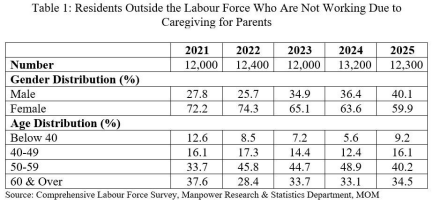
In evaluating how best to support working caregivers, the Government considers the effectiveness of measures in meeting diverse caregiving needs in a sustainable manner, and will need to strike a balance with employers’ operational needs and the employability of caregivers.
Many working caregivers have highlighted that flexible work arrangements, or FWAs, are the most useful form of support. We have hence focused on encouraging the adoption of FWAs and other work-life harmony practices to help caregivers manage work and personal responsibilities. This is done through the Tripartite Guidelines on FWA Requests (TG-FWAR) as well as FWA implementation resources and training by tripartite partners and the Institute of Human Resource Professionals.
The Government will continue to review our support schemes for working caregivers.
Ms He Ting Ru
Annual Publication Of SAF’s Carbon Emissions To Improve Transparency Of Climate Transition Plans And Outreach Efforts To Improve Public Understanding
Ms He Ting Ru asked the Coordinating Minister for Public Services and Minister for Defence (a) whether the SAF will consider publishing its carbon emissions on a yearly basis to improve the transparency of its climate transition plans, while redacting and aggregating selected data for security purposes; and (b) if not, what other steps can be taken to help the public better understand its climate transition approach.
Mr Chan Chun Sing: The Ministry of Defence’s (MINDEF’s) carbon emissions are published in the GreenGov.SG report, which has been published annually by the Ministry of Sustainability and the Environment (MSE) since 2023. The GreenGov.SG report may be found on the MSE website.
Impact Assessment Of Investments Into AI Manpower And Capability Development From 2022 To Date
Ms He Ting Ru asked the Minister for Digital Development and Information in relation to the commitments announced at the Singapore Week of Innovation and Technology (SWITCH) 2022 on AI manpower and capability development, including the additional US$50 million investment (a) whether the Government assesses that these initiatives have met their stated objectives to date; and (b) on what basis was this assessment made.
Mrs Josephine Teo: The additional US$50 million investment for AI manpower and capability development supported the expansion of the AI Apprenticeship Programme (AIAP) and a new Singapore National Research Foundation (NRF) Fellowship for AI.
Since 2018, the AIAP has developed over 400 skilled AI practitioners, through practical training based on projects commissioned by industry partners and AI Singapore (AISG). To ensure quality completion of the project, apprentices are supervised by full-time AI engineers from AISG. On completion of their apprenticeships, participants decide whether to continue with the organisations where they received training or elsewhere. Over 85% of AIAP graduates took up AI engineering-related roles across the economy. The remaining 15% joined AISG to support the national and industry projects that AISG undertakes, and to help scale up the AIAP programme.
Four NRF Fellowships for AI have been awarded, to attract and anchor outstanding early-career AI researchers to conduct independent research in Singapore. The awarded Fellows are in the early stages of their research, and NRF will engage them closely to track their progress.
Assessment Of Outcomes And Benefits Of National Multimodal Large Language Model Programme Towards Singapore's National AI Strategy 2.0
Ms He Ting Ru asked the Minister for Digital Development and Information (a) whether the National Multimodal Large Language Model Programme launched in 2023 has met its stated objectives to date; (b) what outcome indicators and performance metrics are used to assess its progress; and (c) whether these outcomes are on track to deliver the intended benefits under Singapore’s National AI Strategy 2.0.
Mrs Josephine Teo: Development of the two Large Language Model (LLM) families under the National Multimodal Large Language Model Programme (NMLP) - Southeast Asian Languages in One Network (SEALION) and Multimodal Empathetic
Reasoning and Learning in One Network (MERaLiON) – helped scientists and engineers in Singapore acquire capabilities to build and fine-tune models, produce datasets and customise models for our region's cultural and linguistic contexts.
Organisations like the Monetary Authority of Singapore and Indonesia's GoTo Group have used these LLM families to develop applications that better serve users in Singapore and Southeast Asia. The development teams for SEALION and MERaLION also collaborate with companies such as Google Research and Microsoft Singapore to build better models. These outcomes are in line with our National AI Strategy 2.0 objectives.
Funding Framework For Distribution Of Public Ai Research Funds
Ms He Ting Ru asked the Minister for Digital Development and Information in relation to the Government’s commitment of over S$1 billion to fund public AI research from 2025 to 2030 (a) how will this funding be allocated across the three pillars of (i) fundamental AI research (ii) applied AI research and (iii) talent development; and (b) what principles guide these allocation decisions.
Mrs Josephine Teo: The funding seeks to sustain long-term investments, create value in high-impact areas, and ensure that our research capabilities and talent remain globally competitive. To respond to emerging opportunities and evolving needs, we generally do not disclose precise allocations. Instead, we ensure that sound processes and relevant experts are in place to exercise judgements flexibly. The administration of these funds is also subject to the system of governance already in place for similar research and development programmes.
Mr Dennis Tan Lip Fong
Annual Data Trends On Contamination Of Recyclables In Blue Bins From 2021 To 2026
Mr Dennis Tan Lip Fong asked the Minister for Sustainability and the Environment (a) what is the specific average contamination rate in blue bins under the National Recycling Programme for 2025; (b) how has this figure trended annually since 2021; and (c) what are the top three specific contaminants that resulted in the highest volume of rejected recyclables in 2025 according to Material Recovery Facility data.
Ms Grace Fu Hai Yien: The aggregated contamination rate for recycling bins and recycling chutes under the National Recycling Programme has remained at about 40%. This is due to the incorrect placement of non-recyclable items in blue recycling bins and chutes and contamination from food and liquid residues.
The most common items incorrectly deposited for recycling include electrical and electronic waste (e-waste), clothing and composite plastics (e.g. toys). E-waste should be deposited at the various e-waste collection points, and the public is encouraged to donate used clothes and toys if they are in good condition.
Ms Sylvia Lim
Bus Stop Installation Adjacent To Blocks 174A To 174D Hougang Avenue 1 For Residents' Convenience Using Public Busses
Ms Sylvia Lim asked the Acting Minister for Transport when will a bus stop be erected adjacent to Blocks 174A to 174D Hougang Avenue 1 so that residents may conveniently use public buses plying Hougang Avenue 1 such as bus service 146.
Mr Jeffrey Siow: The Land Transport Authority (LTA) is conducting site feasibility studies for a pair of new bus stops along Hougang Avenue 1, adjacent to Blocks 174A to 174D. If found feasible, the design and construction of a new bus stop will take about six to nine months.
Mr Chua Kheng Wee Louis
Traffic Priority System And Glide System Synchronisation And Peak Period Public Buses Priority At Key Intersections
Mr Chua Kheng Wee Louis asked the Acting Minister for Transport (a) whether the deployment of the Traffic Priority System (TPS) is in sync with the Green Link Determining (GLIDE) system; and (b) whether the Government will consider extending the TPS to allow public buses to have priority at traffic junctions near bus interchanges and heavy traffic intersections during peak periods.
Mr Jeffrey Siow: The Traffic Priority System (TPS) is synchronised with the Green Link Determining (GLIDE) system. It prioritises the passage of emergency ambulances conveying patients with life-threatening conditions in the vicinity of a hospital.
We will consider whether the TPS should be extended to more vehicle types, such as public buses, with due consideration to the needs of other road users.

