


Written Answers to WP's Oral Questions
Mr Chua Kheng Wee Louis
Review Of Major Games Award Programme
Mr Chua Kheng Wee Louis asked the Acting Minister for Culture, Community and Youth (a) whether the Government is aware of when was the last review of the Major Games Award Programme; (b) if so, when was it; and (c) whether the Ministry will work with the Singapore National Olympic Council to update cash incentives under the Programme given inflation, and to provide incentives for SEA Games Silver and Bronze medallists.
Mr David Neo: The Government directly invests in the development of our athletes in a few areas:
First, we give direct support to our athletes through the Sport Excellence initiatives, commonly known as "Spex". This includes our spexCarding, spexPotential and spexScholarship programmes, where athletes receive holistic and individualised support encompassing sport science, sport medicine, and athlete life support, as well as grants to offset training costs and loss of wages. The spexPotential and spexScholarship programmes provide monthly stipends to athletes, recognising their commitment to an increased training and competition load.
Second, we invest in building up support services needed by our athletes, such as providing dedicated funding for sport science and sport medicine, coaches, athlete life services and sporting infrastructure.
We are committed to sustained investment in developing athletes to their full potential, and such support is not conditional only on winning medals. Recognition and rewards play a complementary role in incentivising our athletes. The Government recognises this.
SportSG administers the Singapore Sport Hall of Fame, which celebrates the exceptional achievements and contributions of Singapore's sporting heroes. The Singapore Sport Hall of Fame now includes a new category for sport leaders, and recognises the achievements of athletes beyond medals, including contributions back to sport and the community.
But it takes a whole Singapore village to journey with, support and develop our athletes. We greatly appreciate efforts by the community to step forward to recognise and support our athletes in all forms.
With regard to the Major Games Award Programme (MAP), it is a private award scheme managed by the Singapore National Olympic Council (SNOC) and funded by their sponsors.
SNOC reviews the scheme periodically, and decides on the categories of awarded medallists and the monetary rewards offered to each of them, in consultation with sponsors.
The MAP award structure takes into account the level of competition and the frequency of the Major Games. The Olympic, Commonwealth and Asian Games have more competitive fields and take place every four years, compared to the SEA Games that takes place every two years.
We encourage more corporates and sponsors to come forward to support our athletes and contribute to the MAP.
Beyond the MAP, SNOC and the National Sports Associations (NSAs) recognise our athletes’ achievements in other ways, such as SNOC’s annual Singapore Sports Awards and NSAs’ awards nights and dinners.
Mr Gerald Giam Yean Song
Total Disbursements Through Sports Excellence Schemes
Mr Gerald Giam Yean Song asked the Acting Minister for Culture, Community and Youth for each of the last three years (a) what was the sum total of direct payments to athletes, including CPF top-ups, under the spexScholarship, spexPotential, spexTAG, spexGLOW and spexEducation schemes; (b) how many athletes received these payments; and (c) what was the median annual cash payment received by each athlete.
Mr David Neo: Our athletes have done well, as seen in the last few editions of the Olympics, Paralympics, Asian Games, Asian Para Games and most recently at the SEA Games in Thailand.
The Government invests in various areas to build up a strong High-Performance Sport (or HPS) system, in order to develop our athletes to their fullest potential. First, direct financial and programme support to athletes through our suite of Sport Excellence (or spex) programmes. We design such support to be bespoke and holistic, based on our athletes’ needs during different stages of their sporting career. Today, we support more than 1,500 carded athletes across 55 sports, compared to 272 athletes across 14 sports when we first started SPEX in 1993. This is a 450% increase in the number of athletes we support and 300% increase in the number of sports. We have enhanced our spex programmes in recent years. We introduced the spexPotential programme in 2024, enhancing support for younger athletes making the transition to higher levels of sporting success. Last year, we awarded our inaugural batch of spexEducation Undergraduate Scholarships, providing greater assurance for our athletes’ academic aspirations. We also introduced CPF top-ups for spexScholars, bolstering their finances as they focus single-mindedly on sport.
Second, systemic investment in our HPS ecosystem. We invest in coaching development, sport science and sport medicine, and athlete life management to give our National Sports Associations (or NSAs), coaches and athletes the competitive edge. Our NSA leaders and administrators play a key role, and we partner them to provide our athletes, coaches and officials the training and competition exposure they need.
The support that each athlete or sport receives is calibrated according to their needs, performance and potential to do well. This support is also reviewed annually to ensure adequacy and accountability. Therefore, we do not encourage focusing only on our financial payments to athletes, or on comparisons across sports and across time, without understanding the context specific to each athlete or sport. Third, we will continue to invest in the hardware, through the new home of Team Singapore, which will bring the Singapore Sports School (or SSP) to Kallang and integrate all elements of the HPS ecosystem under one roof – sport science and sport medicine support, national training centres and sport administration. The Government will continue to review our policies and programmes for our athletes and for the HPS ecosystem. But we cannot achieve our ambitions alone. Alongside the Government’s efforts and commitment, we encourage corporate partners and Singaporeans to come together and support our athletes, whether through donations to the One Team Singapore Fund, or other means.
Amount Of Opportunity Fund Grants Disbursed To Schools In Last Three Years
Mr Gerald Giam Yean Song asked the Minister for Education (a) what was the total amount of Opportunity Fund grants disbursed to schools in the last three years; (b) what percentage of eligible students from lower-income households have utilised this fund to participate in enrichment programmes and overseas trips; and (c) what specific measures are in place to ensure that all eligible students are aware of and can apply for the fund.
Mr Desmond Lee: For the last 3 years, on average, $10m per annum has been disbursed from the Opportunity Fund to the General Education schools. Students on MOE Financial Assistance Scheme (MOE FAS) and School-based Financial Assistance Scheme (SBFAS) are automatically provided with the Opportunity Fund grants. They do not need to apply. For students not on MOE FAS and SBFAS, schools will inform the parents to approach the schools for assessment if they need financial assistance.
On average, about 50,000 students benefit from the Opportunity Fund each year.
Employers Sanctioned For Submitting Fictitious Recruitment Records For Employment Pass Applications
Mr Gerald Giam Yean Song asked the Minister for Manpower (a) in the past three years, how many employers were sanctioned for submitting fictitious recruitment records to justify Employment Pass applications; and (b) whether the Ministry will consider revoking the work passes of foreign hiring managers found complicit in such fraudulent practices.
Dr Tan See Leng: The Ministry of Manpower (MOM) adopts a firm position against employers who attempt to circumvent our work pass framework and do not fairly consider local candidates, such as by advertising job vacancies on MyCareersFuture as a token measure or providing false information in their work pass applications.
Between 2023 and 2025, MOM took enforcement action against an average of 140 employers each year for not fairly considering local candidates. This includes incidents where employers had submitted fictitious advertisements or provided false information to MOM. Our enforcement actions range from written warnings to debarment from hiring foreign workers for up to 24 months. If foreign hiring managers are found to be complicit in such fraudulent activities, we will also take enforcement action against them. Such actions may include revocation of work passes and debarment from employment in Singapore.
Mr Dennis Tan Lip Fong
Help For Farms Given Switch From "30 By 30" Goal To New Targets For Fibre And Protein Productions By 2035
Mr Dennis Tan Lip Fong asked the Minister for Sustainability and the Environment (a) how will the Singapore Food Agency support and transition farms that had invested heavily in technology to meet the original broad "30 by 30" food sustainability target, but whose produce is less aligned with the new, specific protein and fibre targets for 2035; and (b) what enhanced grants or offtake schemes are available to assist such farms.
Mr Dennis Tan Lip Fong asked the Minister for Sustainability and the Environment why some types of vegetables have been excluded from the updated definition of “fibre” under the new targets for local fibre and protein production, which replaced the original “30 by 30” farming goals.
Ms Grace Fu Hai Yien: This will be addressed in the next Sitting on 13 January 2026, together with similar Parliamentary Questions for a more holistic reply.
Follow-Up From Feedback On Disamenities From Bus Depot Construction Site At Forested Area Between Tampines Road And Buangkok East Drive
Mr Dennis Tan Lip Fong asked the Acting Minister for Transport regarding residents' feedback on disamenities arising from the current bus depot construction site at the forested area between Tampines Road and Buangkok East Drive since the beginning of work (a) what specific measures have been taken to address the concerns raised, including requests to relocate the bus depot; and (b) what further measures will be taken to eliminate or mitigate these amenities.
Mr Jeffrey Siow: Government agencies including the Land Transport Authority (LTA) have received feedback on the location and the construction of the bus depot. While the bus depot cannot be relocated, LTA is implementing a number of mitigating measures that will address residents’ feedback. A 12-metre-high temporary noise barrier will be built to provide sound insulation from construction activities, even though the nearest residents are more than 200m from the work site. Noise monitoring systems have also been installed to continuously measure and record noise levels from construction. To minimise dust during construction, measures such as spraying exposed surfaces with water, and cleaning vehicles before they leave the site, will be implemented.
Mr Chua Kheng Wee Louis
Help For Farms Given Switch From "30 By 30" Goal To New Targets For Fibre And Protein Productions By 2035
Mr Chua Kheng Wee Louis asked the Minister for Sustainability and the Environment given that the "30 by 30" has been revised to a new target for fibre and protein by 2035 (a) whether there are any food types that have been excluded in the new 2035 target; (b) if so, why; and (c) whether the new targets are intended to be aspirational or realistically achievable.
Ms Grace Fu Hai Yien: This will be addressed in the next Sitting on 13 January 2026, together with similar Parliamentary Questions for a more holistic reply.
Actions Against Companies That Do Not Abide By Competition Commission's Directions
Mr Chua Kheng Wee Louis asked the Deputy Prime Minister and Minister for Trade and Industry whether the Competition and Consumer Commission of Singapore has recourse against companies that do not abide by its directions for mergers that are deemed to be anti-competitive and the maximum penalties that may be imposed in such cases.
Mr Gan Kim Yong: Under the Competition Act 2004, the Competition and Consumer Commission of Singapore (CCS) can issue legally binding directions to prohibit, dissolve or modify anti-competitive mergers, and impose a financial penalty on the merger parties where warranted.
In the event of non-compliance with a merger direction issued by CCS, CCS may apply to register the direction with the Courts. Any person who fails to comply with a registered direction may be in contempt of court. The court will apply the usual sanctions for contempt of court and may impose a fine not exceeding S$20,000 or imprisonment for a term not exceeding 12 months, or both.
Mr Kenneth Tiong Boon Kiat
Impact On SME Tenants Following Major Acquisitions Of Heartland Malls
Mr Kenneth Tiong Boon Kiat asked the Deputy Prime Minister and Minister for Trade and Industry (a) whether the Competition and Consumer Commission of Singapore is evaluating the reported potential CapitaLand–Mapletree merger and will mandate a formal Phase 1 or Phase 2 review; (b) if so, how will the relevant market be defined to ensure accurate assessment; and (c) whether additional safeguards to protect SME tenants from possible abuse of dominant position in lease renewals will be considered.
Mr Gan Kim Yong: Tenancy mix and turnover in commercial developments are the result of commercial decisions made by both property owners and tenants. These decisions are influenced by market factors, such as consumer demand preferences and prevailing economic conditions.
With regard to competition concerns arising from mergers and acquisitions, Singapore adopts a voluntary merger notification regime. Under this regime, merger parties are not required to notify the Competition and Consumer Commission of Singapore (CCS) of their merger transactions under the Competition Act to balance between effective regulatory oversight and keeping compliance costs low. Instead, merger parties are expected to self-assess whether their transaction may give rise to potential competition concerns. Nevertheless, CCS is empowered to step in if it obtains information suggesting that a merger may result in potential competition issues. Merger parties may approach CCS for pre-notification discussions or seek guidance on whether their merger may be anti-competitive. To support businesses in this process, CCS has published detailed guidance on the circumstances under which mergers may raise competition concerns.
In the cases of the acquisition of The Clementi Mall and the reported potential CapitaLand-Mapletree merger, the parties concerned have not formally notified CCS for a merger assessment. CCS will continue to monitor both developments.
Separately, apart from competition oversight under the Competition Act, the Government has put in place measures to support fair and balanced lease negotiations between property owners and tenants. The Government worked with the Fair Tenancy
Industry Committee (FTIC) to publish a Code of Conduct for Leasing of Retail Premises in Singapore. Since February 2024, all qualifying retail lease agreements must comply with the Code of Conduct under the Lease Agreements for Retail Premises Act. The Code sets out leasing principles to prevent the inclusion of unreasonable clauses in lease agreements, such as prohibiting landlords from charging a markup on electricity costs. In the event of disagreements over the lease negotiations or terms, the parties may bring their cases to the Singapore Mediation Centre for mediation or adjudication.
More broadly, the retail scene in Singapore remains competitive and vibrant, offering a wide range of options to consumers. The Government continues to support local retailers and SMEs in strengthening their capabilities.
Enterprise Singapore supports local retailers through schemes that help SMEs enhance productivity, transform their businesses and expand overseas. These include the Productivity Solutions Grant, the Enterprise Development Grant, and the Market Readiness Assistance Grant.
The Government also supports targeted programmes that encourage local retailers to innovate and provide differentiated offerings. These include the Retail Maverick Challenge, which enables local retailers to pilot innovative and experiential retail concepts, as well as Design Orchard Retail Singapore (DORS), which showcases over 80 local design brands.
The Government will continue to partner with industry stakeholders and key trade associations, such as the Singapore Retailers Association (SRA), to explore additional ways to support local retailers and maintain the vibrancy of Singapore's retail sector.
Piloting Installation Of Fire-Rated Outdoor Charging Cabinets Within Communal Facilities For PMDs
Mr Kenneth Tiong Boon Kiat asked the Minister for National Development given the rising incidence of Personal Mobility Device battery fires in residential settings, whether the Government will consider piloting fire-rated outdoor charging cabinets in HDB void decks or multi-storey carparks, similar to facilities deployed in New York City and Taiwan, with subsidised electricity rates to incentivise residents to charge devices in these safer communal facilities.
Mr Chee Hong Tat: Agencies such as the Land Transport Authority (LTA), Singapore Civil Defence Force (SCDF) and Housing and Development Board (HDB) work closely to monitor Active Mobility Device (AMD) ownership, charging and usage patterns in Singapore. We also study new operating models and regulatory developments on AMD charging and parking in other jurisdictions.
As different jurisdictions have different contexts and circumstances, we should carefully assess if the overseas practices are applicable here in Singapore. Taking the example of AMD charging facilities in public areas, there will be trade-offs for residents such as having less space for other uses in HDB multi-storey car parks and void decks.
The key factor to improving safety is to prevent AMD-related fires in the first place, instead of where the device is charged. It is more effective to ensure AMDs in Singapore meet prescribed technical and safety requirements. If the devices are non compliant, shifting the charging and parking to public areas would still lead to fire incidents that pose safety risks to residents.
AMD users should only purchase compliant devices, refrain from modifying their devices, and adopt safe charging practices. This is the main safeguard against fire risks from AMDs. The Ministry of Transport (MOT) and LTA thus take a strict enforcement approach towards the import, sale and use of non-compliant AMDs, and are looking to strengthen regulations on the online sale of AMDs later this year.
Mr Abdul Muhaimin Abdul Malik
Robustness Of Trials Where Nets Were Placed In 35 Flats In Punggol And Toa Payoh To Prevent Pigeon Nesting Behaviour
Mr Abdul Muhaimin Abdul Malik asked the Minister for National Development (a) whether the Ministry has assessed if the trial to place netting on air conditioner ledges on only 35 flats in Punggol and Toa Payoh can yield robust findings on pigeon nesting behaviour; (b) what criteria was used when selecting these estates; (c) whether other estates with persistent pigeon issues were offered to participate in the trial; and (d) if not, why not.
Mr Chee Hong Tat: The Housing and Development Board (HDB) is conducting a study to evaluate the effectiveness of half-height netting solutions in preventing pigeon nesting at the air-conditioner ledges of HDB blocks. The study will complement NParks’ island-wide pigeon management efforts.
HDB is carrying out a trial on 35 units with two typical types of air-conditioner ledges. This would allow HDB to assess the effectiveness and robustness of the solution, before deciding if it can be scaled up to other parts of Singapore. HDB had selected the flats in Punggol and Toa Payoh for the trial after considering feedback from the Town Councils (TCs) and residents regarding pigeon nesting at air conditioner ledges.
After the trial is completed, HDB will share its findings with all the TCs.
Holding Preschool Operators Accountable For Deployment Of Staff Not Qualified For Child-Minding Duties And Adequacy Of Current Measures
Mr Abdul Muhaimin Abdul Malik asked the Minister for Social and Family Development (a) how are preschool operators held accountable when child abuse incidents arise from deployment of staff who is unqualified for child-minding duties; (b) what penalties or corrective actions will apply for such cases; (c) whether the Ministry will review the adequacy of current safeguards in preschools; and (d) if so, when will findings of such a review be published.
Mr Masagos Zulkifli B M M: Preschools are responsible for ensuring the safety of children under their care, and must comply with requirements under the Early Childhood Development Centre (ECDC) Act and Regulations, and other prevailing legislation. Operators must seek the Early Childhood Development Agency’s (ECDA) approval for all staff whom they wish to deploy to work in a preschool. They must also establish the necessary systems and processes to ensure child safety, including appropriate deployment and supervision of all staff.
ECDA will take action against errant operators, considering the facts of each case. This may include imposing financial penalties, directing the operator to submit and implement a corrective action plan, shortening or revocation of the preschool’s licence. For errant staff, ECDA can impose administrative actions like stern reminders, coupled with a requirement to undergo retraining, or cancel approval for the individual to be deployed in the preschool.
Child safety and wellbeing is a key priority for MSF, and ECDA has been strengthening safeguards for child safety in preschools over the years. We will continue to review and enhance our safeguards and enforcement measures as necessary.
Assoc Prof Jamus Jerome Lim
Recouping Losses Suffered By State Investment Entities
Assoc Prof Jamus Jerome Lim asked the Prime Minister and Minister for Finance (a) whether the Government has any information or data on whether suing for damages is a common approach to recoup losses suffered by state investment entities; and (b) if so, what (i) criteria (ii) loss quantum and (iii) time period determines whether and when to commence lawsuits.
Mr Jeffrey Siow: GIC and Temasek are commercial entities. As part of their fiduciary duties, the Government expects the investment entities to reserve all necessary legal rights to safeguard the value of their investments and take legal action where appropriate. Any legal action undertaken should take into account the relevant facts, the legal merits, the applicable laws and regulations in the relevant jurisdictions and the potential costs and benefits of the available dispute resolution options, amongst other commercial considerations.
Mr Fadli Fawzi
Reasons For Masjid Al-Firdaus Closure
Mr Fadli Fawzi asked the Acting Minister-in-charge of Muslim Affairs (a) what is the rationale for not retaining the existing Masjid Al-Firdaus in Choa Chu Kang alongside the new mosque in Tengah; and (b) how does MUIS intend to work with relevant agencies to ensure that SAF and Home Team servicemen and foreign workers will be able to access the new mosque in Tengah easily to meet their prayer needs.
Mr Abdul Muhaimin Abdul Malik asked the Acting Minister-in-charge of Muslim Affairs (a) what considerations led to the decision to close and demolish Masjid Al-Firdaus after 63 years of service; (b) whether the Ministry had assessed alternatives to redevelopment plans in the area; and (c) how will the mosque’s heritage and its role in the community be meaningfully preserved beyond retaining its name.
Assoc Prof Dr Muhammad Faishal Ibrahim: My response will cover the questions raised by Mr Fadli Fawzi and Mr Abdul Muhaimin Abdul Malik in today's Order Paper together. As mentioned in the response to a Parliamentary Question (PQ) submitted in February 2025 by then-Member Zhulkarnain Abdul Rahim, Masjid Al Firdaus has been operating on a Temporary Occupation Licence (TOL) issued by the Singapore Land Authority (SLA). The land parcel on which the mosque is sited is intended for future development, and further plans will be shared when ready.
The Islamic Religious Council of Singapore (MUIS) continues to plan and develop mosques to adequately meet the prayer needs of the community. The new mosque in Tengah will have a larger capacity and enhanced facilities to meet future needs. It will also be sited in a more central location with better transport links to better serve Muslims in the area, as well as Bukit Batok and Choa Chu Kang. To ensure that the community has sufficient prayer spaces, Masjid Al-Firdaus will continue to operate on its current site until the new mosque is completed in the early 2030s.
MUIS will work with the mosque committee on potential plans to preserve Masjid Al-Firdaus’s heritage, such as documenting its history and continuing its traditions in the new mosque. We will continue to work with relevant agencies and local stakeholders to meet the religious needs of the community.
Ms He Ting Ru
Considerations For Declassification Policy To Include Mechanism For Researchers To Nominate Documents For Review
Ms He Ting Ru asked the Minister for Digital Development and Information following the declassification of the Albatross Files, what consideration has the Ministry given to future declassification policy, including the possible introduction of a formal mechanism by which historians and other researchers may nominate documents for review for declassification.
Mrs Josephine Teo: As Members are aware, my Ministry recently declassified and released the contents of Dr Goh Keng Swee’s Albatross File, together with the excerpts of the oral histories of many of our founding leaders pertaining to the Separation of Singapore from Malaysia. The extensive release was unprecedented. Singaporeans got an intimate look into how our pioneer leaders felt, thought and did in the lead up to our independence. My Ministry is committed to making as much of our recent history as possible available to the wider public. A deeper appreciation of our history and how we got here will strengthen our national identity.
Today, under the NLB Act, any person may, for “the purpose of reference or research” request to access public archives – that is, government records of national or historical significance that have been transferred to the National Archives of Singapore (NAS) and are more than 25 years old. The government agency from which the public archives were transferred decides whether to allow access, taking into account considerations such as supporting research into our collective past, while safeguarding sensitive information and complying with relevant confidentiality and other obligations.
The NAS also facilitates the process by which anyone can ask a relevant government agency to review public records for declassification. This provides a formal channel for historians and other researchers to nominate documents for review. Upon request, the relevant government agency will assess the public record based on its content and whether there are any concerns in disclosure of the content such as those pertaining to national security, confidentiality obligations and personal privacy.
My Ministry will continue to work with NAS and relevant agencies to facilitate such reviews and to make more records available over time.
Possible Revisions To History And Social Studies Syllabuses In Light Of Declassification Of Albatross Files
Ms He Ting Ru asked the Minister for Education in light of the declassification of the Albatross Files (a) what amendments are expected to be made to the history and social studies syllabuses in schools; and (b) how the Government’s decision-making process on declassifying the Albatross Files will be explained in the curricula, including its choice to declassify them only 60 years after the event.
Mr Desmond Lee: Part (a) of this question has been answered as part of MOE’s written reply to Parliamentary Question No. 44 and part (b) as part of MDDI’s oral reply to Parliamentary Question No. 68 on 12 January 2026. Members may refer to the transcripts for the reply.
Reasons For Early Tenancy Termination Of Timbre At One Punggol Hawker Centre
Ms He Ting Ru asked the Minister for Sustainability and the Environment regarding the early termination of Timbre’s tenancy for One Punggol Hawker Centre (a) what were the reasons for the early termination of tenancy; and (b) whether NEA will consider directly managing the Hawker Centre.
Ms Grace Fu Hai Yien: Timbre and the National Environment Agency (NEA) mutually agreed to terminate Timbre’s tenancy at One Punggol Hawker Centre (OPHC) on 14 August 2026 due to Timbre’s operational challenges. This date would allow NEA sufficient time to appoint a new operator and ensure an orderly transition with minimal disruption to stallholders and patrons.
There are no plans for NEA to directly manage OPHC, which will continue to be a Socially-conscious Enterprise Hawker Centre (SEHC).
Written Questions
Mr Gerald Giam Yean Song
Bilateral Economic Engagement Strategies With Newly Admitted Asean Member Timor Leste
Mr Gerald Giam Yean Song asked the Deputy Prime Minister and Minister for Trade and Industry (a) what is the Government's assessment of trade and tourism opportunities for Singapore in Timor Leste, following its accession to ASEAN in October 2025; and (b) what are the Government's plans to boost Singapore's trade and tourism with Timor Leste.
Mr Gan Kim Yong: Timor-Leste acceded to ASEAN on 26 October 2025 and is in the process of implementing the Roadmap for Timor-Leste’s Full Membership in ASEAN. This will take time as Timor-Leste will need to accede to all ASEAN treaties, conventions, agreements, and instruments under the three ASEAN Community pillars,[1] in parallel with undertaking the necessary domestic reforms towards a more accessible, transparent and predictable economic environment.
Timor-Leste is a nascent market for Singapore companies. In 2024, Singapore’s total trade with Timor-Leste amounted to $89.9 million. Direct flights between Singapore and Timor-Leste commenced in 2024 and Singapore welcomed 3,668 visitors from Timor-Leste in the same year. With Timor-Leste’s economic integration into ASEAN, we will work with interested companies to explore opportunities in Timor-Leste. Singapore remains committed to support Timor-Leste’s integration into ASEAN through the eSTARS (Enhanced Singapore-Timor-Leste ASEAN Readiness Support) package, which offers a customised slate of programmes. This includes supporting Timor-Leste on the workings of ASEAN across the three Community pillars and ASEAN’s growing network of external partners, as well as tailored assistance for ASEAN economic agreements, leadership and customised capacity building programmes, and postgraduate scholarships which are aligned with Timor Leste's development priorities. These efforts will contribute to the development of the Timor-Leste economy, including trade and tourism cooperation with Singapore and other ASEAN countries.
[1] The three pillars are Political-Security, Economic, and Socio-Cultural.
Singapore's Foreign Disaster Relief Operation Objectives And Contingent Size Enhancement Plans
Mr Gerald Giam Yean Song asked the Minister for Foreign Affairs (a) how do foreign disaster assistance and rescue missions further Singapore’s foreign policy objectives as a responsible global citizen; (b) what are the current size and standby capacities of these teams; and (c) whether there are plans to significantly expand contingent sizes during major regional disasters by incorporating trained volunteers, full-time national servicemen, or operationally ready national servicemen.
Dr Vivian Balakrishnan: Singapore contributes to foreign disaster assistance and rescue missions as a responsible and constructive member of the international community. These contributions help to support people in times of need, demonstrate solidarity with affected countries, and promote broader bilateral ties.
The Singapore Civil Defence Force (SCDF) maintains a 24/7 operationally ready contingent capable of rapid mobilisation and deployment for overseas humanitarian missions. Operating under the codename “Operation Lionheart (OLH)”, the primary capability of this contingent is to provide Urban Search and Rescue (USAR) assistance to disaster-affected countries. SCDF’s OLH contingent comprises 80 personnel and four search dogs.
Aside from SCDF regular officers, the OLH contingent incorporates both full time National Servicemen (e.g. NSF Medical Doctors) and Operationally Ready National Servicemen (in roles such as Deputy Team Leader, Rescue Technician, etc). The OLH was recently deployed to Myanmar in March 2025 after a devastating earthquake to assist in search and rescue efforts, including the successful extrication of a live casualty from a partially collapsed building, the recovery of disaster victims from quake-affected structures, as well as the establishment of a medical outpost for the provision of medical aid.
For major regional disasters, SCDF maintains established protocols for activating additional standby personnel; and additional OLH teams can be deployed in support of the humanitarian efforts, if required.
Mr Kenneth Tiong Boon Kiat
Developments Towards Singapore’s Digital Warehouse Receipt Systems And Metal Warrant Financing Framework
Mr Kenneth Tiong Boon Kiat asked the Deputy Prime Minister and Minister for Trade and Industry (a) why digital Singapore-based warehouse receipts remain underutilised for financing critical minerals despite the 2021 Electronic Transactions Act (ETA) amendments; (b) whether the Ministry will operationalise section 16Q of the ETA to accredit trusted issuers; and (c) how does Singapore's framework for metal warrant financing compare to systems already operational in Dubai and the UK.
Mr Gan Kim Yong: Most critical minerals traded by Singapore-based companies are stored and financed through the London Metal Exchange (LME) ecosystem, including LME-approved warehouses in Singapore and overseas. Banks which are LME members recognise and accept LME’s digital warehouse receipts as collateral in trade financing.
We understand that some companies may store metals in non-LME warehouses in Singapore, due to lower storage costs or to hold the metals for end-use rather than trading. These warehouses typically issue physical receipts, as they and the banks do not have the economies of scale and hence, the commercial incentive to adopt separate local digital receipt platforms.
Metal warrant financing in Dubai and the UK similarly relies on internationally recognised exchange-based systems such as the LME. EnterpriseSG engages the industry regularly and will review the need to accredit trusted issuers if and when there is sufficient market interest.
Market Share And Pricing Safeguards For Private Equity Backed Nursing Homes
Mr Kenneth Tiong Boon Kiat asked the Coordinating Minister for Social Policies and Minister for Health following the Competition and Consumer Commission of Singapore's clearance of the recent merger between Singapore's two largest private nursing home operators, (a) what is the combined market share of private equity-backed nursing home operators; (b) what percentage of the Ministry's Build-Own-Lease operating subventions currently flow to such operators versus Voluntary Welfare Organisations; and (c) what safeguards exist against future price increases in an increasingly consolidated market.
Mr Ong Ye Kung: The two merging private nursing home operators will account for around 10% of the total nursing home market. The Competition and Consumer Commission of Singapore has assessed that the merger does not result in a substantial loss of competition in the provision of nursing home services. One of the key reasons is that under the Build-Own-Lease model, Government fully funds the capital costs of development and appoints both private and non-private operators for the facility through competitive tenders, which lowers the barrier to entry for nursing home operators and supports the diversity of options. The distribution of Government operating subvention to private operators is generally proportionate to their subsidised market share.
Ms Sylvia Lim
Data On Court Applications Filed Against Suppliers For Unfair Practices Over Past Two Years
Ms Sylvia Lim asked the Deputy Prime Minister and Minister for Trade and Industry how many Court applications under the Consumer Protection (Fair Trading) Act has the Competition and Consumer Commission of Singapore filed against suppliers for engaging in unfair practices over the last two years.
Mr Gan Kim Yong: From 2024 to 2025, 11 cases of unfair practices by suppliers under the Consumer Protection (Fair Trading) Act 2003 were resolved by the Competition and Consumer Commission of Singapore (CCS) without the need for action by the court.
In the same period, CCS filed one application for court orders against two immigration consultancy businesses that had engaged in unfair trade practices under the Consumer Protection (Fair Trading) Act 2003. More details on the case can be found at https://www.ccs.gov.sg/media-and-events/newsroom/announcements-and media-releases/cccs-secures-court-orders-against-immigration-consultancy businesses-for-misleading-practices/.
Ms He Ting Ru
Ten-Year Trend Analysis Of Mental Health Condition Diagnosis Detection Among National Servicemen
Ms He Ting Ru asked the Coordinating Minister for Public Services and Minister for Defence (a) what percentage of National Servicemen currently diagnosed with mental health conditions received their first diagnosis (i) before enlistment and (ii) during their National Service; and (b) how do these percentages compare to those from 10 years ago.
Mr Chan Chun Sing: Minister of State for Defence, Mr Desmond Choo had provided the latest figures on the proportion of full-time National Servicemen (NSFs) who sought help for mental health related issues, in his response to a parliamentary question from Ms Goh Sze Kee on 4 November 2025.
While the figures vary year to year, there has been a general upward trend of NSFs seeking mental health support over time. This is consistent with our national youth mental health trend.
Lasting Powers Of Attorney Amendments And Revocations By Family Justice Courts And Donee Age Group In Last Five Years
Ms He Ting Ru asked the Minister for Social and Family Development based on Government records over the past five years, how many Lasting Powers of Attorney have been (i) amended, (ii) revoked by the donee and (iii) revoked by court order issued by the Family Justice Courts, respectively, each as broken down by donee age group.
Mr Masagos Zulkifli B M M: Under the Mental Capacity Act, no amendments can be made to a Lasting Power of Attorney (LPA) once it is executed. To make changes to an LPA, a Donor must revoke his/her LPA and make a new LPA to replace the one that has been cancelled. An LPA can only be revoked by the Donor and not the Donee.
In the past five years (2021-2025), 4,379 LPAs were revoked and replaced with a new LPA by the Donor. Of these, 3,799 Donors were aged 50 and above. Within the same period, four LPAs were revoked by a court order.
Mr Fadli Fawzi
Human Papillomavirus Vaccination Take-Up Rates By Gender And Age Groups For Past Five Years
Mr Fadli Fawzi asked the Coordinating Minister for Social Policies and Minister for Health (a) what is the current Human Papillomavirus (HPV) vaccination take-up rates for Singaporeans aged 9 to 26, broken down by (i) males and (ii) females, respectively, over the past five years; and (b) whether there are plans to review access to school-based HPV vaccination for males.
Mr Ong Ye Kung: Under the National Childhood and Adult Immunisation schedules, the human papillomavirus (HPV) vaccination is recommended for females aged nine to 26 years for prevention of cervical cancer. To increase vaccination coverage among the young females, a school-based vaccination programme was launched in April 2019.
The HPV vaccination rates for females aged 15 years may be found in the Reports on Communicable Diseases Surveillance in Singapore and the Department of Statistics Singapore website. As there is currently no vaccination recommendation for males, the coverage is not tracked.
While HPV vaccination also confers protection against HPV-related cancers in males, the incidence amongst males is many times lower than cervical cancer amongst females, hence vaccination is not a national recommendation for young males. Nevertheless, males who feel that they are at high risk of getting HPV may consult their doctor on HPV vaccination.
Population Planning Criteria To Determine Construction Of New Mosques
Mr Fadli Fawzi asked the Acting Minister-in-charge of Muslim Affairs (a) what is the population planning parameter used to determine whether a new mosque will be built; and (b) whether such a parameter includes the (i) daytime working population and (ii) foreign workers.
Assoc Prof Dr Muhammad Faishal Ibrahim: The Islamic Religious Council of Singapore (MUIS) plans ahead for the religious needs of the Muslim community. It takes a prudent and sustainable approach in building new mosques, which are funded by the community via the Mosque Building and MENDAKI Fund (MBMF). MUIS takes into consideration key factors that contribute to the future utilisation of facilities, such as projected population changes, as well as land development plans, including the building of new housing estates.
MUIS also monitors worship patterns on the ground, which includes Muslim residents as well as local and foreign workers, to ensure adequate supply of prayer spaces. Where necessary, MUIS works with the mosques and relevant agencies to provide additional prayer spaces, such as dual worship sessions for Friday prayers, and the provision of prayer spaces at dormitories. MUIS will continue to support the Muslim community in fulfilling its religious obligations.
Assoc Prof Jamus Jerome Lim
Review Of Three-Year Suspension Of Primary 1 Student Intake Imposed On Madrasahs Given Consistent Successful PSLE Performance
Assoc Prof Jamus Jerome Lim asked the Minister for Education in view that the four madrasahs have met the PSLE benchmark since 2021 (a) whether failure to meet the PSLE benchmark will result in a three-year prohibition on the intake of Primary 1 students; and (b) if so, whether the Ministry will review such a requirement.
Mr Desmond Lee: The four madrasahs are designated schools under the Compulsory Education Act. They are required to meet the PSLE benchmark at least twice within each three-year assessment period. This requirement, which remains relevant, ensures that children in madrasahs have a firm academic foundation. Since 2011, the four madrasahs have met this requirement.
Reasons For Lack Of Lift Installation Plans For Pedestrian Overhead Bridge Near Block 301d Anchorvale Road
Assoc Prof Jamus Jerome Lim asked the Acting Minister for Transport (a) whether the relative density of seniors living in a nearby precinct, rather than at the town level, is considered when prioritising lift installations for pedestrian overhead bridges; and (b) whether such considerations were applied in the decision to not
retrofit the pedestrian overhead bridge near Block 301D Anchorvale Road with an elevator.
Mr Jeffrey Siow: The Land Transport Authority (LTA) considers the number of seniors living in the vicinity when prioritising the retrofitting of lifts at pedestrian overhead bridges. Block 301D is not at Anchorvale Road but Anchorvale Drive. The pedestrian overhead bridge near Block 301D Anchorvale Drive meets this criterion and will be retrofitted with a lift within the next few years.
Mr Chua Kheng Wee Louis
Data On Unutilised Skillsfuture Credits And Plans For Redeployment Of Unutilised Funds
Mr Chua Kheng Wee Louis asked the Minister for Education following the expiry of the one-off SkillsFuture Credit top-up on 31 December 2025 (a) what are the numbers of eligible Singaporeans that have (i) not utilised the credit and (ii) partially or fully utilised the credit, respectively; (b) what is the total amount that remains unutilised; and (c) how will the unutilised sum of monies be redeployed by the Ministry.
Mr Desmond Lee: The SkillsFuture Credit utilisation data for end-2025 will be available in February 2026.
Breakdown Of New Employment Pass Applications In Financial Services Sector And Non-Financial Services Sectors In Last Five Years
Mr Chua Kheng Wee Louis asked the Minister for Manpower (a) for each year over the last five years, what is the 10th percentile, 25th percentile, median, 75th percentile and 90th percentile salary for new Employment Pass (EP) applications for (i) the financial services sector and (ii) sectors outside financial services; and (b) whether EPs have been granted to persons who did not meet the minimum qualifying salary for their relevant application periods.
Dr Tan See Leng: The Ministry of Manpower (MOM) regularly reviews the Employment Pass (EP) qualifying salary to keep pace with local PMET1wages and ensure that EP holders are of good calibre. From 2021 to 2025, the EP minimum qualifying salary increased from $5,000 to $6,200 for the financial services sector and from $4,500 to $5,600 for all sectors other than financial services.
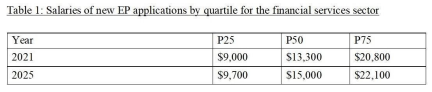
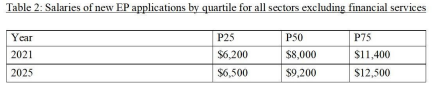
Over the same period, the median fixed monthly salary of new EP applications2 increased from $13,300 to $15,000 for those in the financial services sector and from $8,000 to $9,200 for those in all sectors excluding financial services. Tables 1 and 2 provide the values for different quartiles.
The EP qualifying salary applies to the vast majority of EP holders. MOM works with sector agencies to provide targeted flexibilities in areas that support our economic priorities. Any such flexibility is granted carefully, taking into account a range of factors.
Note(s) to Question No(s) 52:
1 Refers to Professionals, Managers, Executives and Technicians.
2 All applications submitted to MOM between 2021 to 2025, regardless of application outcome.
Mr Dennis Tan Lip Fong
Construction Of Wildlife Exclusion Fences Between Central Catchment Nature Reserve And Lorong Asrama Forest In View Of Enhancing Ecological Connectivity
Mr Dennis Tan Lip Fong asked the Minister for National Development (a) whether the Government can share the rationale for constructing wildlife exclusion fences between Central Catchment Nature Reserve and Lorong Asrama forest, given the commitment to enhancing ecological connectivity in the North West Region; and (b) whether the implementation of alternative connectivity measures, such as rope bridges and culverts, can be considered for this site.
Mr Chee Hong Tat: To mitigate vehicular-wildlife collisions, the National Parks Board has announced earlier this year that it would extend exclusion fences to nine additional locations in Singapore, including major roads along areas such as the Central Catchment Nature Reserve. These locations were identified to be higher-risk areas based on past incidents.
Developed in consultation with wildlife groups and academic experts, the exclusion fences also serve to guide wildlife towards alternative crossings such as the Eco-Link @ BKE and existing culverts. This makes it safer for wildlife to move between green spaces.
Breakdown Of Bird Species Tracked And Conservation Status Of Bird Species In Forested Area East Of Sungei Serangoon
Mr Dennis Tan Lip Fong asked the Minister for National Development (a) whether the Ministry tracks the (i) total number of bird species and (ii) number of migratory bird species, in the forested area east of Sungei Serangoon between Tampines Road and Serangoon East Dam; (b) if so, what are they; (c) whether the Ministry tracks the conservation status of all bird species in the area; and (d) how many are classified threatened according to Nature Society Singapore.
Mr Chee Hong Tat: The National Parks Board keeps track of the conservation status of bird species, including locations of verified sightings, via expert contributions through the Singapore Red Data Book, and data submitted by the public.
Based on the 2024 edition of the Singapore Red Data Book, Nature Society Singapore reported sightings of 52 threatened bird species in the area between Buangkok East Drive and Lorong Halus Wetland, which is north of where plans have been announced to site a bus depot to improve public transport services for residents.
Mr Abdul Muhaimin Abdul Malik
Monitoring Of And Investigations Into Illegal Short-Term Rental Listings On Online Platforms
Mr Abdul Muhaimin Abdul Malik asked the Minister for National Development (a) whether the Ministry conducts active monitoring of illegal short term rental listings on online platforms; and (b) how many public reports were received and investigated by the Ministry regarding suspected illegal short-term rentals since 2017; and (c) how many of these cases have led to prosecution.
Mr Chee Hong Tat: The Urban Redevelopment Authority (URA) actively monitors rental listings on online platforms. Depending on the severity of the case, URA takes a range of enforcement actions against illegal short-term rentals in private residential properties, including court prosecution for egregious cases.
Since 2017, URA has investigated about 3,600 cases of illegal short-term rentals, and prosecuted 35 offenders in court.
Data On Subletting Of Hdb Shops Purchased By Foreign Buyers And Proposal To Impose Absd On Foreign Buyers
Mr Abdul Muhaimin Abdul Malik asked the Minister for National Development (a) how many HDB shops purchased by foreign buyers have been sublet; (b) whether the Ministry will consider imposing Additional Buyer's Stamp Duty (ABSD) on foreign buyers of HDB shop units, including shops where there is no residential component; and (c) if not, why not.
Mr Chee Hong Tat: Of the 8,500 privately-owned Housing and Development Board (HDB) shops, less than 1% are owned by foreign individuals. There is no requirement for owners, whether they are locals or foreigners, to inform HDB when they sublet their shops.
The objective of the Additional Buyer’s Stamp Duty (ABSD) is to moderate demand for residential property. There are currently no plans to impose ABSD on commercial properties, including non-residential HDB shop units.

