


Written Answers to WP's Oral Questions
Assoc Prof Jamus Jerome Lim
Factors Considered When Pritorising Rail Line Upgrades
Assoc Prof Jamus Jerome Lim asked the Acting Minister for Transport (a) what criteria LTA uses to prioritise rail line upgrades such as transitions from single car to two-car operations; (b) whether ridership thresholds, infrastructure readiness, or other factors were considered in prioritising the Punggol LRT ahead of the Sengkang LRT; and (c) if so, what the corresponding figures or assessments were for each system.
Mr Jeffrey Siow: Light Rail Vehicles (LRVs) for the Sengkang-Punggol LRT can be deployed across all loops. New two- car LRVs were deployed in the Punggol loops in the second half of last year and new two-car LRVs are being deployed in the Sengkang loops since January this year. By end February 2026, a total of three and four new LRVs will be deployed to the Sengkang and Punggol loops respectively.
The new LRVs were first deployed at Punggol primarily for operational reasons. Any train fault during the initial deployment will be less disruptive and more easily managed when the new LRVs are operating in the Punggol loops, as it would not affect the launching of LRVs from the SPLRT depot located at Sengkang.
The performance of the new LRVs has since stabilised. Subsequent deployment of new LRVs will primarily be based on the level of crowding in each of the loops, while taking into consideration operational requirements.
Placement Of GCE "O" Level Private Candidates In Junior Colleges
Assoc Prof Jamus Jerome Lim asked the Minister for Education (a) whether Singaporeans who are private candidates for the GCE O-Level examinations are disadvantaged in their allocation to junior colleges if they do not participate in the Joint Admissions Exercise (JAE); and (b) whether the Ministry can assure candidates who secure sufficient points for junior college admission that they are able to enroll in one, even without participating in the JAE.
Mr Desmond Lee: The Joint Admissions Exercise (or JAE) is open to all GCE O Level certificate holders, including private candidates, who meet the age requirements and eligibility criteria. Candidates are treated the same under the JAE, based on the prevailing posting framework whether they are school or private candidates. However, those who were previously admitted to a course in Junior College (or JC), Millenia Institute, polytechnic or the Institute of Technical Education (ITE) can only apply for courses in other institution types when they participate in subsequent JAE.
We encourage candidates seeking admission to a JC to participate in the JAE. Under the JAE, all candidates who are eligible for JC and select a JC course as their first choice will be posted to a JC with remaining vacancies if they are unsuccessful in all their course choices. Those who meet the JC eligibility criteria but do not participate in the JAE can apply directly to a JC, but will be limited to any remaining places after the JAE.
Channelling Of Additional Charge Collected Under Beverage Container Return Scheme
Assoc Prof Jamus Jerome Lim asked the Minister for Sustainability and the Environment (a) whether the additional 10-cent-per-bottle charge under the NEA-led Beverage Container Return Scheme is channelled to beverage producers to help offset the costs of collecting and recycling empty containers; and (b) why no such cost offset is provided to (i) NEA for funding reverse vending machines and (ii) town councils for utilities costs incurred.
Ms Grace Fu Hai Yien: The National Environment Agency (NEA) has licensed BCRS Ltd. to operate the Beverage Container Return Scheme. BCRS Ltd. is an industry-led, not-for-profit company incorporated by a consortium of beverage producers.
BCRS Ltd. is responsible for the collection and recycling of returned beverage containers. This includes leasing and deploying Reverse Vending Machines (RVMs), managing the logistics of collecting the empty containers and making payments to partners such as town councils for utility costs incurred by the RVMs. The scheme operator is funded through the producer fees it collects and through the sale of recyclables collected. The 10 cents charge per bottle referred to by the Member would be the deposit refundable to consumers who return the empty bottles to the RVMs under the scheme. Members may wish to refer to the combined reply made on 3 February 2026 when the Scheme was discussed extensively.
Ms He Ting Ru
Assessment Of Links To Or Implications For Singapore From Epstein Files Saga
Ms He Ting Ru asked the Coordinating Minister for National Security and Minister for Home Affairs (a) whether the Government has assessed if any information arising from the Epstein Files in the United States has potential links to or implications for Singapore, including possible links to human trafficking or sexual offences involving minors; and (b) whether any follow-up actions are being considered by the Government.
Mr K Shanmugam: Police have not received any information that suggests possible criminal activities in Singapore arising from the Epstein Files.
Assessment Of IPS Finding That Policy Language May Portray Citizens As Recipients Of Government Generosity Rather Than Stakeholders
Ms He Ting Ru asked the Prime Minister and Minister for Finance (a) what is the Ministry’s position on a finding by the Institute of Policy Studies in January 2026 that policy language may portray citizens as recipients of Government generosity rather than stakeholders; (b) what proportion of Government benefits are framed as tax-funded entitlements versus discretionary handouts; and (c) whether the Ministry will consider reframing its policy language to acknowledge citizens’ contributions.
Mr Jeffrey Siow: The IPS study suggested that government communications can do more to recognise the contributions of citizens, and affirm their role as stakeholders. The Ministry of Finance (MOF) agrees and will continue to highlight this in our communications, as well as support initiatives that provide more opportunities for active citizen participation. At the same time, our communications must remain clear about the nature and intent of government support, including the benefits provided to Singaporeans across different stages of life. All support measures are funded by tax and other revenues. Many are permanent, structural schemes that provide sustained support. Others are deliberately time-bound, so that we can review their design, and ensure they remain relevant and effective. Only a small proportion of measures – about 5% in the FY2025 Budget – are one-off.
Impact Of Government-Issued Vouchers And Credits On 2025 GDP Growth
Ms He Ting Ru asked the Deputy Prime Minister and Minister for Trade and Industry (a) whether there are estimates of how much of the reported 2025 GDP growth was driven by time-limited vouchers and credits that boost short-term consumer spending; (b) whether the Government has assessed what underlying the economic growth would have been without such measures; and (c) if so, what are these estimates and assessments.
Mr Gan Kim Yong: Singapore’s GDP growth of 5.0 per cent in 2025 was largely driven by outward-oriented sectors. In particular, the manufacturing, wholesale trade and finance & insurance sectors saw strong growth on the back of the global AI investment boom, as well as resilient global trade and macroeconomic conditions. Collectively, they accounted for around 3.1 percentage-points, or 62.1 per cent, of the GDP growth in 2025.
The support measures for households and SG60 initiatives that were announced in Budget 2025 included CDC vouchers, SG60 vouchers and child LifeSG credits. These were introduced primarily to help Singaporean households defray living expenses and to share the benefits of our nation’s progress.
Consumer-facing sectors such as retail trade and food & beverage services that would benefit from these measures, collectively contributed about 0.04 percentage point, or 0.7 per cent, of the GDP growth in 2025.
Mr Gerald Giam Yean Song
Study And Mitigation Of Midge Population Problem At Bedok Reservoir Since November 2025
Mr Gerald Giam Yean Song asked the Minister for Sustainability and the Environment (a) whether the midge population at Bedok Reservoir from since November 2025 is larger compared to previous years; (b) whether studies have been conducted on midge resistance to current biological larvicides; (c) whether there are plans to rotate chemical controls; and (d) what is the measurable effectiveness of LED diversion in reducing midge counts in residential units.
Ms Grace Fu Hai Yien: The midge population at Bedok Reservoir in the period from November 2025 to January 2026 is higher compared to previous years. The Public Utilities Board's (PUB’s) data shows that the current biological larvicide remains effective. PUB thus does not have plans to rotate its chemical controls. In response to the higher midge population in this period, PUB has increased the application of biological larvicide and the frequency of fogging. LED spotlights concentrate the midges which allows for more targeted fogging. For this reason, LED spotlights remain a useful part of the suite of measures, even though PUB has not been able to quantify their effectiveness.
PUB will continue to monitor the midge situation at our reservoirs closely and review the measures as needed.
Mr Low Wu Yang Andre
Number Of Fitness Corners And Public Fitness Facilities Installed And Those That Are Equipped For Strength Training
Mr Low Wu Yang Andre asked the Acting Minister for Culture, Community and Youth (a) how many fitness corners and other freely accessible public fitness facilities are installed in parks, housing block flats and other public places; and (b) of these, how many are equipped with adjustable or variable resistance machines capable of higher impact progressive strength training as opposed to fixed-resistance or bodyweight stations.
Mr David Neo: The Government provides accessible public fitness facilities for Singaporeans’ use in our Housing and Development Board (HDB) estates, parks and ActiveSG sport centres.
There are over 3,400 fitness corners installed in HDB estates, Sport-in-Precinct facilities, and public parks maintained by NParks. Most of the fitness corners are multi-generational fitness corners, that cater to Singaporeans of different ages. Some of these have equipment that use fixed-resistance or body-weight, which make them generally easier to use.
Residents can also access any of our 28 ActiveSG gyms around the island, which are well-equipped with different types of equipment, including free-weight or variable resistance machines. Some ActiveSG gyms have specialised machines that use pneumatic technology, air pressure and lever arms instead of traditional weights. These provide safe and accessible workouts for users of all abilities.
Update On Mandate For National Space Agency Of Singapore
Mr Low Wu Yang Andre asked the Deputy Prime Minister and Minister for Trade and Industry whether the mandate of the forthcoming National Space Agency of Singapore will include (i) developing or encouraging the development of a domestic capability to launch small payloads or microsatellites to orbit and (ii) the funding of research into emerging launch technologies to enable such a capability and for potential export.
Mr Gan Kim Yong: The National Space Agency of Singapore does not intend to prioritise the development of launch capability from Singapore at this juncture. It is not practical nor cost-effective to develop such a capability given Singapore’s land constraints and congested air space, vis-à-vis leveraging commercial launch services which are readily available overseas.
Satellites from Singapore have been launched from reliable overseas spaceports, including those in French Guiana, India, Japan, and the United States. We will continue to pursue such partnerships and cooperation arrangements to maintain resilient and reliable access to launch services.
Nonetheless, we will continue to monitor emerging launch technologies, and remain open to supporting those that demonstrate commercial potential and strategic value for Singapore.
Mr Kenneth Tiong Boon Kiat
Higher Income Tax Payments Following Change From Percentage-Based To Fixed-Dollar Working Mother's Child Relief
Mr Kenneth Tiong Boon Kiat asked the Prime Minister and Minister for Finance (a) based on the Year of Assessment (YA) 2025 data, how many working mothers with children born from 2024 paid higher income tax following change from percentage-based to fixed-dollar Working Mother's Child Relief; (b) what is the projected additional tax revenue over the next decade as the affected cohort grows; and (c) whether this projected revenue is consistent with the objective of encouraging higher-order births.
Ms Indranee Rajah: The Working Mother’s Child Relief (WMCR) is part of a broader package to support Singaporeans in their marriage and parenthood journey. We have over the years significantly increased financial support such as the Baby Bonus Cash Gift and the Child Development Account First Step Grant, and enhanced parental leave provisions. We also introduced the new Shared Parental Leave scheme and the Large Families Scheme last year. All in, we expect these initiatives to cost the Government close to $7 billion in FY2026, up from over $4 billion in FY2020.
About 9,500 working mothers paid higher income tax in YA 2025 than they would have under the old WMCR basis. The change in basis of the WMCR to a fixed dollar relief was to provide equal support for children of the same child order regardless of the mother’s income, which improves the progressivity of our support. We are unable to project the additional tax revenue from the WMCR change over the next 10 years, as this is dependent on many variables that could change over time, such as the working mother’s income, the other qualifying reliefs, and number of children she may eventually have.
However, we expect the cost of the marriage and parenthood initiatives to far exceed any additional tax revenue from the WMCR change.
Findings From 2020 Pilot To Remove CCA Selection Trials
Mr Kenneth Tiong Boon Kiat asked the Minister for Education (a) what have been the findings of the 2020 pilot to remove CCA selection trials; (b) how many schools have adopted the no-trial model; and (c) whether the Ministry will require schools to offer both recreational and competitive CCA tiers so that students wishing to participate for leisure and development are not excluded by selection.
Mr Desmond Lee: Co-Curricular Activities (CCA) are an integral part of a holistic education aimed at developing our students’ character, skills and values. The Primary Schools in the pilot study were able to allocate students to their CCA choices without selection trials.
Today, about two-thirds of primary schools do not conduct CCA selection trials. Most of the remaining schools conduct trials only for a few CCAs that are oversubscribed, keeping the enrolment manageable to ensure a quality learning experience for students.
Schools customise their CCA offerings to best fit their student profiles and available resources. Many already provide recreational options. Schools also work with SportSG to provide additional recreational sports opportunities such as the Sports Education Programme and the recently launched School Sports Fiesta as enrichment beyond regular CCAs. Students also have many opportunities to learn and play a range of sports during Physical Education classes and during unstructured play at recess.
We will continue to strengthen our CCA system, to ensure meaningful development opportunities for all students.
Mr Dennis Tan Lip Fong
Legislating Mandatory Disclosure Of Odds And Probability Ranges For Blind Box Or "Gacha" Products
Mr Dennis Tan Lip Fong asked the Coordinating Minister for National Security and Minister for Home Affairs whether the Government intends to legislate mandatory and standardised disclosure of odds and probability ranges for blind box or "gacha" products sold in Singapore.
Mr K Shanmugam: MHA and GRA had studied this issue and have decided to introduce regulations stipulating the conditions under which blind boxes may be offered, to better manage gambling inducement risks.
The regulations are being drafted. The Member’s suggestion to have mandatory and standardised odds and probability disclosure will be among the points that will be considered for the regulations.
Data On Amount And Destinations For Recyclables Collected From Blue Recycling Bins
Mr Dennis Tan Lip Fong asked the Minister for Sustainability and the Environment (a) what proportion of recyclables from the blue recycling bins have been exported in 2025; (b) which are the primary destination countries; and (c) what robust verification measures are in place to ensure that such exported recyclables are legitimately recycled and not subjected to overseas dumping or rejection by host countries.
Ms Grace Fu Hai Yien: Metal, paper, glass and plastics make up the majority of the recyclables collected from blue recycling bins. Over the past years, we estimate that about 90% of these recyclables from the blue bins have been exported, mainly to other Asian countries.
In line with our obligations under the Basel Convention, Singapore has put in place controls which ensure that the export of hazardous wastes and certain controlled non-hazardous recyclables, such as mixed plastic waste, can only take place with consent from the importing country, which confirms that the importing country is able to manage the waste in an environmentally sound manner. For the export of recyclables that are not covered by the Basel Convention, such as sorted streams of metals, paper and glass, companies would have to adhere to the relevant domestic regulations of the importing country.
Update On Progress Of Train Lines Under Extension And Construction
Mr Dennis Tan Lip Fong asked the Acting Minister for Transport (a) whether an update can be provided on the progress of (i) Circle Line stage 6 and (ii) Thomson East Coast Line stage 5 and Downtown Line 3 extension; and (b) whether the Ministry can confirm the specific opening months for these segments following the completion of current tunnel reinforcement and systems integration testing.
Mr Jeffrey Siow: The ongoing tunnel strengthening works on the CCL must be completed, before the remaining testing and preparatory works for Circle Line Stage 6 can resume and Circle Line Stage 6 can be open. If the tunnel strengthening works remain on schedule, we can open Circle Line Stage 6 in the first half of 2026.
The Thomson-East Coast Line Stage 5 and Downtown Line 3 extension are expected to open in the second half of 2026.
More details on specific opening dates and any further service adjustments required to prepare for the opening of these line extensions will be announced when ready.
Written Questions
Mr Low Wu Yang Andre
Data On Subscription Cancellation Complaints Across Sectors For Past Five Years
Mr Low Wu Yang Andre asked the Deputy Prime Minister and Minister for Trade and Industry (a) in the last five years, whether the Government has any data on the number of complaints received by CASE, CCS and other public agencies regarding difficulties in cancelling recurring subscriptions or being subscribed to services without express consent; and (b) what are the top sectors contributing to these complaints.
Mr Gan Kim Yong: The Competition and Consumer Commission of Singapore (CCS) received between one and six complaints annually from 2021 to 2025, on difficulties in cancelling recurring subscriptions or being subscribed to services without express consent. The Consumers Association of Singapore (CASE) received 49 and 44 such complaints in 2024 and 2025 respectively. More than 90% of these complaints were either resolved with CASE acting on the consumer’s behalf to negotiate with the business or did not require follow-up after CASE rendered advice to the consumers. The top three sectors contributing to these complaints are (i) telecommunications services, (ii) gym and fitness memberships, and (iii) food delivery platform subscriptions.
Tracking Of Recurring Police Reports Against Business Sales Practices In Past Five Years To Identify Potential Criminal Conduct
Mr Low Wu Yang Andre asked the Coordinating Minister for National Security and Minister for Home Affairs (a) in the past five years, how many business entities were the subject of recurring or repeated police reports regarding sales practices that were subsequently deemed to be civil disputes; and (b) whether the Police tracks such repeated reports to identify potential criminal conduct.
Mr K Shanmugam: The Police do not track police reports of cases which were regarded as civil in nature. Assessments are made on the facts, and where necessary, advice is obtained from the Attorney-General's Chambers (AGC) on whether a case is likely criminal and can be the subject of prosecution.
Data On Feedback Received On Misleading Social Media Content In Past Five Years And Number Of Cases Involving Paid Influencers Or Sponsored Posts Without Proper Disclosure
Mr Low Wu Yang Andre asked the Minister for Digital Development and Information (a) whether the Government has data on the amount of feedback received by the Advertising Standards Authority of Singapore or public agencies in the last five years regarding misleading content on social media; and (b) how many of these cases
involved paid influencers or sponsored posts without clear disclosure.
Mrs Josephine Teo: From 2021 to 2025, the Advertising Standards Authority of Singapore (ASAS) received between 40 and 48 cases of feedback each year regarding social media advertisements with misleading content. Around 2% involved paid influencers or sponsored posts without disclosure. They had breached the Singapore Code of Advertising Practice (SCAP) and would typically have been asked by ASAS to amend or remove their content.
Mr Dennis Tan Lip Fong
Annual Data On Complaints To Case For Blind Box And “Gacha” Mechanisms From 2023 To 2026 And Outcomes Against Errant Retailers
Mr Dennis Tan Lip Fong asked the Deputy Prime Minister and Minister for Trade and Industry (a) whether the Ministry has data on the number of complaints regarding blind box or ‘gacha’ mechanisms that the Consumers Association of Singapore (CASE) has received annually since 2023; (b) how many of these cases have been referred to Competition and Consumer Commission of Singapore (CCS) for investigation; and (c) what are the outcomes, including any warnings or penalties issued to retailers.
Mr Gan Kim Yong: The Consumers Association of Singapore (CASE) received zero, four and five complaints involving blind boxes in 2023, 2024 and 2025 respectively. All complaints were about the non-fulfilment of orders and missing or defective items. None of these cases were referred to the Competition and Consumer Commission of Singapore for further investigation, as CASE was able to address them and provide assistance to the complainants.
Registration Process Support Measures For Healthcare Professional Candidates For Past Five Years
Mr Dennis Tan Lip Fong asked the Coordinating Minister for Social Policies and Minister for Health (a) over the past five years, what is the percentage of healthcare professionals who have conditional or provisional registration but fail to get full registration after the fixed supervisory and training term; and (b) what are the measures taken to help these individuals attain full registration.
Mr Ong Ye Kung: Generally, in recent years, 3% to 5% of healthcare professionals (HCPs) did not obtain full registration by the end of their fixed supervision and training term.
HCPs generally commence clinical practice under provisional or conditional registration. Those who do not attain full registration after the end of a fixed supervision and training term may continue to practise safely under supervision and continue to work towards meeting the requirements to be fully registered. Standardised training programmes and competency frameworks enable them to progress towards independent practice under full registration. Regular performance reviews during the supervisory period also allow for early identification of areas requiring improvement, enabling targeted support and additional training where needed.
Mr Kenneth Tiong Boon Kiat
Ten-Year Breakdown Of Full-Time National Servicemen Numbers Across SAF, SPF And SCDF
Mr Kenneth Tiong Boon Kiat asked the Coordinating Minister for Public Services and Minister for Defence (a) how many Full-time National Servicemen were enlisted in each of the last 10 years, broken down by the SAF, SPF, and SCDF; and (b) in each of those years, how many Full-time National Servicemen were serving in their second year of national service.
Mr Chan Chun Sing: As the enlistment numbers vary from year-to-year, it is more meaningful to compare them over longer time periods, as follows.
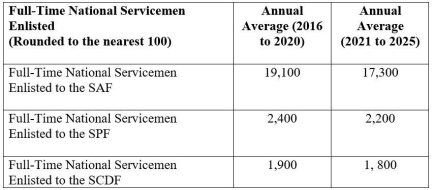
The percentage of enlistees who progress to complete their two-year term has consistently exceeded 95%. The small numbers who are unable to complete the two year term are mostly due to medical reasons.
Accuracy Standards Of Bus Eta System Over Past Three Years And Monitoring Measures Of System Contractor's Performance
Mr Kenneth Tiong Boon Kiat asked the Acting Minister for Transport (a) what accuracy standards apply to the bus Expected Time of Arrival (ETA) system; (b) what has been the measured accuracy rate over the past three years; (c) whether the Ministry is satisfied with the ETA system contractor's performance, given inaccuracies reported well before the January 2026 failure; and (d) what monitoring measures will prevent recurrence.
Mr Jeffrey Siow: The Expected Time of Arrival (ETA) system is expected to predict actual bus arrival times within a three-minute range, at least 95% of the time. There is some inherent variation in bus arrival times, due to variable dwell times at preceding bus stops, and traffic speeds due to congestion, accidents or roadworks.
In the past three years the actual performance of the system has met the prescribed performance target. The ETA failure in January was due to a defect in the software on the buses that was triggered by a server failure. The defect has since been fixed, and the system’s performance is stabilising.
Since 2024, we have begun to upgrade the ETA system to improve arrival time predictions, and provide more real time information to commuters. The Land Transport Authority (LTA) is closely monitoring the reliability and accuracy of the ETA system and has taken remedial actions to prevent a recurrence.
Ms Eileen Chong Pei Shan
National Mindline 1771 Usage Statistics, Demographic Analysis And Service Utilisation Across Support Channels And Categories
Ms Eileen Chong Pei Shan asked the Coordinating Minister for Social Policies and Minister for Health (a) what is the demographic profile of help-seekers on the national mindline 1771 to date, by (i) age group and (ii) gender; (b) what is the distribution of contacts across (i) telephone (ii) WhatsApp and (iii) webchat channels; and (c) what proportion of help-seekers remain anonymous.
Ms Eileen Chong Pei Shan asked the Coordinating Minister for Social Policies and Minister for Health since the launch of national mindline 1771 in June 2025 (a) what is the total number of contacts received across all channels; (b) what
proportion of contacts required (i) immediate crisis intervention (ii) early support and counselling and (iii) wayfinding and referrals respectively; and (c) what are the most common referral pathways.
Mr Ong Ye Kung: Since the launch of the national mindline 1771 service in June 2025, counsellors have handled more than 39,000 calls, messages and webchats, with 26% of help-seekers choosing not to disclose their personally identifiable information. The distribution of help-seekers across the hotline, WhatsApp messaging and webchat messaging channels is approximately 60%, 25% and 15% respectively.
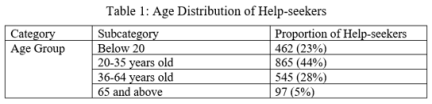
Most of the help-seekers do not explicitly reveal their age or gender. However, based on counsellors' interactions with help-seekers across all channels, gender could be determined in approximately 37% of cases with fairly similar numbers of males and females.
For help-seekers who chose to share their age, most are 20 to 35 years old as shown in Table 1.
Of the help-seekers attended to, approximately 10%, 75% and 15% required immediate crisis intervention, early support and counselling, and wayfinding and referrals respectively. Help-seekers are mostly referred to Community Outreach
Teams (CREST), Community Intervention Teams (COMIT) and Family Counselling Centres (FSCs).
Data On Spousal Abuse Cases With Both Spouses Filing Complaints In 2024 And Safeguards To Prevent Abusers From Making Counter-Reports
Ms Eileen Chong Pei Shan asked the Minister for Social and Family Development in respect of the 2,136 spousal abuse cases in 2024 (a) how many involve counter-reports or cross-complaints filed by both parties; (b) what assessment protocols exist to identify the primary aggressor versus defensive responses; and (c) what safeguards prevent abusers from using counter-reports as a coercive control tactic.
Mr Masagos Zulkifli B M M: Spousal abuse cases are managed by Protection Specialist Centres (PSCs) and Family Service Centres (FSCs). Currently, there is no detailed breakdown of spousal abuse cases, such as the number of counter-reports or cross complaints, due to differences in how agencies record data.
Practitioners in PSCs and FSCs apply professional frameworks and practice guidelines to assess domestic violence dynamics. This includes conducting structured interviews with involved parties, reviewing prior reports and case histories, and undertaking relevant checks where appropriate. These processes enable professionals to make objective, evidence-informed assessments without pre-judgement, thereby reducing the risk of abusers misusing counter-reports as a coercive control tactic.
Members of the public who are experiencing abuse, or who know someone in an abusive relationship, are encouraged to seek help early by contacting the National Anti-Violence & Sexual Harassment Helpline (NAVH) at 1800-777-0000 or by making an online report.
Breakdown Of Spousal Abuse Cases In 2024 By Gender And Age Of Victims And Perpetrators, Types Of Abuse And Referral Sources
Ms Eileen Chong Pei Shan asked the Minister for Social and Family Development of the 2,136 new spousal abuse cases in 2024 that is reported in the Domestic Violence Trends Report 2025 (a) what is the gender breakdown and age distribution of (i) victims and (ii) perpetrators respectively; (b) what is the breakdown by type of abuse; and (c) what are the common referral sources for such cases.
Mr Masagos Zulkifli B M M: The Ministry of Social and Family Development (MSF) currently does not track data for spousal abuse by age, sex, and type of abuse. We are working with community agencies to collect more granular data on spousal abuse.
Self-referrals constituted a significant proportion of spousal abuse cases managed by Family Service Centres, where clients sought help on their own. The Member may wish to refer to the Domestic Violence Trends Report 2025 for details.
Mr Gerald Giam Yean Song
Legitimacy Of Myanmar’s January 2026 General Elections, Supporting Asean’s Position Of Non-Recognition And Impacts On Resolving Myanmar’s Political Situation
Mr Gerald Giam Yean Song asked the Minister for Foreign Affairs in view that there is no consensus within ASEAN to recognise Myanmar's election (a) what is the Government’s assessment of the legitimacy of the Myanmar general election concluded on 25 January 2026; (b) whether Singapore aligns with the ASEAN chair’s current position of non-recognition; and (c) how the conduct of this election affects Myanmar’s implementation of the Five-Point Consensus.
Dr Vivian Balakrishnan: As I have previously stated in this House, meaningful political progress in Myanmar requires a cessation of hostilities, inclusive dialogue, and participation by all stakeholders. These preconditions are necessary for a Government with legitimacy and a measure of popular support to emerge, and to bring the country forward. These preconditions have not yet emerged.
The ASEAN Five-Point Consensus remains the framework for addressing the situation in Myanmar. This includes upholding the decision to maintain Myanmar’s non-political representation at ASEAN Summits and ASEAN Foreign Ministers’ Meetings, until there is meaningful progress in the implementation of the Five-Point Consensus. Singapore will continue to support ASEAN Chair Philippines and ASEAN’s efforts in ensuring a Myanmar-owned and Myanmar-led resolution that is in line with the Five-Point Consensus.
Singpass Login Success Rates And Application Abandonment Patterns For CDRT Claims
Mr Gerald Giam Yean Song asked the Minister for Law since 2023 (a) what is the annual number of unique SingPass logins to the Community Justice and Tribunals System for Community Disputes Resolution Tribunals claims; (b) of these, how many successfully submitted a claim; (c) which stage of the form has the highest rate of application abandonment; and (d) what is the median length of time taken for successful claim submissions.
Mr Edwin Tong Chun Fai: Between 2023 and 2024, around 394 claims were filed with the Community Disputes Resolution Tribunals (CDRT) via logins using SingPass or CJTSPass (for individuals who do not have SingPass) to the Community Justice and Tribunals System (CJTS).
The CJTS does not track the other requested data.
Ms He Ting Ru
Data On Adoption Of FWA For Teachers And Ensuring Consistency Of Implementation Of FWA Across Schools
Ms He Ting Ru asked the Minister for Education with the implementation of flexible work arrangements (FWA) for teachers (a) whether data is collected on how often teachers are able to work from home; (b) how is this arrangement practicable given the average teacher’s workload; and (c) how does the Ministry ensure consistency of implementation across schools.
Mr Desmond Lee: The Ministry of Education (MOE) does not collect such data. The flexible work arrangements vary in approach, length of time and operational needs of schools. MOE’s approach to supporting teacher well-being while prioritising students learning needs, is to provide guidelines to all schools and give School Leaders the autonomy to make local decisions that meet both operational needs and the well-being needs of teachers. Notwithstanding this, there are channels for staff to provide feedback on the implementation of flexible work arrangements in their schools. This can be through the regular staff engagements surveys that we conduct or through the unions.
MOE encourages School Leaders to support teachers’ requests for flexible working arrangements where feasible. This includes reporting later at the start of the school day or leaving earlier before the end of the school day if they have no lessons or duties and flexibility for teachers to attend online meetings at home where feasible. Teachers in most secondary schools, Junior Colleges and Millenia Institute get to work from home on at least one Home-Based Learning day per term.
Impact Of Bus Arrival Timing System Faults On Bus Services And Commuters, And Corrective Measures Taken
Ms He Ting Ru asked the Acting Minister for Transport regarding the fault in the bus arrival timing system (a) how many bus services and commuters were affected; (b) what post-deployment checks are or have been conducted on the vendor’s system to ensure accuracy; and (c) whether the reported root cause being a memory cache build-up raised cybersecurity or resilience concerns.
Mr Jeffrey Siow: Around 4,000 buses were affected by intermittent data transmission and missing bus arrival timing predictions. As buses are deployed across services at different times, we do not have an estimate of the impact on commuters. Bus operations were not impacted otherwise. Predictions from the Expected Time of Arrival system are cross checked against the actual arrival timing of buses logged via the separate Bus Fleet Management System to identify any spikes in inaccurate or missing predictions.
Based on preliminary investigations, the root cause of the incident was defective software coupled with a server failure in January 2026. These resulted in a buildup of data in the internal memory storage of on-board data transmitters, which eventually prevented many of the transmitters from functioning properly. There are no cybersecurity concerns. The software has since been fixed and the same error should not recur. An upgrade of the Bus Fleet Management System has also been in progress since 2024, and will integrate and improve bus arrival time predictions.
Assoc Prof Jamus Jerome Lim
Breakdown Of Primary 3 To 6 Students Receiving Private Tuition By Subject And Median Household Spending To Evaluate Sufficiency Of School-Based Learning
Assoc Prof Jamus Jerome Lim asked the Minister for Education (a) whether the Ministry tracks (i) the proportion of Primary 3 to 6 students receiving private tuition broken down by subject and (ii) the median household spending on private tuition; and (b) if so, how these indicators are used to evaluate the sufficiency of school-based learning.
Mr Desmond Lee: The Ministry of Education (MOE) does not track the proportion of Primary 3 to 6 students receiving private tuition, broken down by subjects. Based on the latest Household Expenditure Survey 2023 by the Department of Statistics, resident households spent on average $104.80 a month on private tuition.
MOE does not use these indicators to evaluate the sufficiency of school-based learning, as learning is influenced by multiple factors in and outside of school, and the reasons for taking up tuition vary.
Deployment Timeline Of Two-Car Trains For Sengkang Punggol LRT At Sengkang East And West Loops By 2026 To 2027
Assoc Prof Jamus Jerome Lim asked the Acting Minister for Transport with regard to the rollout of two-car trains for the Sengkang-Punggol Light Rail Transit system that began in the third quarter of 2025, how many two-car trains are expected to be deployed for the Sengkang East Loop and Sengkang West Loop, in each case by (i) June 2026 (ii) December 2026 (iii) June 2027 and (iv) December 2027, respectively.
Mr Jeffrey Siow: By end-February 2026, seven new LRVs would have already been deployed on the Sengkang-Punggol LRT. The remaining 18 new LRVs will be progressively deployed across the Sengkang-Punggol LRT network from early 2027 onwards, after the completion of the Sengkang-Punggol depot expansion works. The exact timeline for deployment will be determined based on the prevailing operational requirements and ridership patterns at the time.
Mr Abdul Muhaimin Abdul Malik
Effectiveness Of Car-Lite Designations On Vehicle Ownership And Transit Usage Since 2019 And Lessons Learnt From Implementation Of Car-Lite Measures
Mr Abdul Muhaimin Abdul Malik asked the Acting Minister for Transport (a) what impact do car-lite designations have on vehicle ownership and public transport usage in the 16 gazetted areas since 2019; and (b) what lessons have been learnt from implementing car-lite measures in HDB estates like Bayshore and Ulu Pandan.
Mr Jeffrey Siow: The 16 gazetted car-lite areas, including Bayshore and Ulu Pandan estates, are still in development. For instance, Bayshore was part of the earliest areas designated in 2019, and its first sites are only expected to be completed around 2030. We will assess the impact of car-lite designations on these areas after they have largely been occupied.

