


Written Answers to WP's Oral Questions
Mr Gerald Giam Yean Song
Secondary Employment For Work Pass Holders Granted Security Officer’s Licence
Mr Gerald Giam Yean Song asked the Acting Minister for Manpower (a) whether secondary employment is permitted for Work Pass Holders granted a Security Officer’s Licence; and (b) if not, how the Government enforces compliance to detect and address any unauthorised practices.
Ms Jasmin Lau: Work Pass Holders granted a Security Officer’s Licence can only work for their designated employer. They are not allowed to engage in secondary employment by taking on another job. The Ministry of Manpower takes a serious view
towards such illegal employment activities. We will investigate upon receiving any complaints and take enforcement action against the employers and Work Pass Holders involved, if warranted.
Estimated Cost And Economic Benefit Of Proposed Undersea Tunnel To Pulau Tekong
Mr Gerald Giam Yean Song asked the Minister for National Development (a) what is the estimated financial cost of the proposed undersea tunnel to Pulau Tekong; (b) what specific civilian uses are being considered for the 500 hectares of reclaimed land; and (c) what economic cost-benefit assessments have been conducted to justify an undersea tunnel over existing ferry services.
Mr Chee Hong Tat: Pulau Tekong is primarily used for military training today. We are studying the siting of civilian uses on Tekong, which could include utilities and other industrial uses.
Compared to ferries, an undersea road tunnel will further enhance accessibility and open up more possibilities for both military and civilian uses on Tekong. Similar to other major infrastructure projects built by the Government, a study on the benefits and financial costs will be done before the project is implemented.
Reducing Environmental Impact For And Documenting Heritage Of Island Communities Before Western Island Project Reclamation Works
Mr Gerald Giam Yean Song asked the Minister for National Development (a) whether the Government will document the cultural and maritime heritage of the former island communities of Pulau Semakau, Pulau Sudong and Pulau Seking before reclamation; and (b) whether the Government will consult descendants of these communities as part of the stakeholder engagement announced for the proposed western island.
Mr Chee Hong Tat: These questions were addressed in the Ministry of National Development’s reply to the questions asked by Dr Charlene Chen, Ms He Ting Ru, Mr Low Wu Yang Andre, and Mr Sharael Taha on 8 September 2026.
Mr Abdul Muhaimin Abdul Malik
Young Children Found Unsupervised In Public Places Who Were Assessed To Be In Need Of Care Or Protection
Mr Abdul Muhaimin Abdul Malik asked the Minister for Social and Family Development (a) in the past three years, how many cases of young children found unsupervised in public places were assessed as being in need of care or protection; and (b) what actions may be taken against parents or caregivers whose neglect endangers a child.
Mr Masagos Zulkifli B M M: MSF does not track statistics specifically on young children found unsupervised in public places who were assessed as being in need of care or protection.
Where Police suspect that such cases may involve neglect, they would refer them to the Ministry of Social and Family Development (MSF) for investigation. From 2022 to 2024, there was an average of 539 child neglect cases that required statutory intervention.
When a child is found to be at risk due to neglect, MSF's immediate priority is to ensure the child's safety. Where the child can remain safely at home, MSF, a Child Protection Specialist Centre or a Family Service Centre will first implement safety plans, monitor compliance and work with the family to improve parenting practices to ensure adequate care and safety of the child. Where required, parents or caregivers may be referred for counselling and other community-based support services to strengthen caregiving capacity. Where serious safety concerns are identified, MSF and Police will take expedited action, including removal of the child and placing them in an alternative care arrangement if necessary. Where there is sufficient evidence that a parent or caregiver may have committed an offence, the case may be referred to the Police and prosecution may be considered.
Proportion Of Preschool Places Offered By Anchor And Partner Operators By 2030
Mr Abdul Muhaimin Abdul Malik asked the Minister for Social and Family Development (a) what proportion of preschool places does the Government intend to bring under Anchor and Partner Operators by 2030; (b) whether the Ministry will track and publish the number of independent preschool closures as this share grows; and (c) whether current arrangements for families displaced by abrupt closures are adequate, particularly on the recovery of prepaid fees and deposits.
Mr Masagos Zulkifli B M M: We intend to expand the network of Government supported preschool operators and have places to cater to more than 80% of preschoolers by 2030. As part of this effort, ECDA will introduce a new grant to help eligible preschool operators that wish to transition onto the Government-supported network. This will allow a broader range of operators, including smaller operators, to benefit from Government support while continuing to offer families with quality preschool options.
The preschool sector is dynamic, with centres opening, restructuring and closing for various reasons. The Early Childhood Development Agency (ECDA) monitors the sector closely, including on preschool closures, and will publish information where appropriate.
In the event of cessation, preschools must assist parents in securing alternative care arrangements to minimise disruption and manage any outstanding financial matters, such as refunds of fees and deposits to parents. ECDA may also assist affected parents who require help with alternative preschool placement. Parents who require further assistance with matters concerning deposit or fee refunds may seek assistance from the Consumer Association of Singapore or approach the Small Claims Tribunal.
Plans For Revamp To Parent Volunteer Scheme In Ongoing Primary 1 Registration Review
Mr Abdul Muhaimin Abdul Malik asked the Minister for Education (a) whether the ongoing review of the Primary 1 registration framework will include reviewing the parent volunteer scheme for Primary 1 registration given that some schools have discontinued it; and (b) if not, what safeguards exist to ensure parents
unable to commit volunteer hours are not disadvantaged.
Mr Desmond Lee: The Ministry of Education has been reviewing the Primary One Registration Framework and will share the outcome of the review soon.
Mr Kenneth Tiong Boon Kiat
Proposal For Work Permit Holders To Be Allowed To Work In Hawker Centres
Mr Kenneth Tiong Boon Kiat asked the Minister for Sustainability and the Environment (a) why work permit holders may be employed in coffee shops and food courts but not in NEA hawker centres, given all are cooked-food trades; (b) how many Long-Term Visit Pass (LTVP) and Long-Term Visit Pass Plus (LTVP+) holders work as hawker stall assistants as at 1 September 2026; and (c) whether the venue-based distinction will be reviewed.
Ms Grace Fu Hai Yien: Hawker centres are a unique part of Singapore's cultural heritage and it is important to preserve the local identity and heritage of our hawker culture. Only Singaporean Citizens and Permanent Residents are allowed to be stallholders at our hawker centres, and stallholders are required to physically operate their stalls. This is unlike other licensed food shops, which may be managed by commercial entities that hire employees to run their outlets. Nonetheless, stallholders in hawker centres can hire eligible Long-Term Visit Pass and Long-Term Visit Pass Plus holders, who are already part of the Singapore family nexus, to work as stall assistants. This strikes a balance between supporting stallholders’ manpower needs and the preservation of hawker centres’ local identity.
As of 1 August 2026, there are about 300 LTVP and LTVP+ holders working as stall assistants in cooked food stalls in hawker centres.
We will continue to monitor the situation and review our policies where necessary, to strike a balance between manpower needs and the Singaporean identity of hawker centres.
Verification Of Declared Salaries Against Qualifying Salary For S Pass Holders In Services Sector
Mr Kenneth Tiong Boon Kiat asked the Acting Minister for Manpower (a) what is the distribution of declared salaries of services-sector S Pass holders relative to the qualifying salary; (b) whether declared salaries are routinely verified against IRAS and salary crediting records; and (c) how many salary kickback prosecutions since 2021 involved S Pass holders.
Ms Jasmin Lau : Based on the Ministry of Manpower's (MOM's) data as at July 2026, the fixed monthly salaries for S Pass holders in the Services sector at the 25th percentile, 50th percentile and 75thpercentile are $3,550, $4,200 and $4,970 respectively.
MOM performs risk-based audits, which include verifying the declared salaries against data from various sources.
The collection of salary kickbacks is an offence under the Employment of Foreign Manpower Act (EFMA). Under the EFMA, offenders may face up to two years of imprisonment, a fine of up to $30,000, or both. Since 2021, MOM has prosecuted about 30 employers for salary kickbacks involving over 100 S Pass holders.
Proportion Of Resigning Teachers Joined Flexi-Adjunct Teaching Scheme
Mr Kenneth Tiong Boon Kiat asked the Minister for Education (a) in each of the last five years, what proportion of resigning teachers joined the Flexi-Adjunct Teaching Scheme within 12 months; (b) whether a Flexi-Adjunct Teacher may decline form teachership or co-curricular duties and remain engaged; (c) how duties exceeding the paid hours are treated; and (d) whether those who resigned and those on no-pay leave are engaged on the same terms.
Mr Desmond Lee: Over the past five years, around a quarter of teachers who resigned were engaged as Flexi-Adjunct Teachers (FAJTs) within a year of leaving the Education Service.
Every FAJT performs both teaching and non-teaching duties, which may include form teachership, CCA duties, or other responsibilities in the school. FAJTs are paid hourly for the work performed and their working hours are subject to a cap. Schools are guided to ensure that the duties assigned to FAJTs are within the paid hours.
Education Officers who are on No-Pay Leave (NPL) or resign to join the FAJT scheme are engaged on the same terms.
Ms Eileen Chong Pei Shan
Regulation And Assessment Of MOE Kindergartens And Kindergarten Care Centres
Ms Eileen Chong Pei Shan asked the Minister for Education (a) whether Kindergarten Care (KCare) centres in MOE Kindergartens (MKs) are licensed under the Early Childhood Development Centres Act; (b) if not, what standards govern staff qualifications, staff-child ratio and children's safety and well-being while in KCare; and (c) whether and how the KCare component is separately specified and evaluated when Student Care Centre operators for schools co-located with MKs are appointed.
Ms Eileen Chong Pei Shan asked the Minister for Education (a) whether MOE Kindergartens (MKs) are assessed against the Early Childhood Development Centres Regulations 2018 and the Early Childhood Development Centres Code of Practice; (b) if so, by whom and how often; and (c) how many MKs have been assessed and how many required rectifications in the past decade.
Mr Desmond Lee: My response will address Question no. 44 and Question no. 45 raised by Ms Eileen Chong on regulations and standards for MOE Kindergartens and Kindergarten Care.
MOE Kindergartens (MKs) are directly operated by the Ministry of Education (MOE) and are part of the primary schools they are located in. MKs are regulated under the Education Act, and are excluded from the Early Childhood Development Centres (ECDC) Act.
MOE has put in place oversight structures and processes to ensure adherence to quality and safety standards in all schools, including MKs. All MKs also take reference from the ECDC Regulatory Standards prior to commencing operations.
MKs conduct a yearly self-appraisal and undergo regular validation exercises by MOE that take reference from the Singapore Preschool Accreditation Framework (SPARK) under ECDA. MOE HQ follows up to provide consultation and relevant support where needed.
Kindergarten Care (KCare) centres are operated by Student Care Centre (SCC)- KCare operators. These operators are selected by considering how well the KCare component meets MOE’s guidelines on staff qualifications and training, staff-to-child ratios, as well as programme implementation, environment setup, and standard operating procedures to safeguard children’s safety, health and well-being. Pre operations checks are conducted to ensure each KCare centre meets baseline standards before commencing operations. To ensure that KCare centres are held to standards comparable to those required by ECDA on similar childcare services, MOE has put in place a KCare Quality Assurance Framework that takes reference from ECDA’s Code of Practice for kindergarten-level childcare services. MOE conducts regular appraisals to ensure standards are maintained.
We will continue to work closely with ECDA in ensuring that our MKs provide quality preschool education for our children.
Mr Fadli Fawzi
Number Of CCAs Remaining Unsold
Mr Fadli Fawzi asked the Minister for National Development (a) as at 31 August 2026, what is the number of Community Care Apartments (CCAs) that remain unsold; (b) what are HDB's plans to sell these flats before completion; (c) whether HDB has any plans to convert such flats to regular 2-room flats if they remain unsold upon completion; and (d) if not, why not.
Mr Chee Hong Tat: Since 2021, the Housing and Development Board has launched a total of around 1,100 Community Care Apartment (CCA) units across five Build-To-Order (BTO) projects. On average, about 7 in 10 CCA units were taken up by the end of each BTO selection exercise. Unselected CCAs are re-offered at subsequent Sale of Balance Flats exercises.
The demand for CCAs has yet to stabilise, as it is a relatively new housing typology, with only one project at Harmony Village @ Bukit Batok completed thus far.
Addition Of Healthcare Providers To List Of Overseas Hospitals Participating In Medisave Scheme
Mr Fadli Fawzi asked the Coordinating Minister for Social Policies and Minister for Health (a) whether any new healthcare providers have been added to the list of overseas hospitals participating in the MediSave scheme since 2010; (b) what key lessons has the Ministry learnt since the implementation of the overseas MediSave scheme; (c) whether there are plans to expand the scheme further; and (d) if not, why not.
Mr Ong Ye Kung: This question has been addressed in the answer to Question No. 40 in the Parliament Sitting on 9 September 2026.
Ms Sylvia Lim
HDB's Role In Ensuring Fire Safety At Coffee Shops And Eating Houses, And Fire Insurance Requirements Imposed On Stallholders
Ms Sylvia Lim asked the Minister for National Development (a) what role does HDB perform in ensuring fire safety at coffee shops and eating houses within HDB blocks; and (b) what are the respective fire insurance requirements imposed on operators of businesses and on individual stallholders.
Mr Chee Hong Tat: The Housing and Development Board (HDB) works closely with the Singapore Civil Defence Force (SCDF) on fire safety matters for coffee shops within HDB blocks. Before commencing renovations, coffee shop operators are required to engage a Qualified Person and submit their fire safety plans to SCDF for approval, as well as their renovation drawings to HDB for approval. Before occupation is allowed, the operator must obtain a Fire Safety Certificate from SCDF.
After operations have commenced, HDB conducts annual fire safety inspections and advises operators on good fire safety practices. Operators are also required to submit kitchen exhaust system servicing reports when renewing their tenancy or Outdoor Refreshment Area licence. This ensures that kitchen exhaust ducts are properly maintained and cleaned, reducing the risk of grease build-up that can cause fires to spread. These checks are in addition to SCDF’s scheduled and unannounced inspections of these premises.
On fire insurance, owners of privately-owned HDB shops are required under the terms of their lease with HDB to purchase basic fire insurance. Tenants of shops let out by HDB are required to take up fire insurance for HDB's fixtures and fittings, and public liability insurance of at least S$1,000,000. Non-compliance may result in non renewal or termination of tenancy.
Mr Low Wu Yang Andre
Update On Study Of Public Transport For Tuas South
Mr Low Wu Yang Andre asked the Minister for Transport regarding LTA’s study of public transport for Tuas South (a) what options, including Bus Rapid Transit and rail, are being assessed; (b) what criteria will determine which option is selected; and (c) what is the intended use of the existing Gul Circle MRT station platforms and tracks.
Mr Jeffrey Siow: We are focusing our study of public transport options for Tuas South on Bus Rapid Transit (BRT) systems because they are potentially more economical, flexible, and faster to implement than rail, while providing better capacity than regular bus services.
The feasibility study for BRT systems will look at projected public transport ridership, land and infrastructure requirements, and its impact on existing traffic. As part of the study, we will look at different vehicle types to determine the optimal system design.
The two additional platforms at Gul Circle MRT station can be used to extend the East-West Line should there be a need in the future.
Mr Dennis Tan Lip Fong
Biodiversity Studies For Tagore Forest
Mr Dennis Tan Lip Fong asked the Minister for National Development (a) whether baseline biodiversity studies have been conducted for Tagore Forest; and (b) whether the Government has studied conserving all or part of the forest as a buffer park to the Central Catchment Nature Reserve given its ecological importance.
Mr Chee Hong Tat: This question was addressed in the Ministry of National Development’s reply to the questions asked by Ms Nadia Ahmad Samdin, Mr Kenneth Tiong Boon Kiat, Mr Dennis Tan Lip Fong, and Mr Cai Yinzhou on 8 September 2026.
Impact Of Western Island Reclamations On Singapore's Pledge To Un To Restore 80 Hectares Of Forest, Marine And Coastal Habitats By 2030
Mr Dennis Tan Lip Fong asked the Minister for National Development (a) how the proposed western islands reclamation is consistent with the 20 national biodiversity targets submitted to the United Nations (UN) in October 2024 for a UN biodiversity conference, in particular the target to restore 80 hectares of forest, marine and coastal habitats by 2030; and (b) whether these targets will be revised.
Mr Chee Hong Tat: To contribute to global targets under the Kunming–Montreal Global Biodiversity Framework, Singapore submitted 20 national targets, taking into account our unique circumstances as a land-scarce and densely populated city-state. One of the targets is to restore at least 80 hectares of forest, marine and coastal habitats by 2030.
We are on track to achieving our national targets. As of March 2026, we have restored 60 hectares of forest, marine and coastal habitats. For instance, NParks has embarked on a mangrove restoration project at Sungei Durian in Pulau Ubin, which aims to naturally restore around 8,000 mangrove plants over time.
Written Questions
Mr Abdul Muhaimin Abdul Malik
Managing Rising Liabilities And Long-Term Funding Needs Of The Pioneer Generation Fund
Mr Abdul Muhaimin Abdul Malik asked the Prime Minister and Minister for Finance (a) why the projected liabilities of the Pioneer Generation Fund had exceeded its remaining balance by about $785 million; (b) what assumptions or cost drivers accounted for this shortfall; and (c) what steps will be taken to ensure the fund's long term sustainability without over-reliance on annual Budget top-ups.
Mr Jeffrey Siow: As at 31 March 2026, the estimated liabilities of the Pioneer Generation (PG) Fund exceed its balance by about $0.9 billion. This shortfall is attributable to two factors. First, healthcare costs and MediShield Life premiums have risen faster than expected, and these account for the main shortfall. Second, scheme enhancements, such as CareShield Life Additional Participation Incentives, have contributed to the shortfall marginally.
The PG Fund is designed to support long-term commitments and outlays that will materialise over many years. Its estimated liabilities will change over time, and we do not seek to match the Fund balance exactly to these liabilities at any one point. But the Government will make fund top-ups as needed, and ensure that the commitments made to our seniors remain fully funded over time.
Assessment Of Wisdom Tooth Surgery Accreditation Standards And Progression Pathways For General Dentists
Mr Abdul Muhaimin Abdul Malik asked the Coordinating Minister for Social Policies and Minister for Health (a) whether the new certificate of competency framework for wisdom tooth surgery recognises the experience of general dentists who have safely performed such procedures for years; (b) whether the requirement to log 30 cases within three years risks incentivising unnecessary surgery; and (c) what progression pathways exist for accredited general dentists to take on more complex cases.
Mr Ong Ye Kung: The Certificate of Competency (COC) framework announced recently by the Singapore Dental Council (SDC) aims to progressively raise the proficiency standards of wisdom tooth surgery at the primary care level. We recognise that general dentists, especially the less experienced ones, will benefit from further training beyond what they had received during their undergraduate education, before they perform higher-risk wisdom tooth surgery. This will ultimately enhance safety and benefit patients.
At this stage, we are starting with a voluntary framework, and inviting experienced general dentists to help us confirm and define the competency standards. They will also service as supervisors to junior dentists. We have for now defined sustained competency as having successfully completed 30 wisdom tooth surgeries over the initial three-year accreditation period. This is a patient volume which, based on the Ministry of Health’s record, most general dentists can comfortably fulfil without leading to unnecessary treatments. It is to be validated and confirmed within this phase of voluntary implementation.
After the standards are defined and confirmed, our intention is to recognise the experience of general dentists who have a sufficiently long history of practice in wisdom tooth surgery, and especially those who have helped us validate and define the COC.
Mr Dennis Tan Lip Fong
Strengthening Enforcement Measures And Public Education On Lane Discipline Requirements For All Large Vehicles
Mr Dennis Tan Lip Fong asked the Senior Minister, Coordinating Minister for National Security and Minister for Home Affairs building on the Traffic Police’s enforcement and public education efforts on lane discipline, whether enforcement will be intensified against all large vehicles, including off-service public buses that fail to travel in the extreme left lane, except where necessary to overtake, turn or avoid bus lanes during operating hours.
Mr K Shanmugam: As stated in our reply to the Member’s Question No. 30 on 4 February 2026, the Traffic Police will continue to enforce the requirement for all large vehicles, including off-service public buses, to keep to the extreme left lane except when overtaking, turning or avoiding an operational bus lane.
Planning Of Semakau Landfill's Future Development In View Of Western Islands' Merger Proposal
Mr Dennis Tan Lip Fong asked the Minister for Sustainability and the Environment regarding the proposed merger of the western islands (a) how will Semakau Landfill operations be affected; (b) whether its projected lifespan to 2035 and beyond remains unchanged; and (c) whether a site for a successor landfill has been identified.
Ms Grace Fu Hai Yien: The National Environment Agency (NEA) will work with the relevant agencies on the future plans for Semakau Landfill. It will continue to pursue measures to extend the lifespan of Semakau Landfill through waste reduction, recycling, and the reuse of waste residues.
Ms He Ting Ru
Strengthening Enforcement Measures And Public Education On Lane Discipline Requirements For All Large Vehicles
Ms He Ting Ru asked the Coordinating Minister for Social Policies and Minister for Health (a) whether the Ministry has received and reviewed any feedback from general practitioners that capitation payments under Healthier SG may not adequately reflect the time and resources required for their expanded scope of work; and (b) what plans does the Ministry have to address any such feedback going forward.
Mr Ong Ye Kung: The Ministry of Health (MOH) has been receiving such feedback, particularly from some GPs caring for patients with more complex chronic needs.
We appreciate the commitment of these GPs and the time and effort they have devoted to these patients. However, patient care needs and clinic workflows vary, and the time and effort spent per patient are uneven. MOH therefore sets a funding rate that is fair and sustainable across the diversity of patients and participating Healthier SG GP clinics. MOH also tiers the funding rates, with a base fee and higher payments for patients who have received more care. We also provide additional remuneration to GPs for vaccinations and health screenings.
In 2025, MOH provided about $350 million to GP clinics under Healthier SG and the Community Health Assist Scheme (CHAS), averaging over $140,000 per clinic. This is a significant investment in primary care. We will continue to review our funding policies to ensure that GPs are fairly remunerated for their enhanced role under Healthier SG.
Reviewing CHAS Income Eligibility Criteria And Subsidy Quantum Amidst Rising Healthcare And Living Costs
Ms He Ting Ru asked the Coordinating Minister for Social Policies and Minister for Health in view of rising healthcare and living costs, whether there are plans for the Ministry to review the Healthier SG Chronic Tier benefits such as through (i) revising the income eligibility criteria for the Community Health Assist Scheme (CHAS) and (ii) increasing the subsidy quantum for CHAS, Merdeka Generation, and Pioneer Generation cardholders.
Mr Ong Ye Kung: The Healthier SG Chronic Tier was introduced in 2024, while the Community Health Assist Scheme (CHAS) was last reviewed in 2025, with enhancements to dental and vaccination subsidies.
The Ministry of Health reviews the policy parameters of Healthier SG Chronic Tier and CHAS from time to time. We will continue to monitor the overall affordability of primary care and review the schemes, where necessary.
Review Of 2025 WorkWell Leaders Impact Measure Findings And Tripartite Advisory On Mental Well-Being Update
Ms He Ting Ru asked the Acting Minister for Manpower (a) whether the Ministry has reviewed recent findings from the 2025 WorkWell Leaders Impact Measure on the organisational factors driving workplace wellbeing and performance; and (b) whether the Ministry will work with its tripartite partners to update the Tripartite Advisory on Mental Well-being at Workplaces accordingly.
Ms Jasmin Lau: The Ministry of Manpower (MOM) has reviewed the findings from the 2025 WorkWell Leaders Impact Measure. For example, a key finding is that providing support for employees’ needs beyond the workplace (e.g., caregiving) boosts organisational wellbeing. This is consistent with the Tripartite Advisory on Mental Health and Well-being at Workplaces, which recommends that companies review their HR and workplace policies to support employee mental well-being, including through the provision of flexible work arrangements.
MOM reviews the Tripartite Advisory on Mental Health and Well-being at Workplaces periodically in consultation with our Tripartite Partners and relevant stakeholders. We will draw on evidence from a range of sources, including the WorkWell Leaders’ findings, for future updates.
Ms Eileen Chong Pei Shan
Reducing Medication Wastage And Medication Disposal Costs In Public Healthcare In Past Decade
Ms Eileen Chong Pei Shan asked the Coordinating Minister for Social Policies and Minister for Health (a) for each year in the past decade, what is the quantity and value of unused, unwanted or expired medication returned by patients to public healthcare institutions; (b) what is the annual cost of disposing such medication; and (c) what measures are being taken to reduce medication wastage.
Mr Ong Ye Kung: The Ministry neither tracks medication returned by patients nor disposal costs of such items in public healthcare institutions. However, there are measures in place to help reduce medication wastage.
Firstly, public healthcare institutions generally supply patients with sufficient medication to last until their next appointment, and do not provide excess medication. For newly prescribed medications, a shorter duration may be dispensed initially and subsequently refilled if there are no side effects.
Secondly, together with patients or their caregivers, pharmacists will review the prescribed medication regime including adherence to medication, at relevant transition points of care to identify medications that are no longer required and minimise unnecessary wastage. As excess medication is not routinely dispensed, returned medications are more commonly due to patients passing on.
Lastly, public education efforts play an important role in reducing medication wastage. The Pharmaceutical Society of Singapore conducts outreach and public education activities to encourage patients not to over-collect medications. Complementing these efforts, the Ministry of Health Know Your Meds Series educates patients on how to keep track of their medication supplies and avoid overstocking which might result in wastage.
Mr Fadli Fawzi
Enhancing Consular's Assistance To Singaporeans Affected By Flash Floods In Nepal And Tibet And During Overseas Disasters
Mr Fadli Fawzi asked the Minister for Foreign Affairs (a) whether an update can be provided on the number of Singaporeans who have requested and received assistance from the Ministry in relation to the flash floods in Nepal and Tibet; and (b) whether the Ministry has assessed the need to increase Singapore's network of consular missions abroad to improve the Ministry's ability to respond and assist Singaporeans during disasters overseas.\
Dr Vivian Balakrishnan: The Ministry of Foreign Affairs (MFA) reached out to almost 100 Singapore Citizens (SCs) and Permanent Residents known to be in Nepal and the Tibet Autonomous Region, China, to check on their safety and wellbeing. MFA is also providing consular assistance to the families of nine SCs who are still missing.
Singapore currently has a diplomatic footprint of over 50 Overseas Missions, supplemented by a network of Non-Resident Ambassadors and Honorary Consuls General. When a crisis occurs in places where we do not have diplomatic representation, MFA works with foreign Governments and other partners to provide consular assistance to Singaporeans in need. For major incidents, we may deploy Crisis Response Teams, as we have done in the case of the Nepal and China floods.
MFA regularly reviews our diplomatic footprint to balance the need for broader coverage against our resource constraints as a small country. Earlier this year, we opened an Embassy in Mexico City. Next year, we will set up an Embassy in Addis Ababa, Ethiopia, and Consulates in Sabah and Sarawak, Malaysia.
Government Funding For AI-Generated Singapore National Day Films And Policy On Supporting Gen-AI Creative Work
Mr Fadli Fawzi asked the Minister for Culture, Community and Youth (a) whether any funding was provided by the National Arts Council or any other Government agency for the two Singapore-made films created using AI that premiered on National Day; and (b) what is the Government's position on providing financial support for creative work that uses generative AI.
Mr David Neo: No funding from the Government was provided for Trace Project and Bersama Majulah, two Singapore-made AI-generated films that premiered on National Day 2026. The use of generative AI does not, in itself, determine whether a project may receive Government funding. Funding agencies assess projects against the objectives and assessment criteria of their respective funding schemes.
Preservation Of Sites, Monuments Study And Conservation Plans For The Lee Rubber Godowns
Mr Fadli Fawzi asked the Minister for Culture, Community and Youth (a) whether the Preservation of Sites and Monuments division has studied the historical value of the Lee Rubber Godowns; (b) if so, whether there are any plans to conserve the site; and (c) if there are no plans, why does the division not consider the Lee Rubber Godowns to be a site of sufficient significance worthy of study for preservation.
Mr David Neo: The National Heritage Board (NHB) has assessed that the site does not have the requisite national importance and historic significance to be considered for preservation as a National Monument. Notwithstanding, the Urban Redevelopment Agency (URA) has engaged the owner to explore the feasibility of retaining one of the Godowns as a heritage marker in the proposed park. Where physical retention is not possible, agencies will work with the owner and relevant stakeholders to document and commemorate the site’s history.
Assoc Prof Jamus Jerome Lim
Data On Weekly Early Intervention Programme For Infants And Children By Age And Level Of Need Compared With Recommended Intervention Intensity, And Changes Linked To Enrolment And Capacity
Assoc Prof Jamus Jerome Lim asked the Minister for Social and Family Development (a) what is the average weekly Early Intervention Programme for Infants and Children (EIPIC) intervention duration per child, by age and level of need; (b) how this duration compares with medically recommended intervention intensity for medium-to-high needs; (c) whether intervention duration has changed in recent years; and (d) if so, whether this change is associated with enrolment relative to capacity.
Mr Masagos Zulkifli B M M: The Early Intervention Programme for Infants and Children (EIPIC) supports children who require medium to high levels of early intervention (EI) support. Children in EIPIC have different needs, and intervention can take different forms. The support needed by each child, including intervention duration, is therefore determined by a transdisciplinary team of EI and allied health professionals at the EIPIC centre, based on the needs of the child. This team regularly reviews and adjusts the plans according to the child’s progress. Children in EIPIC typically receive between five and 12 hours of intervention each week.
Breakdown Of Enrolled Students With Special Educational Needs By School Type From 2015 To 2025
Assoc Prof Jamus Jerome Lim asked the Minister for Education for each year from 2015 to 2025, what is the proportion of students with Special Educational Needs (SEN) as a share of total enrolment, broken down by school type (i) Government (ii) Government-aided (iii) independent (iv) Special Assistance Plan and (v) Integrated Programme schools.
Mr Desmond Lee: Around 7% of the student population in General Education (Gen Ed) schools have Special Educational Needs (SEN). All schools have students with SEN and can support them.
The student population with SEN has risen gradually across all school types. In 2025, it is 8% for both Government and Government-aided Schools; 3% for Integrated Programme Schools (which includes Independent Schools) and 4% for Special Assistant Plan Schools.
Review Of City Direct Service Departure Times, Peak Hour Alignment And Extended Morning And Evening Windows
Assoc Prof Jamus Jerome Lim asked the Minister for Transport in respect of City Direct Services 654, 671, 677 and 682 (a) what determines their first and last departure times; (b) whether LTA has assessed if their morning departure windows align with peak travel hours; and (c) whether LTA will consider extending morning and evening departure windows for commuters with earlier or later working hours.
Mr Jeffrey Siow: City Direct Services (CDS), including Service 654, 671, 677, and 682, provide an alternative travel option to the MRT for some commuters during periods of highest travel demand to and from the city centre.
To meet commuter needs during the morning peak, CDS are typically timed to depart slightly before the peak of peak, to reach the city centre at around the same time as commuters who use the MRT during that period. As with all other bus services, the Land Transport Authority will periodically review and adjust CDS timings based on ridership demand.
Peak-Period Capacity Utilisation Of Sengkang City Direct Services And Consideration For Increase Of Trips To Relieve Peak-Period Crowding
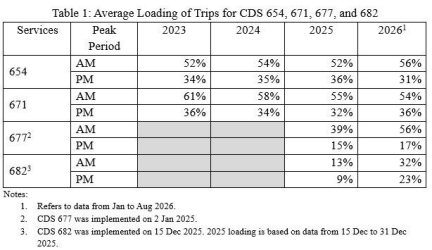
Assoc Prof Jamus Jerome Lim asked the Minister for Transport (a) what was the average peak-period capacity utilisation of City Direct Services 654, 671, 677 and 682 respectively, for each year since 2023, broken down by morning and evening peaks; and (b) whether LTA will consider increasing trips on Sengkang City Direct services to relieve peak-period crowding.
Mr Jeffrey Siow: The average loading of City Direct Services 654, 671, 677, and 682 are in Table 1. There are no plans to increase the number of trips at the moment.
Assessment Of City Direct Service Coverage Gaps In Buangkok And Sengkang, And Considerations Of Additional City Direct Route
Assoc Prof Jamus Jerome Lim asked the Minister for Transport (a) whether LTA has assessed coverage for Buangkok and other parts of Sengkang that are not served by Services 654, 671, 677 or 682; and (b) if so, whether LTA will consider introducing an additional City Direct route to serve these areas.
Mr Jeffrey Siow: City Direct Services provide an alternative travel option for some commuters to the city centre. To ensure that they are well utilised, City Direct Services operate routes with high peak demand and where it is possible to offer competitive travel times to rail; they are not intended to serve all areas.
Mr Chua Kheng Wee Louis
Singapore's Position On Joining WAICO, Implications Of Pax Silica Signatory Status And Asean Consensus On AI Governance Initiatives
Mr Chua Kheng Wee Louis asked the Minister for Digital Development and Information (a) whether Singapore has received an invitation to join the World Artificial Intelligence Cooperation Organisation (WAICO); (b) whether the Government intends to join WAICO; (c) whether Singapore's position as a signatory of the Pax Silica initiative precludes Singapore from joining WAICO; and (d) whether there is an ASEAN consensus on joining WAICO or the Pax Silica initiative.
Mrs Josephine Teo: This question has been addressed in the oral reply to Singapore's position on WAICO and Pax Silica at the 9 September 2026 Parliament Sitting.
Students At Institutes Of Higher Learning Billed For Full Tuition And Other Fees When On Mandatory External Internships And Consideration Of Fee Proration
Mr Chua Kheng Wee Louis asked the Minister for Education (a) whether there are students at autonomous universities and other Institutes of Higher Learning who are billed for full tuition and other compulsory fees during semesters spent on mandatory full-time external internships with no regular coursework; (b) what services do these fees fund during such periods; and (c) whether fee proration will be considered for these periods.
Mr Desmond Lee: Institutes of Higher Learning typically derive the semester fees based on the total cost of the degree or diploma programme nett of subsidies if any, spread evenly over the standard number of semesters required to complete the course. The standard number of semesters includes the duration of mandatory full time internships that form part of the course graduation requirement. As such, there is no need for fee proration while students are on such internships.
Electricity Demand Drawn From Grid Versus On-Site Generation And Proportion Of Green Energy Commitment From Local Renewable Generation Versus Imported Sources For DC-CFA2
Mr Chua Kheng Wee Louis asked the Minister for Trade and Industry (Energy and Industry) regarding data centres awarded under the second Data Centre Call for Application (DC-CFA2) exercise (a) what is the amount of electricity demand to be drawn from the grid versus on-site generation when commissioned, and their share of the total data centre demand; (b) what proportion of their green energy commitment will come from Singapore-based renewable generation, versus imported electricity or market-based instruments; and (c) how will this be verified.
Dr Tan See Leng: The data centres which have been provisionally awarded capacity under the second Data Centre Call for Application (DC-CFA2) exercise will have a combined capacity of 200 megawatts (MW). This will represent around 12 per cent of Singapore’s total data centre capacity. The electricity demand of the data centres will be primarily drawn from the national grid, supplemented by on-site solar. More than half of this capacity will be powered by Singapore-based low-carbon power generation from building‑integrated/building-applied photovoltaics (BIPV/BAPV), and fuels such as biomethane, ammonia and hydrogen. These data centres will be required, as a condition of their capacity support, to report their overall electricity consumption and substantiate the proportion of this electricity consumption that is generated from low-carbon sources to the Infocomm Media Development Authority and the Economic Development Board.
Designating Surface Season Parking Lots For Oversized Commercial Passenger Vehicles Within Hdb Estates And Raising Height Limits For Covered Car Parks
Mr Chua Kheng Wee Louis asked the Minister for National Development (a) whether HDB can consider designating a small number of surface season parking lots within housing estates for oversized commercial passenger vehicles that cannot access multi-storey, sheltered or basement car parks due to height restrictions; and (b) whether HDB can consider raising the height limit for entry into covered car parks.
Mr Chee Hong Tat: The Member may wish to refer to the written reply given by the Ministry of National Development to a related question posed by Assoc Prof Jamus Jerome Lim on 8 January 2025.
Cases Of Migrant Domestic Worker Security Bond Forfeitures Since 2021, Abscondment Cases And Financial Support For Employers Facing Hardship
Mr Chua Kheng Wee Louis asked the Acting Minister for Manpower (a) how many Migrant Domestic Workers (MDWs) security bond forfeiture cases are there annually since 2021; (b) what is the number of cases involving absconding MDWs and the proportion of employers who filed police reports and had their bond fully or partly forfeited despite reasonable efforts to track their MDW; and (c) whether financial support will be considered for employers facing hardship from the unilateral abscondment.
Ms Jasmin Lau: The security bond serves to ensure that employers remain responsible for the upkeep and repatriation of Migrant Domestic Workers (MDWs). From 2021 to 2025, there were a total of 45 cases of Migrant Domestic Worker (MDW) security bond forfeiture, or nine cases per year on average. Of the 45 cases, 15 cases involved MDWs who went missing. For all 15 cases, employers had half of the $5,000 security bond forfeited ($2,500), in recognition that they had made reasonable efforts to locate their MDWs.
The Ministry of Manpower does not have plans to provide financial support employers in fulfilling their security bond liabilities.
Mr Gerald Giam Yean Song
Government And Commercial Data Compromised In LiteLLM Supply Chain Attack And Measures To Prevent Recurrence
Mr Gerald Giam Yean Song asked the Minister for Digital Development and Information (a) what types of data owned by the Government or commercial entities in Singapore were compromised in the AI supply chain attack on LiteLLM; (b) what remedial actions were taken to safeguard any personal and Government data lost; and (c) what is being done to prevent a recurrence.
Mrs Josephine Teo: LiteLLM is widely used open-source AI software. Hackers compromised it by using login details stolen in an earlier breach to add malicious code to software updates.
GovTech used scanning and detection tools to identify the affected Government agencies and informed them quickly. The attack was confirmed to have compromised only one user account, which supported a small number of agencies. The affected agencies changed any login details that might have been exposed and checked their system records for signs of unauthorised activity. There is no evidence that any Government data, including personal data held by the Government, was stolen or compromised.
The Government does not have a complete picture of how the incident affected commercial entities. Each company should check its own systems, fix any problems, and make any required reports. SingCERT has published an advisory on the incident and can provide cybersecurity guidance and help where needed.
Attacks on software supply chains are an ongoing threat. The risks cannot be removed completely. However, the Government will keep reviewing and improving how it prevents, detects, and responds to such attacks, so that similar incidents are less likely and cause less harm.
Guidelines For Condominium Delivery Drop-Off Shelving To Improve Resident Convenience, Minimise Delivery Waiting Time And Avoid Food Waste
Mr Gerald Giam Yean Song asked the Minister for National Development whether the Ministry will issue guidelines under the Building Maintenance and Strata Management Act encouraging Management Corporations Strata Titles to provide delivery drop-off shelving when condominium residents are temporarily unreachable, in order to improve residents' convenience, minimise delivery personnel's waiting time and avoid food waste.
Mr Chee Hong Tat: Under the Building (Strata Management) Act, the Management Corporations Strata Title (MCSTs) are empowered to manage their estates, including making decisions on the provision of amenities such as delivery drop-off shelves. MCSTs can refer to the Last-Mile Delivery Guide for Developments issued by the Land Transport Authority and the Urban Redevelopment Authority on 1 September 2026. This guide is available online and has also been circulated to MCSTs.
Mr Kenneth Tiong Boon Kiat
Distribution Of Student Participation In MP Attachment Programme Across Constituencies Including Opposition Wards, Selection Criteria And Transparency Of Selection Process
Mr Kenneth Tiong Boon Kiat asked the Minister for Education (a) how many students participated in school-organised attachments to Members of Parliament (MPs) at Meet-the-People Sessions, such as the MP Attachment Programme, in each year since 2020; (b) what percentage were attached to MPs in Aljunied GRC, Hougang SMC or Sengkang GRC; (c) who selects the constituency, and on what criteria; and (d) whether the criteria will be published.
Mr Desmond Lee: Some schools may organise learning experiences for specific student groups where students attend Meet-the-People Sessions. The objective is to provide students with age-appropriate exposure to community issues. Such decisions, including the choice of constituency, are made by schools based on their learning objectives and practical considerations.
The Ministry of Education does not track students’ participation in Meet-the People Sessions. Students may also participate in community activities in their own personal capacity.
Offering Computing In Secondary Schools And Providing Institutional Support And Dedicated Curriculum And Pedagogical Resources
Mr Kenneth Tiong Boon Kiat asked the Minister for Education (a) whether Computing can be offered as a core subject in secondary schools; (b) how many secondary schools teach Computing in-house and how many via the centre-based programme; (c) what proportion of the cohort takes Computing; (d) whether Computing can be given its own Curriculum Planning and Development Division post and Master Teacher portfolio; and (e) whether Computing will become a subject before upper secondary.
Mr Desmond Lee: The Ministry of Education (MOE) recognises the importance of developing digital and AI literacies in students. Our approach is to equip all students with foundational digital and AI literacy through existing subjects and programmes such as “Code for Fun” while providing opportunities for interested students to study Computing in greater depth.
At the lower secondary level, our students pick up computational thinking skills through the learning of mathematics. International benchmarking studies have found our students to be strong in computational thinking.
From the 2026 Secondary 3 cohort, upper secondary students can offer G1, G2 and G3 Computing as an elective subject based on their strengths and interests. MOE has no plans to introduce Computing as a standalone subject before upper secondary level.
Students from over 110 secondary schools offer G1, G2 or G3 Computing. These include students from over 40 schools who offer G3 Computing at four centres. Collectively, they make up about 13% of the Secondary 3 cohort.
There are dedicated Computing curriculum officers and a senior specialist in MOE, as well as Senior Teachers and Lead Teachers for Computing.
Ms Eileen Chong Pei Shan
Prescribed Teacher-Child Ratios In Moe Kindergartens And Proportion Of Moe Kindergartens Exceeding Prescribed Ratios In Past Five Years
Ms Eileen Chong Pei Shan asked the Minister for Education (a) what is the prescribed maximum teacher-child ratio in MOE Kindergartens (MKs) at Kindergarten 1 and Kindergarten 2 respectively; (b) whether this is a binding requirement or a guideline; and (c) in each of the past five years, what is the percentage of MKs that had classes which exceeded the prescribed ratio.
Mr Desmond Lee: All the Ministry of Education Kindergartens maintain a teacher-child ratio within 20 children to one teacher for Kindergarten 1, and 25 children to one teacher for Kindergarten 2. This is aligned with sector requirements stipulated by the Early Childhood Development Agency (ECDA).
Mr Low Wu Yang Andre
Projected Annual HDB Housing Demand And Minimum Occupation Period Resale Supply For 2027 To 2040 Informing Gillman Barracks And Maju Forest Development Decisions
Mr Low Wu Yang Andre asked the Minister for National Development (a) whether HDB can share its projected annual housing demand, household formation and Minimum Occupation Period (MOP) resale supply for 2027 to 2040; and (b) how these projections specifically informed decisions to develop Gillman Barracks and Maju Forest.
Mr Chee Hong Tat: This question was addressed in the Ministry of National Development’s reply to the questions asked by Ms Nadia Ahmad Samdin, Mr Kenneth Tiong Boon Kiat, Mr Dennis Tan Lip Fong, and Mr Cai Yinzhou on 8 September 2026.
Land Reclamation Sand Import Sources For Past Five Years, Future Procurement Plans, And Social And Environmental Mitigation Safeguards For Reclamation Projects
Mr Low Wu Yang Andre asked the Minister for National Development (a) in the past five years, which countries has Singapore imported sand from for land reclamation and the quantity from each country, respectively; (b) what countries will sand be imported from for current or planned reclamation projects; and (c) whether public procurers must assess and mitigate social and environmental harms from extraction in source countries.
Mr Chee Hong Tat: This question was addressed in the Ministry of National Development’s reply on 8 September 2026 to the questions by Ms He Ting Ru and Mr Fadli Fawzi.

