Written Answers to WP's Oral Questions
Mr Fadli Fawzi
Remuneration, Allowance Or Benefits Of Grassroots Advisers Who Are Not Elected MPs
Mr Fadli Fawzi asked the Acting Minister for Culture, Community and Youth (a) whether Grassroots Advisers who are not elected Members of Parliament are considered as officers in the Public Service; (b) what kind of remuneration, allowance, or benefit are provided to them; and (c) what kind of information, if any, do they receive that would not ordinarily be shared with the public, in the course of their work.
Mr Edwin Tong Chun Fai: I am answering in my capacity as the Minister charged with the responsibility for the People’s Association (PA). Grassroots Advisers (GRAs) are not officers in the Public Service, and do not receive any remuneration or other allowance or benefit in their role as GRAs. The work and objectives of the People’s Association (which have been discussed in Parliament on previous occasions) will, from time to time, require information and data in order for such work to be carried out effectively. To this extent, GRAs and grassroots organisations (GROs) receive relevant information which will enable them to discharge their functions.
Such information is shared in accordance with relevant legislation and any prevailing public service regulations.
Rationale For Correction Direction Issued On 23 March 2026 For Correction Notice To Be Published In The Straits Times
Mr Fadli Fawzi asked the Minister for Digital Development and Information what were the considerations behind the requirement in the correction direction issued by the Protection from Online Falsehoods and Manipulation Act (POFMA) Office on 23 March 2026 to publish the correction notice in The Straits Times, rather than only on pages and posts carrying the false statements of facts.
Mrs Josephine Teo: Countries worldwide continue to grapple with the persistent challenge of online falsehoods, which can spread quickly. Falsehoods can polarise societies, undermine public trust in institutions, and threaten the foundations of democratic discourse – by attacking the shared factual basis upon which debate can take place.
The Protection from Online Falsehoods and Manipulation Act (POFMA) provides the Government with targeted tools to address online falsehoods. These include directions to publish correction notices on both online and, where necessary, offline channels, to correct falsehoods and inform the public of the facts. In addition, persistent communicators of falsehoods may be designated as Declared Online Locations, with readers cautioned to exercise discretion when accessing such sources for information. These tools address the distinctive challenges that online falsehoods present, namely their potential for rapid proliferation and viral transmission, permanence in digital environments, and tendency for false information to achieve broader circulation than facts. Falsehoods can go beyond digital boundaries and spread through offline discourse – influencing public understanding even among those who have not encountered the original false content online.
In assessing what measures were necessary in the specific case highlighted by the Member, the Government took into account the overall context. The Online Citizen (TOC), which received the Correction Direction issued on 23 March 2026, has a history of publishing falsehoods. Due to this repeated pattern of behaviour of spreading multiple online falsehoods, TOC’s website, Facebook and X pages have also been designated as Declared Online Locations under POFMA on more than one occasion – first in July 2023 and again in July 2025. Despite these measures, TOC has continued to disseminate false and misleading content. Over the past six years, TOC and its affiliated pages have been issued 25 Correction Directions.
To mitigate against the impact and reach of the falsehoods communicated by TOC, it was necessary to supplement the online correction notices with a print correction notice in The Straits Times, so that the facts are made accessible beyond the online audience.
The Government will assess the need for a print correction notice depending on the circumstance of each case, to ensure corrections are effective in reaching the relevant audiences.
Measures To Encourage Prudence Among Borrowers As Household Liabilities Outpaced Asset Growth
Mr Fadli Fawzi asked the Prime Minister and Minister for Finance (a) whether the Government is concerned that household liabilities outpaced asset growth in the fourth quarter of 2025 for the first time since 2019, especially if interest rates are not reduced in an inflationary environment; and (b) whether the Monetary Authority of Singapore will take any action to further encourage prudence among borrowers, and if not, why not.
Mr Gan Kim Yong (for the Prime Minister): Over the full year of 2025, Household Assets grew faster than Household Liabilities. The main reason for the increase in Household Liabilities was the rise in mortgages, alongside the pickup in property transactions for owner occupation in the latter half of 2025. Most of the rest of the increase in liabilities was due to personal loans, including those collateralised by assets, mainly for investments and business purposes.
Singapore's household balance sheets remain fundamentally strong, with Household Net Worth continuing to expand. Household Assets are about nine times the size of liabilities, providing substantial buffers against shocks. Liquid assets such as cash and deposits also continue to exceed total Household Liabilities.
MAS has also put in place safeguards to pre-empt over-borrowing. For example, the Total Debt Servicing Ratio incorporates an interest rate floor to determine loan affordability and guard against excessive leverage taken when interest rates are low. For unsecured consumer credit, MAS imposes minimum income requirements, borrowing limits, and credit suspension for borrowers with persistent debt.
MAS complements these safeguards through public financial education efforts under MoneySense, which promotes prudent money management and discourages over-borrowing. We will monitor developments and review our policies as appropriate.
Mr Dennis Tan Lip Fong
Appointment Of Design And Planning Consultants For Estate Upgrading Programme For Jalan Naung And Realty Park Estate
Mr Dennis Tan Lip Fong asked the Minister for National Development (a) whether the design and planning consultants have been appointed for the Estate Upgrading Programme (EUP) for Jalan Naung and Realty Park Estate following the tender called in 2025; and (b) whether the project remains on track to commence physical works by the middle of 2026.
Mr Chee Hong Tat: The Building and Construction Authority had called a tender in December 2025 to appoint consultants for the design and planning of the project. The tender has not yet been awarded.
We did not announce any plans to commence construction works for the project by the middle of 2026. As stated in MND’s written reply to the Member’s Question on 14 October 2025, the project will commence with the design and planning phase. Construction will begin after the design and planning phase is completed.
New Solutions Deployed To Provide Same-Floor Lift Access In HDB Blocks
Mr Dennis Tan Lip Fong asked the Minister for National Development (a) what new technical or engineering solutions have been successfully deployed in the past three years to provide same-floor lift access for HDB blocks previously deemed unfeasible for the Lift Upgrading Programme; and (b) whether these methods are suitable and cost-effective for use at Blocks 830 to 832 and 835 Hougang Central.
Mr Chee Hong Tat: The Lift Upgrading Programme (LUP) was launched in 2001 to provide direct lift access to flats and enhance convenience for residents. At that time, more than 1,000 out of 5,300 Housing and Development Board (HDB) blocks without lift access were initially assessed to be unfeasible for LUP due to cost or site constraints.
HDB continually monitors new technical and engineering solutions that reduce cost of LUP or overcome site constraints. Where new technologies are found viable, HDB studies each location and implements them at suitable sites. Through such efforts, the vast majority of the 5,300 blocks have benefited from LUP, with about 100 blocks remaining due to high costs or site constraints. These include the four blocks at Hougang Central.
HDB will continue to monitor new technological advancements that could help the remaining blocks without direct lift access. Residents who are in urgent need of direct lift access due to medical conditions or mobility reasons can apply for the Lift Access Housing Grant (LHG) of up to $80,000 to help them buy another flat with direct lift access. These residents can approach HDB for assistance on their LHG application.
Mr Chua Kheng Wee Louis
Number Of Variable Capital Companies In Singapore
Mr Chua Kheng Wee Louis asked the Prime Minister and Minister for Finance since the last review of Variable Capital Companies (VCCs) and their managers conducted by the MAS (a) what is the current number of VCCs in Singapore; (b) how many VCCs currently do not (i) hold any assets and (ii) have any investors; and (c) what is the number of VCCs that have had supervisory interventions or regulatory actions directed.
Mr Gan Kim Yong (for the Prime Minister): As at 1 April 2026, there were 1,338 VCCs managed by licensed fund managers and banks. The use of VCCs, alongside our growing asset management industry, is part of Singapore’s value proposition as a trusted asset management and funds centre.
The Monetary Authority of Singapore (MAS) carries out regular monitoring and review of fund managers as part of its supervision of the fund management industry. This involves reviewing the activities of fund managers, including their regulatory compliance when using the VCC fund structure. Fund managers are required to remediate any observed control weaknesses following such reviews. From time to time, MAS may also publish good practices for wider adoption across the industry.
Last year, 25 VCCs were found to have held no assets without a valid reason. The fund managers of these VCCs have been directed to de-register them.
Terms For Infrastructure Upgrades And Range Of Electrical Capacity In EV Charging Contracts In HDB Car Parks
Mr Chua Kheng Wee Louis asked the Acting Minister for Transport for the initial installations of electric vehicle (EV) chargers in close to 2,000 HDB carparks (a) whether the tenders for EV charger deployment includes electrical infrastructure upgrades; and (b) what is the range of electrical capacity that is available at HDB
carparks today and the corresponding maximum number of chargers that can be installed before further capacity upgrades are required.
Mr Jeffrey Siow: The electrical capacity available varies across carparks. Tenders for electrical infrastructure upgrades are separate from that for the deployment of EV chargers at the Housing and Development Board (HDB) carparks, as they involve different scopes of work and contractors. For example, in May 2025, a tender was awarded to upgrade electrical infrastructure at 300 HDB multi-storey carparks.
The electrical capacity available varies across carparks. HDB carparks can support three to 12 slow charging points today based on typical electricity capacities.
Investigations Of Singapore-Based Companies In 19 March 2026 US Indictment On Unlawful Diversion Of AI Technology To China
Mr Chua Kheng Wee Louis asked the Coordinating Minister for National Security and Minister for Home Affairs (a) whether the US authorities have informed the Government of any involvement by entities or persons in or operating from Singapore in the recent 19 March 2026 US indictment on unlawful diversion of AI technology to China; and (b) whether the Government is investigating any Singapore incorporated company or Singapore based persons for possible breaches of such US export controls.
Mr K Shanmugam: The US has not approached the Singapore Government to share information relating to involvement of Singapore entities or persons in the indictment which the Member is referring to.
Singapore will only investigate and enforce breaches of our own laws. While Singapore does not enforce the laws, including the export controls, of other countries, we expect all companies operating in Singapore to take into account such regulations and other relevant laws when conducting international business activities. We also do not condone businesses deliberately using their association with Singapore to circumvent or violate the export controls of other countries.
Mr Kenneth Tiong Boon Kiat
Unchanged Cap On CPF Balances Earning Additional 1% Interest
Mr Kenneth Tiong Boon Kiat asked the Minister for Manpower (a) why has the $60,000 cap on CPF balances earning the additional 1% interest remained unchanged since 2008 when other major CPF parameters are revised regularly; (b) whether the Ministry will consider pegging growth of this cap to growth of Full Retirement Sum (FRS); and (c) how much interest do CPF members forgo annually because the cap has not tracked FRS growth.
Dr Tan See Leng: The Government pays extra interest on Central Provident Fund (CPF) balances up to a cap to help members boost their retirement savings through compounding interest. Since 2008, 1% extra interest has been paid on the first $60,000 of combined CPF balances. The Government enhanced this in 2016, paying an additional 1% of extra interest on the first $30,000 of CPF balances for all members aged 55 and above. This enables members with lower balances to benefit from a higher effective interest rate on their savings.
The CPF retirement sums, such as the Basic or Full Retirement Sums (BRS or FRS), are set independently based on the amount of savings needed to provide an adequate level of retirement payouts. It is therefore not accurate to link the balance cap to the growth in FRS quanta. As such, there is no interest forgone by CPF members.
The retirement sums guide members on how much to set aside based on their retirement needs. These are complemented by a comprehensive suite of measures implemented by the Government to help Singaporeans build their retirement savings. Over the years, we have introduced the Majulah Package, and enhanced the Silver Support Scheme, Matched Retirement Savings Scheme, and Workfare Income Supplement. In Budget 2026, we have also announced a CPF Top-Up for older Singaporeans who have not met the Basic Retirement Sum.
Extension Of Asset-Conversion Framework For Funding Of SERS Land Acquisitions To VERS
Mr Kenneth Tiong Boon Kiat asked the Minister for National Development (a) whether the asset-conversion framework under which Past Reserves fund Selective En bloc Redevelopment Scheme (SERS) land acquisitions will extend to Voluntary Early Redevelopment Scheme (VERS); (b) since SERS sites are selected for high redevelopment potential whereas VERS sites are selected by age, how the Government satisfies itself that VERS acquisitions are value-neutral rather than net drawdowns; and (c) whether the President's Office has been consulted on this extension.
Mr Chee Hong Tat: VERS is a long-term and complex undertaking. We aim to flesh out as much of the policy framework as possible during this term of Government. For now, it is too early to discuss the funding source and other details, which are part of the policy design.
Arrangements To Ensure Essential Supply Lines To Singapore During Regional Conflicts Or Naval Disruptions
Mr Kenneth Tiong Boon Kiat asked the Acting Minister for Transport in view that the Strait of Hormuz crisis has shown foreign carriers prioritising their home governments’ interests, and that Singapore no longer has a nationally aligned shipping line following the divestment of Neptune Orient Lines in 2016, what arrangements are being put in place to ensure essential supply lines to Singapore are maintained during a regional conflict or naval disruption.
Mr Jeffrey Siow: Singapore secures our essential supply lines through diversifying our sources, maintaining our position as a trusted global hub, and strengthening international partnerships.
Singapore is served by a wide network of global shipping lines calling regularly at the Port of Singapore. Changi Airport is likewise connected to about 170 cities worldwide by a range of airlines. This reduces dependence on any one operator and ensures that alternative shipping options remain available even in times of disruption.
We also work with like-minded partners to keep trade routes open and facilitate the continued flow of essential goods during disruptions through bilateral and multilateral arrangements.
Mr Abdul Muhaimin Abdul Malik
Average Daily Working Hours For Preschool Educators
Mr Abdul Muhaimin Abdul Malik asked the Minister for Social and Family Development (a) what are the average daily working hours for preschool educators since the shift to a five-day work week, compared to the previous six-day model; (b) whether sector engagements have surfaced concerns that a 44-hour weekly cap has resulted in longer daily shifts for educators; and (c) if so, what steps will the Ministry take to address these concerns.
Mr Masagos Zulkifli B M M: The Early Childhood Development Agency (ECDA) consulted key stakeholders extensively when it ceased the provision of Saturday childcare services from January 2025 onwards. ECDA surveyed over 8,000 parents and nearly 800 childcare centres across different operator types, and spoke to about 100 parents, educators, and operators to gather different viewpoints. Stakeholders supported the removal of the requirement for childcare centres to operate on Saturdays as it would greatly improve educators’ wellbeing, avail time for their own family needs, and make a career in the early childhood (EC) sector more attractive and sustainable.
EC educators’ working hours are determined by their employment contracts. After the shift to a five-day work week, some preschool operators have increased daily working hours slightly, in order for educators to perform activities like lesson preparation and classroom set-up, although some others have been able to complete the work within existing daily work hours.
ECDA will continue to pay close attention to the well-being of our educators, while striving to give our children a good start in life. As updated during MSF’s Committee of Supply Debates, ECDA will convene a sector-wide review from the second quarter of 2026 to look at the operating processes and support structures in the sector to better support our educators. This review seeks to strengthen the sector’s long-term manpower resilience by enhancing the overall value proposition of an EC career and improving EC educators’ daily work experience.
Review Of Minimum Staff-To-Child Ratios For Infant Care And Preschool Class Level
Mr Abdul Muhaimin Abdul Malik asked the Minister for Social and Family Development (a) in what year were the current minimum staff-to-child ratios for infant care and each preschool class level last formally reviewed; (b) what was the scope of that review; and (c) whether that review considered the adequacy of ratios for supporting children with developmental needs in inclusive classroom settings.
Mr Masagos Zulkifli B M M: When the Early Childhood Development Centres Act was enacted in 2017, minimum requirements for staff-to-child ratio for preschools were reviewed to ensure the safety and well-being of children. The Early Childhood Development Agency (ECDA) took reference from international jurisdictions and engaged the sector to ensure that preschools’ manpower and staffing considerations adequately catered for the developmental needs of children at different ages.
While the legislated ratios ensure that minimum safety standards are upheld, preschools have the operational flexibility to respond to varied needs and demands. In practice, they can and do operate with more than the minimum staff requirement, in accordance with their programming objectives and manpower.
In particular, to ensure that the ratios are adequate for supporting children with developmental needs in inclusive classroom settings, preschools must seek ECDA’s approval if they wish to enrol children with developmental needs beyond 15% of the preschool’s capacity for such children to ensure sufficient resources to support all children. Preschools can also deploy more staff to support classes with children with developmental needs, or receive support from Early Intervention (EI) professionals.
Drivers Caught Watching Videos Or Using Auto-Scrolling Social Media Applications Whilst Driving
Mr Abdul Muhaimin Abdul Malik asked the Coordinating Minister for National Security and Minister for Home Affairs (a) whether the Ministry collects data on the number of drivers caught watching videos or using auto-scrolling social media applications whilst driving; and (b) if so, whether there has been an increasing trend.
Mr K Shanmugam: The Traffic Police does not track the requested data.
Mr Pritam Singh
Response To Decline In Percentage Of Graduates Securing Full-Time Employment In 2025 Graduate Employment Survey
Mr Pritam Singh asked the Minister for Education (a) how the Government assesses the 2025 Graduate Employment Survey which revealed that 74.4% of graduates secured full-time employment, down from 79.4% in 2024; and (b) what new measures it will introduce or consider in response.
Mr Desmond Lee: This question has been addressed by the Ministry of Education's answer to oral Parliamentary Question Nos 105 and 106 on 7 April 2026.
Town Councils' Community Improvement Projects Accepted For FY2025
Mr Pritam Singh asked the Minister for National Development (a) whether the Ministry has considered or accepted any Community Improvement Projects Committee (CIPC) nominations from any Town Council for FY2025; (b) when will nominations open this year for Town Councils to put up CIPC proposals for consideration; and (c) whether the Ministry intends for Town Councils to combine their FY2025 nominations into their list of FY2026 nominations.
Mr Chee Hong Tat: The Community Improvement Projects Committee (CIPC) is a funding scheme to provide funding support to Town Councils and Citizens’ Consultative Committees for small-scale improvement works in the Housing and Development Board (HDB) estates.
Following requests from several Town Councils to extend the deadline for FY2024 CIPC nominations due to the handing and taking over processes after General Election 2025, the Ministry of National Development (MND) extended the timeline for submission. The FY2024 projects were awarded three months ago, in January 2026.
To allow all Town Councils sufficient time to work on their FY2024 projects, MND has not started the exercise for Town Councils to submit CIPC nominations for the FY2025 and FY2026 cycles. When the nomination process is ready to commence, we will inform the Town Councils and Citizens’ Consultative Committees on the details.
Mr Gerald Giam Yean Song
National Security Assessment Of Proposed Simba-M1 Merger
Mr Gerald Giam Yean Song asked the Minister for Digital Development and Information (a) whether the Government has conducted a national security assessment of the proposed Simba-M1 merger, including the implications of foreign ownership of the merged entity and Simba’s use of Huawei for its 5G infrastructure; and (b) what measures are in place to address any such national security risks from telco operators.
Mrs Josephine Teo: The proposed consolidation is being assessed in accordance with IMDA’s Telecom and Media Competition Code (TMCC). IMDA is conducting a comprehensive review of Simba and M1's commitments to ensure that public interests, including national security considerations, continue to be met and there is no significant lessening of competition. IMDA will make a decision when it has studied these considerations thoroughly.
For national security reasons, we do not disclose which systems are designated as critical information infrastructure. It is clear that our telecommunications infrastructure is critical and our telcos play an important role in safeguarding it by adhering to strict security and resilience requirements.
Average Daily Non-Contact Time For Educators In Preschools
Mr Gerald Giam Yean Song asked the Minister for Social and Family Development (a) whether the Ministry has data on the current average daily non contact time for educators in preschools under the Anchor Operator and Partner Operator schemes; (b) when was the teacher-child ratio last adjusted; (c) whether the Ministry will review the current ratio; and (d) whether the Ministry will consider a tiered staffing model with distinct ratios for early childhood educators and ancillary care assistants.
Mr Masagos Zulkifli B M M: The Early Childhood Development Agency (ECDA) does not have data on the average daily non-contact time for educators in preschools.
When the Early Childhood Development Centres Act was enacted in 2017, minimum requirements for staff-to-child ratio for preschools were reviewed to ensure the safety and well-being of children. These ratios are calibrated based on the programme level of children, type of programme hours, and the qualifications of staff. For example, one qualified early years educator is required for every eight children at the Playgroup level during programme hours. During non-programme hours, or if an additional assistant early years educator is deployed during programme hours, this can increase to 12 children.
Preschools can and do operate with more than the minimum staff requirement to cater to their programming objectives and manpower deployment needs such as staff leave and training. On top of staff-to-child ratios, preschools may also deploy additional non-certified staff to assist certified educators with setting classroom routines, and the daily care and supervision of children.
Assoc Prof Jamus Jerome Lim
Workload With 2% To 9% Salary Increase For Teachers
Assoc Prof Jamus Jerome Lim asked the Minister for Education whether the reported increase in teacher salaries of 2% to 9% will be accompanied by additional duties that may increase the workload of the teaching corps.
Mr Desmond Lee: The Ministry of Education conducts periodic salary reviews to ensure that the overall salary package of teachers remain market competitive. The planned salary revision of 2 to 9 percent is not tied to additional duties.
Average Duration Between Issuance Of HDB Flat Eligibility Letter And Signing Of Lease Agreement
Assoc Prof Jamus Jerome Lim asked the Minister for National Development (a) what is the current average duration between the issuance of an HDB Flat Eligibility (HFE) letter and the signing of the Agreement for Lease; and (b) whether there is scope to update the HFE loan amount to reflect any income changes if the duration exceeds a certain period.
Mr Chee Hong Tat: To help flat buyers with their planning and preparations, the HDB Flat Eligibility (HFE) letter was introduced in May 2023 to give buyers upfront clarity on their eligibility to buy a new or resale flat, as well as the housing grant and the Housing and Development Board (HDB) housing loan amount they may qualify for. Buyers must have a valid HFE letter when they apply for an HDB flat.
In November 2023, HDB extended the validity period of the HFE letter from six to nine months. This strikes a balance between providing flat buyers with greater convenience and ensuring currency of eligibility assessments. For buyers whose HFE letter is expiring within 30 days, they may apply for a fresh HFE letter. Applications with a complete set of documents are mostly processed within seven working days. Until a fresh HFE letter is issued, buyers can still use their existing HFE letter to apply for a flat. We have no plans to extend the validity period further, as a longer validity period comes with a trade-off that the information submitted could become less current.
Buyers who are successful in their new flat application will be invited to book a flat according to their balloted queue number. Even if their HFE letter has expired by then, the HDB housing loan amount they are eligible for remains unchanged. This helps buyers to make informed choices when they apply for their flats. Buyers will then be invited to sign the Agreement for Lease, typically within nine months after flat booking.
Buyers with genuine need to review the HDB housing loan amount they are eligible for can seek HDB’s assistance on a case-by-case basis.
Ms Eileen Chong Pei Shan
Food Wastage And Student Satisfaction Rates In Schools With Central Kitchen Meal Model
Ms Eileen Chong Pei Shan asked the Minister for Education (a) whether the Ministry monitors food wastage rates in schools under the Central Kitchen Meal Model (CKMM), specifically the proportion of bento meals disposed of uneaten; (b) if so, what are the current wastage rates across the 13 CKMM schools; and (c) how do these rates compare to wastage rates in schools still operating under the individual stallholder model.
Ms Eileen Chong Pei Shan asked the Minister for Education with student satisfaction listed as one of four evaluation criteria for the Central Kitchen Meal Model (CKMM) (a) what specific indicators and measurement methods are used to assess student satisfaction with bento meals across the 13 schools; and (b) what satisfaction thresholds must be met for the CKMM to be considered successful.
Mr Desmond Lee: My response will address the questions raised by Dr Charlene Chen and Ms Eileen Chong on food wastage and student satisfaction under the Central Kitchen Meal Model (CKMM).
While traditional canteen stalls provide on-the-spot flexibility for students to select dishes and customise portion sizes and taste, what the students order may not always provide a balanced meal including sufficient vegetables.
When we first rolled out the Central Kitchen Meal Model, we observed food wastage in the initial weeks of implementation. This was particularly noticeable among our younger primary school students. Some children could not finish their meal portions, and others needed time to get used to the new flavours and dishes they have not tried before. As meals are pre-ordered, students were also adjusting to the new system of not being able to choose on the spot.
Since the start of the year, the Ministry of Education (MOE), schools and operators have been listening to the feedback and making improvements. For example, when celery proved unpopular with students, operators switched to broccoli, which has been better received. This is the kind of response we seek, one that maintains nutrition while ensuring children eat what is served.
Regarding menu diversity and options, I would like to address a common misconception. Under the Central Kitchen Meal Model, students actually have more choices than before. Our operators now offer six to 14 different meal options daily, with menus changing weekly or even daily. Compared to the small number of stalls these 13 schools previously had, our students are getting more variety now.
We are not guessing what students like. We regularly gather feedback on flavours and variety, and we track which bento options are most popular. This data helps us fine-tune menus to match student preferences whilst still meeting the Health Promotion Board's nutritional standards. MOE is also working on establishing clear satisfaction benchmarks to guide our operators. At the same time, we recognise that our students’ tastes are wide and varied, and it is not possible to satisfy all tastes and preferences. However, we remain committed to doing our best to provide meals that are both nutritious and appealing.
MOE is committed to continue working closely with schools and operators to improve the Central Kitchen Meal Model implementation. We will also explore other canteen models to complement traditional canteen stallholders. Our goal remains the same, to ensure students continue to have good access nutritious and affordable food that they enjoy eating.
Written Questions
Ms Eileen Chong Pei Shan
Utilisation Rates Of Parent Care Leave By Public Servants From 2023
Ms Eileen Chong Pei Shan asked the Prime Minister and Minister for Finance for each year from 2023 (a) what is the number and percentage of public servants who utilised parent-care leave; and (b) what is the average and median number of days of parent-care leave taken by public servants.
Mr Chan Chun Sing (for the Prime Minister): From 1 January 2025, the Civil Service had broadened its two-day provision of Parent Care Leave (PCL) to Family Care Leave (FCL) to include other immediate family members – such as grandparents, siblings, and grandchildren – in view of additional caregiving demands.
From 2023 to 2025, on average each year, about 42,300 officers or 46% of eligible officers in the Civil Service took at least one day of Parent Care or Family Care leave. The mean and median number of days of corresponding leave taken were 1.74 days and two days respectively.
Employment Reference System Transparency Reform And Worker Rights Verification Processes For Migrant Domestic Workers
Ms Eileen Chong Pei Shan asked the Minister for Manpower regarding the Ministry’s employer feedback system for migrant domestic workers (MDWs) (a) whether MDWs are notified when employer feedback is submitted about them or when such feedback is attached to their employment record; (b) whether MDWs have an independent right to contest such feedback; and (c) whether MDWs can access and view feedback attached to their own employment record.
Ms Eileen Chong Pei Shan asked the Minister for Manpower regarding the Ministry's employer feedback system for migrant domestic workers (MDWs) (a) whether and how the Ministry verifies employer feedback submissions before attaching them to an MDW's employment record; (b) how many such submissions were received in each of the past five years; and (c) of these, how many were attached to an MDW's record.
Dr Tan See Leng: Prospective employers of migrant workers (MWs) and migrant domestic workers (MDWs) may have different concerns and priorities when seeking feedback on a worker’s past performance. As such, the Ministry of Manpower (MOM) does not require employers to submit feedback on their workers directly to MOM. Instead, to support more informed hiring decisions, MOM allows past employers to be a referee for their ex-worker, by providing their contact details for prospective employers to reach out to them. Any feedback that past employers wish to provide is shared between the employers directly.
From 2021 to 2025, the number of instances in which past employers of MDWs offered to act as referees for their ex-workers is as shown in the table. The figures account for less than 2% of MDWs whose work permits expire or are cancelled each year. As MOM has no access to feedback shared by past employers of MDWs, we do not verify the feedback or attach them to an MDW’s employment record.

MWs and MDWs are not notified when their past employer offers to be a referee. This confidentiality allows for employers to share candid feedback, without becoming the subject of speculation as to whether they had shared any negative feedback. MOM has no plans to change the existing referee process.
Mr Chua Kheng Wee Louis
Reintroduction Of Course Fees Relief From 2027 And Alternative Personal Income Tax Reliefs For Skills Upgrading
Mr Chua Kheng Wee Louis asked the Prime Minister and Minister for Finance with Course Fees Relief having lapsed from year of assessment 2026 onwards, whether the Government is considering (i) reintroducing the relief from year of assessment 2027 onwards or (ii) introducing alternative personal income tax reliefs and rebates tied to continuous learning and skills upgrading.
Mr Jeffrey Siow: The Course Fees Relief ended from the Year of Assessment 2026 as the Government has introduced more targeted, direct support for lifelong learning and upskilling. These include course fee subsidies, training allowances, salary support for those undertaking on-the-job training through Career Conversion Programmes, and the SkillsFuture Credit which can be used for out-of-pocket costs on top of course fee subsidies.
Given these support measures, there are no plans to reintroduce the relief or introduce alternative personal income tax reliefs and rebates tied to continuous learning and skills upgrading.
Consideration For Extension Of Hdb Flat Eligibility Letter Validity Period For Unsuccessful Bto Applicant Re Applications
Mr Chua Kheng Wee Louis asked the Minister for National Development whether the Government is considering (i) extending the validity period of the HDB Flat Eligibility (HFE) letter or (ii) introducing an option to extend the validity period to minimise processing time for re-applications by unsuccessful BTO applicants.
Mr Chee Hong Tat: To help flat buyers with their planning and preparations, the Housing and Development Board (HDB) Flat Eligibility (HFE) letter was introduced in May 2023 to give buyers upfront clarity on their eligibility to buy a new or resale flat, as well as the housing grant and HDB housing loan amount they may qualify for. Buyers must have a valid HFE letter when they apply for an HDB flat.
In November 2023, HDB extended the validity period of the HFE letter from six to nine months. This strikes a balance between providing flat buyers with greater convenience and ensuring currency of eligibility assessments. For buyers whose HFE letter is expiring within 30 days, they may apply for a fresh HFE letter. Applications with a complete set of documents are mostly processed within seven working days. Until a fresh HFE letter is issued, buyers can still use their existing HFE letter to apply for a flat. We have no plans to extend the validity period further, as a longer validity period comes with a trade-off that the information submitted could become less current.
Buyers who are successful in their new flat application will be invited to book a flat according to their balloted queue number. Even if their HFE letter has expired by then, the HDB housing loan amount they are eligible for remains unchanged. This helps buyers to make informed choices when they apply for their flats. Buyers will then be invited to sign the Agreement for Lease, typically within nine months after flat booking.
Buyers with genuine need to review the HDB housing loan amount they are eligible for can seek HDB’s assistance on a case-by-case basis.
Mr Abdul Muhaimin Abdul Malik
Complaints Received On Defective Non-Vehicle Consumer Goods Under Consumer Protection Act And Outcomes Of Complaints From 2021 To 2025
Mr Abdul Muhaimin Abdul Malik asked the Deputy Prime Minister and Minister for Trade and Industry for each year from 2021 to 2025, (a) how many complaints concerning defective non-vehicle consumer goods were received by CASE under the Consumer Protection (Fair Trading) Act; (b) how many of these were not resolved in favour of the consumer; and (c) what are the three most common reasons for unsuccessful resolution of such cases.
Mr Gan Kim Yong: From 2021 to 2025, the Consumers Association of Singapore (CASE) received between 156 and 176 complaints annually concerning defective non-vehicle consumer goods. Over two-thirds of these complaints were successfully resolved in favour of the consumer.
Of the remaining one-third, around 26% were not resolved due to parties being unable to reach an amicable resolution or a lack of response from either the business or the consumer. The remaining 7% are recent cases that are still undergoing the negotiation process.
The three most common reasons for unsuccessful resolution are:
i. Disagreement over whether the good was defective or if the damage was due to wear-and-tear or consumer misuse;
ii. Disagreement over the return policy, e.g. whether the good can be refunded instead of being repaired or replaced; and
iii. Partial refunds for the good proposed by the supplier which were deemed insufficient by the consumer.
Public Feedback On SMRT MirrorMoves Community Space At Marina South Pier And Expansion Plans To Other MRT Stations With Lower Ridership
Mr Abdul Muhaimin Abdul Malik asked the Acting Minister for Transport (a) what feedback has the Ministry received from the public regarding the use of SMRT's MirrorMoves space at Marina South Pier MRT station since its launch in January 2026; and (b) whether the Ministry plans to work with SMRT to expand similar community spaces to other MRT stations, particularly those with lower ridership.
Mr Jeffrey Siow: The Ministry of Transport and the Land Transport Authority have not received any feedback from the public on SMRT’s MirrorMoves space at Marina South Pier MRT station. Where it is safe and does not disrupt commuter flow and public transport operations, public transport operators will continue to make spaces available for community activities under their ongoing community engagement and partnership programmes.
Mr Fadli Fawzi
Police Reports And Investigations On Pro-Palestine And Pro-Israel Activities Since October 2023, And Investigations Outcomes
Mr Fadli Fawzi asked the Coordinating Minister for National Security and Minister for Home Affairs (a) how many police reports and investigations have been made in relation to (i) pro-Palestine causes and (ii) pro-Israel causes, since October 2023; and (b) what have been the outcomes of these investigations.
Mr K Shanmugam: Since October 2023, the Police have investigated into eight cases of unlawful public assemblies and processions that were in relation to the Israel Hamas conflict. All of the eight cases were in support of Palestine.
The Police had investigated into these cases because potential offences under the Public Order Act 2009 were disclosed, and not because of the support of Palestine by the defendants.
Among these eight cases, four are currently undergoing Police investigations and one was acquitted by the Court but pending appeal by the Attorney-General’s Chambers. The remaining three cases have concluded with warnings issued by the Police to the persons involved.
Considerations For Permanent Member Appointments To Presidential Council For Minority Rights And Misconduct Removal Procedures
Mr Fadli Fawzi asked the Acting Minister for Culture, Community and Youth (a) what are the considerations for Cabinet when making a recommendation to the President to appoint a person as a permanent member of the Presidential Council for Minority Rights (PCMR); (b) whether there are mechanisms to remove a PCMR member for misconduct or reasons other than those enumerated in Article 72 of the Constitution; and (c) if not, why not.
Mr David Neo: The Presidential Council for Minority Rights (PCMR) consists of a Chairman and not more than 20 members, of which up to 10 members may be permanent members appointed for life. Permanent members are individuals of distinction, chosen from those who hold or have held high offices, including Cabinet Ministers. Non-permanent members are mature citizens who have either rendered distinguished public service or attained eminence in their fields. They may be appointed for a period of three years and are eligible for reappointment.
Under Article 73 of the Constitution, a PCMR member (whether permanent or non-permanent) shall vacate his seat in the PCMR if he ceases to be a Singapore citizen, or resigns, or becomes subject to any of the disqualifications in Article 72. For example, a person who is of unsound mind or an undischarged bankrupt is disqualified from membership of the PCMR. Cases of misconduct that result in a person being convicted of an offence and sentenced to at least one year’s imprisonment or a fine of at least $10,000, would also result in that person’s disqualification for membership of the PCMR.
Mr Kenneth Tiong Boon Kiat
Approval Rates For Egg Freezing Applications Among Women Above Age 37 And Consideration To Remove Age Limit
Mr Kenneth Tiong Boon Kiat asked the Coordinating Minister for Social Policies and Minister for Health (a) how many applications for egg freezing by women above 37 have been received since the age limit was reviewed and how many were approved; (b) what criteria the approving authority uses to assess these applications and whether these criteria are published; and (c) whether the Ministry will consider removing the age limit.
Mr Ong Ye Kung: The Ministry of Health receives about 40 appeals per year from women above 37, which are then assessed on a case-by-case basis. About 70% of them were approved based on individual circumstances.
It is not advisable to remove the age limit completely. The quality of a woman’s eggs declines over time, and egg freezing allows women to freeze their eggs when younger, to improve the chances of pregnancy if used later. We should not remove that signal completely. That said, a successful pregnancy will still depend on many other factors such as the age in which the implantation was conducted and the health of the couple.
IVF Usage Rates Through Eef Programme Since June 2023 And Consideration To Remove Marriage Requirement For Use Of Frozen Eggs
Mr Kenneth Tiong Boon Kiat asked the Coordinating Minister for Social Policies and Minister for Health (a) of the more than 800 women who have frozen their eggs under elective egg freezing (EEF), how many have used them for in-vitro fertilisation (IVF) in Singapore; (b) whether the Ministry tracks Singaporean women undergoing IVF abroad, and if so, what trends have been observed since June 2023; and (c) whether the Ministry will consider removing the marriage requirement for use of frozen eggs in IVF.
Mr Ong Ye Kung: The Ministry of Health does not track the statistics which the Member has asked for. The marriage requirement for IVF is aligned with existing position of the Government based on the social norm in our society, which is that marriage is between a man and a woman, who may decide to bring up children as a family unit.
Ms He Ting Ru
Inclusion Of Gender-Specific Considerations In Guidelines On Parental Consent For Minor Mental Health Services In View Of Higher Rates Of Anxiety And Depression Among Adolescent Girls
Ms He Ting Ru asked the Coordinating Minister for Social Policies and Minister for Health (a) whether the expert group developing guidelines on parental consent for minors accessing mental health services has reviewed or collected evidence on gender differences in adolescents’ help seeking behaviour; and (b) how these guidelines will take into account the higher reported rates of anxiety and depression among adolescent girls.
Mr Ong Ye Kung: The guidelines are intended to guide care professionals in their provision of mental health services to young persons regardless of their gender and mental health symptoms. The guidelines aim to balance timely access to mental health support and ensuring parental involvement, while putting in place safeguards to keep young persons safe.
Data On Parental Consent Cited As Barrier To Accessing Mental Health Services For Vulnerable Minors
Ms He Ting Ru asked the Coordinating Minister for Social Policies and Minister for Health (a) what data the Ministry holds on minors who cited parental consent requirements as a barrier to accessing mental health services in 2024 and 2025; and (b) how this barrier compares across minors from lower-income households, in out-of-home care or from households where family violence has occurred.
Mr Ong Ye Kung: The Ministry of Health (MOH) does not actively track the numbers requested by the Member. Nevertheless, parental consent is a barrier that may hinder minors’ access to mental health services, especially when the parent may be one of the causes of the minor’s mental distress. This is a concern that likely cuts across households of all income levels. MOH is currently developing guidelines to address this issue.
Safeguards To Prevent Disposable Carrier Bag Charges From Becoming Profit-Generating Mechanisms
Ms He Ting Ru asked the Minister for Sustainability and the Environment in relation to the disposable carrier bag charge (a) what is the policy rationale for not ring-fencing proceeds for environmental purposes; (b) whether the Ministry has assessed the risk of such charges becoming profit-generating mechanisms; and (c) if so, what safeguards are in place to prevent this.
Ms Grace Fu Hai Yien: The objective of the disposable carrier bag charge (DCBC) is to nudge consumers to reduce the excessive use of disposable carrier bags. The DCBC has helped supermarket operators achieve a 70 to 80 per cent reduction in the number of bags issued at their supermarket outlets.
Merchants, including supermarket operators, incur costs in providing disposable carrier bags for their customers. Many merchants already charge for such bags on their own accord, either as part of their sustainability initiative or as a commercial decision. To avoid disadvantaging the supermarket operators, the National Environment Agency has decided not to mandate specific uses for proceeds collected through the implementation of the DCBC.
Supermarket operators who are obligated to implement the DCBC are required to publish information annually on the number of disposable carrier bags supplied, amount of proceeds collected, and how the proceeds are used. This ensures transparency and public accountability.
Thus far, the large majority of proceeds collected has been channelled towards environmental or social causes, including initiatives to support lower income families. The proceeds have also allowed some supermarket operators to embark on sustainability projects. The Government will continue to monitor the use of proceeds by the supermarket operators, and encourage them to channel the proceeds to environmental or social causes.
Assessment Studies On Underreporting Of Workplace Injuries And Effectiveness Of Reporting Channels And Whistleblower Protections
Ms He Ting Ru asked the Minister for Manpower (a) whether the Ministry has conducted any studies to assess underreporting of workplace injuries, including against healthcare or insurance records; (b) what assessment has been made of the effectiveness of existing reporting channels and whistleblower protections; and (c) whether further enhancements are being considered.
Dr Tan See Leng: Under the Workplace Safety and Health (WSH) Act and Work Injury Compensation (WIC) Act, employers are required to report workplace injuries to the Ministry of Manpower (MOM). Healthcare records cannot be used to assess the extent of underreporting as doctors are not required to separately maintain records of workplace injuries. Instead, cases of underreporting are detected through our regular checks and investigations into complaints from whistleblowers. The average number of underreporting breaches has been low at about 30 cases annually over the past five
years.
As for comparison against insurance records, the iReport system that is used for reporting workplace injuries is the same reporting channel through which all WIC insurance claims are initiated. This streamlined process facilitates employers’ timely and comprehensive reporting of workplace injuries.
Workers who suspect that a workplace injury has not been reported can submit a report to MOM directly through the iReport system without fear of reprisal. Under the WSH Act, workers are protected against dismissals or threats of dismissal for reporting to MOM.
Where MOM’s investigations uncover workplace injuries that were not reported or reported late, appropriate enforcement actions would be taken against the parties involved, including fines or prosecution. To allow for a more complete oversight of workplace injuries, the reporting requirements were expanded in 2020 to cover all injuries that result in at least one day of sick leave or light duties. To provide a stronger deterrence, the maximum fines for failing to report an injury were also doubled in 2024 to $10,000 for first-time offenders and $20,000 for repeat offenders.
MOM will continue to monitor the reporting trends and tighten our enforcement efforts against underreporting, if required.
Impact Of Traffic Data Distinction Between Local And Foreign Vehicles In LTA’s Calibration Model For ERP Rates
Ms He Ting Ru asked the Acting Minister for Transport (a) whether the traffic volume data used to calibrate ERP rates distinguishes between locally and foreign registered vehicles; and (b) whether LTA's calibration model accounts separately for the proportion of traffic that has no marginal price sensitivity at individual ERP charging points, such as foreign-registered vehicles on flat-rate fees.
Mr Jeffrey Siow: The traffic volume data does not distinguish between local and foreign-registered vehicles.
Currently, when using ERP-priced roads during ERP operational hours, foreign registered vehicles with the In-Vehicle Unit (IU) pay ERP charges while foreign cars without an IU pay a $5 daily flat fee. While we do not consider this split in the determination of ERP rates, in 2024, the proportion of foreign-registered vehicles with IUs versus those paying the flat fee is 4:3.
Mr Dennis Tan Lip Fong
Review Of Early Intervention Programmes For Infants And Children To Include Subsidies For Standalone Therapies
Mr Dennis Tan Lip Fong asked the Minister for Social and Family Development whether the Ministry will review the Early Intervention Programmes for Infants and Children (EIPIC-P) to include subsidies to help parents cover standalone therapies like behavioural and speech therapy for autistic children under 12, ensuring those suspected of having developmental delays can access affordable, consistent intervention while awaiting a formal diagnosis.
Mr Masagos Zulkifli B M M: Before children with developmental needs can be referred to a Government-funded Early Intervention (EI) programme like the Early Intervention Programme for Infants and Children (EIPIC), or EIPIC-P, which is delivered by appointed private providers, they must first be formally assessed by a paediatrician to determine the level of EI support they need. This enables children to be referred to the most appropriate EI programme. Under these programmes, each child under six years old has an Individualised Education Plan (IEP) tailored to his developmental needs and goals. This plan is developed and regularly reviewed by EI professionals in consultation with Allied Health Professionals and families.
Families seeking standalone therapies beyond Government-funded programmes can tap on the Child Development Account to pay for additional EI services registered with the Early Childhood Development Agency.
SPED schools serving students with moderate-to-severe Special Educational Needs (SEN) are resourced with Allied Health Professionals, including occupational therapists, physiotherapists, and speech therapists, who provide students with in school therapeutic support. These professionals work alongside teachers to integrate therapy into daily learning activities, constructing sessions based on students' needs and their IEP. Beyond direct intervention, therapists guide staff on adaptive strategies and assistive technologies, so that therapy goals can align with educational objectives to work toward independence and enable overall development.
When students with sensory and physical impairments join mainstream schools, the Ministry of Education partners agencies such as AWWA and the Singapore Association for the Deaf to provide roving school-based educational support services.
LTA Staff Deployment Pilot Programme For Peak Hour Commuter Etiquette Interventions At Busy MRT Stations
Mr Dennis Tan Lip Fong asked the Acting Minister for Transport beyond passive signage, whether LTA will pilot more active behavioural nudges and station level interventions at busy stations like Hougang MRT station, including deploying on-site staff during peak hours to (i) urge considerate behaviour to other commuters when boarding or alighting and (ii) encourage better commuter etiquette, such as moving to the carriage centre and removing backpacks.
Mr Jeffrey Siow: Public Transport Operators deploy staff during peak hours at the platforms of busier stations to manage crowds and encourage gracious commuting behaviour such as giving way to alighting passengers, and allowing wheelchair users and other passengers who are less mobile to board first.
As announced at the Ministry of Transport’s COS, more prominent priority queues for boarding trains and lifts will be introduced to nudge commuters to give way to those in need. The Public Transport Council and the Land Transport Authority will also continue with their public education efforts, including leveraging the Thoughtful Bunch characters “Move-In Martin” and “Bag-Down Benny” to amplify our messages as part of our broader effort to promote gracious and caring commuter behaviour.
Mr Gerald Giam Yean Song
Industry Skills Council's Involvement In Development Of Current Skills Framework And Practitioner Engagement To Ensure Alignment With Operational Skills
Mr Gerald Giam Yean Song asked the Minister for Education (a) to what extent the Industry Skills Councils, which comprise representatives from employers, sectoral lead agencies, industry associations and unions, have been involved in developing the current Skills Framework; and (b) whether sufficient practitioner engagement is in place to ensure training curricula in all industries are aligned with the required operational skills and responsive to industry needs.
Mr Desmond Lee: SkillsFuture Singapore (SSG) takes a data-driven approach in developing the Skills Frameworks. For example, labour market surveillance data, such as job posting data, is used to analyse skills trends and provide intelligence on in demand and emerging skills. SSG also consulted employers, industry associations, unions, training organisations and Government agencies in refining each Skills Framework. There are currently Skills Frameworks in 38 sectors, which are continually refreshed.
Our Institutes of Higher Learning also work closely with relevant industry partners, to integrate industry exposure into their curricula e.g., through industry projects, work attachments and internships. This ensures that their curricula remain relevant and responsive to industry needs.
Annual Skills Development Fund Disbursements For In House On-The-Job Training Subsidies Over 10 Years And Local Enterprise Support Plans
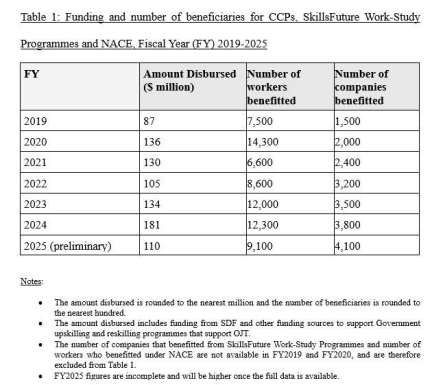
Mr Gerald Giam Yean Song asked the Minister for Manpower (a) in each of the last 10 years, what is (i) the total amount disbursed from the Skills Development Fund to provide subsidies for in-house On-the-Job Training (OJT) and (ii) the total number of workers and companies that benefited; and (b) whether the Ministry has plans to increase OJT funding to address skills gaps and manpower shortages in local enterprises.
Dr Tan See Leng: Since 2019, the Government has spent close to $1 billion from the Skills Development Fund (SDF) and other funding sources to support broad-based training programmes with on-the-job training (OJT) components, such as Career Conversion Programmes (CCPs), SkillsFuture Work-Study Programmes as well as training and consultancy services provided under the National Centre of Excellence for Workplace Learning (NACE). Data prior to 2019 is unavailable. These efforts have benefitted more than 70,000 workers and 20,000 companies. The annual breakdown of funding and number of beneficiaries are provided in Table 1. The Government is prepared to continue expanding support for OJT to meet the training needs of enterprises and help workers develop industry-relevant skills.
Assoc Prof Jamus Jerome Lim
Informal Target Quotas Of And Allocation Of Placement For Singaporeans In Phd Programmes In Autonomous Universities
Assoc Prof Jamus Jerome Lim asked the Minister for Education (a) whether there are informal or target quotas for Singaporeans in PhD programmes in the autonomous universities (AUs); (b) if so, what share of places is allocated to citizens; and (c) if not, whether the Ministry will encourage the AUs to consider such quotas for Singaporeans.
Mr Desmond Lee: Our Autonomous Universities (AUs) aim to attract the best academic minds, both Singaporean and from overseas, to conduct high-quality research and contribute meaningfully to their fields of study and Singapore's research landscape.
At the same time, the Government works with the AUs to develop a strong Singaporean base of academic talent. For example, the Singapore Teaching and Academic Research Talent (START) scheme provides a suite of undergraduate and postgraduate scholarships and awards to Singaporeans keen on pursuing an academic career at the AUs. Singaporean PhD students in the AUs receive the highest level of tuition fee subsidies and stipends to reflect the privileges of citizenship.
Singapore Citizens and Permanent Residents constitute around one-third of the PhD student population at the AUs.
Twinning Programmes Between Autonomous Universities And Chinese Universities For Admission Into Phd Programmes
Assoc Prof Jamus Jerome Lim asked the Minister for Education whether the Ministry will be able to provide any information on (i) official or informal twinning programmes in the autonomous universities (AUs) that allow students from Chinese universities to enter PhD programmes in the AUs after completing their Master’s degrees and (ii) reciprocal arrangements that exist for Singaporeans pursuing PhDs at Chinese universities.
Mr Desmond Lee: The Autonomous Universities (AUs) collaborate with a wide range of international partners in education and research. This allows our AUs and students to benefit from the experiences of reputable universities around the world, while also contributing to knowledge creation in areas of mutual benefit. For example, some AUs have established joint PhD programmes with Chinese universities. These programmes are open to students from both the AUs and Chinese universities, regardless of nationality.
Mr Pritam Singh
Annual Number Of Income-Related Bto Flats And ECS Housing Application Appeals To Ministry From 2020 To 2025
Mr Pritam Singh asked the Minister for National Development for each year from 2020 to 2025, how many appeals has the Ministry received, respectively, from (i) BTO flat applicants whose income exceeded the monthly income ceiling (ii) Executive Condominium applicants whose income exceeded the monthly income ceiling.
Mr Chee Hong Tat: From 2020 to 2025, the number of appeals to waive the income ceiling to buy flats from the Housing and Development Board (HDB) or Executive Condominium (EC) units from property developers were:
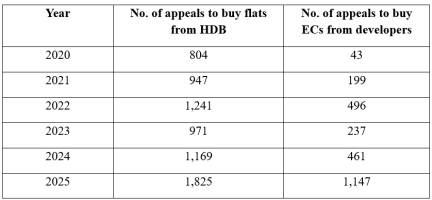
As we mentioned during previous media interviews and the 2026 Committee of Supply debate, the Ministry of National Development and HDB are reviewing the income ceilings.
Annual Median Application Rates By Singles For Purchase Of 2-Room Flexi Flat From HDB For Past Six Years
Mr Pritam Singh asked the Minister for National Development what is the median application rate for singles who seek to purchase a 2-room flexi flat from HDB for each year from 2020 to 2025, respectively.
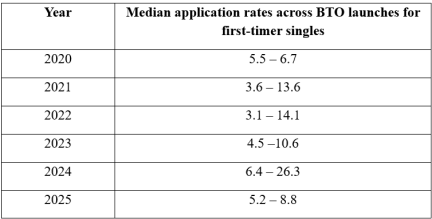
Mr Chee Hong Tat: The median application rates of first timer singles applying for 2-room Flexi flats in Build-To-Order (BTO) exercises conducted from 2020 to 2025 are indicated below.