


Written Answers to WP's Oral Questions
Assoc Prof Jamus Jerome Lim
Inclusion Of Data Of Households In Monthly Income Band Of More Than $20,000
Assoc Prof Jamus Jerome Lim asked the Deputy Prime Minister and Minister for Trade and Industry (a) why the data for current bands for household market income starts at below $1,000 and stops at $20,000; (b) whether the Department of Statistics Singapore will consider expanding the "$20,000 & Over" category into additional bands.
Mr Gan Kim Yong: The income bands for the new household market income series published by the Department of Statistics (DOS) follow that adopted for the earlier household employment income series to facilitate comparison across series.
DOS regularly reviews the household income statistics that it publishes to ensure that they remain relevant and meet user needs. Following a recent review, DOS will be expanding the income bands in its upcoming releases of household income.
Local Employee Headcount, Salary And Seniority Distribution Measurements For Foreign Companies Receiving Tax Incentives
Assoc Prof Jamus Jerome Lim asked the Deputy Prime Minister and Minister for Trade and Industry (a) whether foreign companies receiving tax incentives are required to establish baseline measurements of their Singaporean employee headcount, salary levels and seniority distribution at the point of incentive approval; and (b) what specific numerical targets or percentage increases in Singaporean employment these companies must achieve annually.
Assoc Prof Jamus Jerome Lim asked the Deputy Prime Minister and Minister for Trade and Industry (a) what penalties, including claw-back provisions, are imposed on foreign companies receiving tax incentives that fail to meet their job creation targets for Singaporean employees within the stipulated timeframe; (b) how many have had their tax incentives reduced or terminated in the past five years for failing to meet Singaporean employment commitments; and (c) what is the monetary amount recovered from enforcement actions.
Mr Gan Kim Yong: Like many jurisdictions, Singapore uses a range of grants and tax incentives to compete for investments. These incentives are not automatically granted to all companies looking to invest in Singapore. They are offered judiciously, and only if our economic agencies assess that the incentives are necessary to secure the investment in Singapore and if the companies would generate a net benefit for our economy.
Companies receiving tax incentives are required to achieve specified economic outcomes, such as job creation, local employment, business spending, or fixed asset investment. Specific targets are calibrated and set according to the nature and scope of each project.
The Government has mechanisms to revoke tax incentives and recover benefits from tax-incentivised companies that fail to achieve their commitments, but the vast majority have managed to do so.
Mr Low Wu Yang Andre
Quantum Of Expenditure On Government Contracts With Palantir Technologies Or Subsidiaries
Mr Low Wu Yang Andre asked the Prime Minister and Minister for Finance what is the quantum of expenditure across all Ministries, Statutory Boards, and Organs of State on procurement contracts, software licences or consultancy services provided by Palantir Technologies or its subsidiaries over the past five years.
Ms Indranee Rajah: Over the past five years, the Government has procured $250,000 of software services from Palantir Technologies Singapore Pte. Ltd, a subsidiary of Palantir Technologies Inc.
Data For Number Of Calls To And Full-Time Counsellors Manning National Mindline 1771
Mr Low Wu Yang Andre asked the Coordinating Minister for Social Policies and Minister for Health (a) since inception in June 2025 (i) how many calls have been made to the national mindline 1771 and (ii) how many calls were unanswered; (b) whether there are plans to expand the pool of full-time counsellors manning the national mindline 1771; and (c) how many volunteers have been trained in the pilot launched by national mindline 1771 in late 2025.
Mr Ong Ye Kung: Since the launch of the national mindline 1771 in June 2025, the service has received more than 47,000 calls, messages and webchats. As of December 2025, the dropped-calls rate was approximately 12% but help seekers can access help immediately via WhatsApp messaging and webchat 24/7.
The national mindline 1771 is manned mainly by full-time counsellors and has plans to hire more to meet the demand. The service is also augmented by volunteers. As of December 2025, more than 25 volunteers have been trained and can be deployed when needed.
Mr Chua Kheng Wee Louis
Factors Contributing To Weaker Full-Time Permanent Employment Outcomes In Selected Courses For 2025 Graduates
Mr Chua Kheng Wee Louis asked the Minister for Education in view of the reduction in full-time permanent employment based on the 2025 Graduate Employment Survey (a) whether the Government is considering providing (i) further employment assistance to recent graduates and (ii) in particular, targeted assistance for graduates of degrees with lower full-time permanent employment levels; and (b) if not, why not.
Mr Desmond Lee: My response will address the matters raised in the questions by Dr Wan Rizal and Mr Louis Chua in Question Nos. 105 and 106 in today's Order Paper, as well as a related Parliamentary Question (PQ) by Mr Pritam Singh, which is scheduled for 8 April.
Let me start by acknowledging what the 2025 Joint Autonomous Universities Graduate Employment Survey (JAUGES) shows. I will then explain what we are doing about it.
The survey found that 88.9% of graduates in the labour force secured employment within six months of completing their final examinations, with 74.4% of them in full-time permanent employment.
Both measures have seen a decline since 2023, but I would like to explain the context. The higher employment rates of 2022 and 2023 reflected the post-pandemic hiring surge - a unique period that was always going to moderate. The proportion of graduates who have secured employment in 2025 is closer to the pre-COVID level. The number of job vacancies has moderated since 2022 and 2023, reflecting more cautious hiring sentiments by companies amid significant economic and geopolitical uncertainties. This may, in part, also be driven by developments in how artificial intelligence, or AI, is reshaping how work is done. However, the specific impact of AI on the demand for entry-level jobs remains uncertain at this point and we will continue to monitor the impact with the Ministry of Manpower (MOM) and the sector agencies.
Graduates of the Arts, Design & Media course cluster saw the largest decline in full time permanent employment of 12%-pts compared to 2024. However, when we look at all graduates who had secured employment - including freelance, project based, and contract work - the decline was much smaller at 4.1%-pts. This could reflect how creative industries are evolving, with many professionals choosing self employment or flexible work arrangements that suit the nature of their craft. Between 2024 and 2025, the proportion of graduates in voluntary part-time temporary employment increased by 5.5%-pts. This is not necessarily a step backwards, but we will continue to monitor the changes closely.
I want to speak directly to our fresh graduates and their families who may be feeling anxious about these numbers. Your concerns are important, and we hear you. While the job market has become more selective, opportunities still exist. The fundamentals of our economy remain strong, and Singapore continues to be a hub for innovation and growth across multiple sectors. Looking at the longer-term trend, graduate outcomes have remained broadly stable in the last 10 years, with around 9 in 10 graduates securing employment within six months of graduation.
We are not standing still. Our Institutes of Higher Learning (IHLs) have ramped up their career support systems for graduating students and fresh graduates. They are hosting more career fairs, facilitating more connections with employers, and proactively reaching out and providing personalised career counselling for students who need extra support. Beyond our campuses, fresh graduates can access comprehensive career services through Workforce Singapore, including one-on-one coaching to help match skills with emerging opportunities. We encourage graduates to use these resources to understand how their skillsets can enable them to seize job opportunities, even if these opportunities are not directly related to their area of study.
In Oct 2025, we launched the Graduate Industry Traineeships (GRIT) and GRIT@Gov Programmes. These are temporary measures designed precisely to bridge the gap between graduation and full-time employment amid uncertainties in the economy. They support structured traineeships that provide real industry experience and skills development. We have already extended these programmes to the 2026 graduating cohort, and we are prepared to expand capacity if needed.
We will continue to watch the trends in our graduate employment outcomes closely, and provide more support to our fresh graduates where needed. Our graduates are among the most talented and well-prepared in the world. The current market conditions are temporary, but the quality of our education and the resilience of our graduates are enduring strengths.
Ms Sylvia Lim
Capacity Enhancements At Sengkang HDB Branch Office To Handle Workload With Closure Of Hougang Branch Office
Ms Sylvia Lim asked the Minister for National Development (a) what capacity enhancements has HDB's Sengkang Branch Office made to handle the workload taken over from HDB's Hougang Branch which closed on 1 September 2025; and (b) how are service levels for residents who previously used HDB's Hougang Branch being tracked to ensure they are not prejudiced by its closure.
Mr Chee Hong Tat: The Housing and Development Board (HDB) Hougang Branch was closed on 1 September 2025 to facilitate the development of the mixed commercial and residential site at Hougang Ave 10 and Hougang Central. Prior to its closure, staff from Hougang Branch were redeployed to Sengkang Branch to ensure more appointment slots were available for booking.
To ensure continued service for Hougang residents, HDB has opened a 24-hour e Lobby on 1 September 2025, on the same day the Branch closed. The e-Lobby is located at Block 806 Hougang Central, close to the previous Hougang Branch. It is equipped with self-help machines such as HDB e-Service kiosks for residents to access HDB services and complete transactions. To assist residents with HDB's e Services, HDB has stationed a service ambassador at the e-Lobby until June 2026, and may extend the duration of the service ambassador if necessary.
HDB actively monitors frontline service standards through various service indicators, including waiting time and customer satisfaction scores. The service standards at Sengkang Branch have met HDB’s targets, and are on par with other HDB Branches.
Mr Fadli Fawzi
Difference Between Non-Combat And Prohibited Involvement With Foreign Militaries
Mr Fadli Fawzi asked the Coordinating Minister for National Security and Minister for Home Affairs (a) how were the authorities made aware in 2025 of the blog post which included a hyperlink to a website that redirected users to the website of the Sar-El Volunteer Corps (Singapore); (b) whether the authorities advised the individual to take down the blog, and on what basis; and (c) why were these events not made public immediately.
Mr K Shanmugam: The Ministry of Home Affairs (MHA) and the Ministry of Defence (MINDEF) issued a joint statement on 24 March 2026 pertaining to two individuals (A and B) who had volunteered with Sar-El in December 2016. Members may refer to the joint statement for the facts.
In 2024, the Internal Security Department (ISD) learned about the blog post made by A, which included a hyperlink to his website that in turn redirected users to the Sar-El Volunteer Corps (Singapore) website. For operational reasons, we do not discuss ISD’s methodologies or sources.
At that time, A was based overseas pursuing his undergraduate studies. ISD subsequently engaged A, along with his father B, when A returned to Singapore in 2025. ISD’s investigations concluded that A and B were not involved in any military activities with the Israel Defense Forces (IDF). Nevertheless, ISD advised A and B that A’s blog post was inappropriate in the context of the conflict in Gaza. Following ISD’s engagement, A voluntarily took down the blog post. A and B are no longer involved with Sar-El.
Many such conversations take place with individuals who wish to go to Israel, Gaza, Ukraine, or other conflict zones. We do not make these conversations public, when the individuals comply, and there are no security issues. When the events involving A and B were re-surfaced recently, MHA and MINDEF provided an account of the facts known to Government.
In general, we do not want Singaporean citizens to be involved in foreign militaries. When the conduct is linked with entities which are not strictly speaking military outfits, but the entities are nevertheless associated with foreign militaries, then whether that is objectionable depends on the facts of each case. We have to look at what the entity does, and its relationship with the military.
In A and B’s case, they were not involved in any military activities in 2016 and no action needed to be taken. However, based on what is currently known about Sar El and its activities today in support of the IDF, involvement in the group, as well as other organisations with similar objectives, would not be acceptable and Singaporeans
should not volunteer with Sar-El. We will consider taking action under our laws, including the Internal Security Act, against any person who still plans to or does proceed to volunteer under these circumstances, or who is otherwise involved in activities found to be prejudicial to Singapore’s national security and interests.
Mr Low Wu Yang Andre
Assessing Aggregate Exposure Of Singapore-Domiciled Financial Institutions To US Private Credit
Mr Kenneth Tiong Boon Kiat asked the Prime Minister and Minister for Finance given US private credit defaults reached a record 9.2% in 2025 and the Bank of England, European Central Bank (ECB), and the US Securities and Exchange Commission (SEC) have each initiated supervisory reviews of private credit risk exposure (a) whether MAS has assessed the aggregate exposure of Singapore domiciled financial institutions to US private credit; (b) whether MAS has conducted or plans to conduct equivalent stress tests; and (c) if not, why not.
Mr Gan Kim Yong (for the Prime Minister): Singapore financial institutions have very small exposure to private credit.
The Monetary Authority of Singapore (MAS) regularly monitors the risk exposures of Singapore financial institutions as part of our supervisory oversight. This includes engaging financial institutions on stress testing their balance sheets, which features global financial stress scenarios such as defaults on private credit assets.
Written Questions
Multiple
Comprehensive Energy Policy Response To Geopolitical Crisis Including Conservation, Diversification, Strategic Reserves And Targeted Household Assistance
Ms He Ting Ru asked the Deputy Prime Minister and Minister for Trade and Industry (a) how the messages asking households to conserve energy are tailored for lower income households living in smaller, already energy efficient homes; and (b) what is the assessment on whether asking such households to do more on conservation is realistic given their current baseline consumption.
Mr Chua Kheng Wee Louis asked the Deputy Prime Minister and Minister for Trade and Industry under the joint statement with Australia on energy security on 23 March 2026 (a) whether quantitative targets have been set for the flow of petroleum oils such as diesel and liquefied natural gas (LNG) between Singapore and Australia; and (b) whether LNG supply commitments have been secured from Australia and if so, at what prices.
Ms He Ting Ru asked the Deputy Prime Minister and Minister for Trade and Industry in view of the economic uncertainty due to the war in Iran (a) what are the specific triggers that the Government uses to determine whether to introduce additional support for lower and middle-income families; and (b) how does the Government assess whether the level of support given to families are adequate.
Ms He Ting Ru asked the Deputy Prime Minister and Minister for Trade and Industry (a) what progress has been made in diversifying Singapore’s sources of energy, food, and other critical imports in light of the Iran war; and (b) whether any further stockpiling or diversification measures are being considered.
Assoc Prof Jamus Jerome Lim asked the Deputy Prime Minister and Minister for Trade and Industry in light of developments in the Strait of Hormuz (a) whether the Ministry expects rising gas prices to be passed through to electricity prices in Singapore; (b) what range of price increases is anticipated; (c) whether financial support will be provided to households not receiving U-Save rebates; and (d) what gas price levels will trigger such support.
Mr Pritam Singh asked the Deputy Prime Minister and Minister for Trade and Industry (a) how does the Singapore-Australia Comprehensive Strategic Partnership 2.0 enhance Singapore's energy security against high energy prices; and (b) under the Partnership, what specific measures have been implemented to compensate for the disruption of LNG supplies from Qatar to Singapore.
Mr Gan Kim Yong: These questions were addressed by the Deputy Prime Minister and Minister for Trade and Industry, the Acting Minister for Transport and Senior Minister of State for Finance, and the Coordinating Minister for National Security and Minister for Home Affairs, in their Ministerial Statements on the Impact of the Middle East Situation on Singapore at the Parliamentary Sitting on 7 April 2026.
Ms He Ting Ru
Outcomes Of Archival Documentation Declassification Requests In Past 10 Years
Ms He Ting Ru asked the Minister for Digital Development and Information for each of the last 10 years, (a) how many requests for archival document declassification were made annually; (b) how many were approved; and (c) what were there top five reasons for rejection.
Mrs Josephine Teo: As the custodian of Government records of national or historical significance, the National Archives of Singapore (NAS) works with Government agencies to facilitate access to Government records that have been transferred to the NAS.
The Member may wish to refer to a Parliamentary Question by Mr Leong Mun Wai at the sitting on 1 March 2023, where he asked about requests to view Government records yet to be declassified. In my response, I shared that Government agencies had reviewed more than 5,000 Government records in response to 2,130 requests by members of the public between 2016 and 2022.
Between 2023 and 2025, more than 4,000 Government records were reviewed by Government agencies in response to 2,361 new requests by members of the public. In total, 72% of the Government records reviewed between 2016 and 2025 have been approved for access. The main reasons for rejection were national security, confidentiality obligations and personal privacy. Today, over 74,000 Government records have been declassified and are available for access.
From time to time, the Government may also release documents even if they have not been requested. We do this so the record of some key milestones in our history can be as full as possible. The recently released Albatross File is one example. Next year, NAS will also be releasing Mr Lee Kuan Yew’s Oral History.
Salary Arrangements For Political Office Holders Seconded To Ntuc In Last 10 Years
Ms He Ting Ru asked the Prime Minister and Minister for Finance in relation to political office holders (POHs) seconded to the National Trades Union Congress (NTUC) (a) what is the average percentage of wages borne by the Government relative to NTUC in the last 10 years; and (b) for each of the last 10 years, what was the total dollar amount borne by the Government for salaries of all POHs seconded to NTUC.
Mr Chan Chun Sing (for the Prime Minister): Political office holders (POHs) are seconded to the National Trades Union Congress (NTUC) to reinforce the Government’s longstanding partnership with the labour unions and facilitate collaboration with the unions in shaping policies that address workers’ concerns in Singapore.
In general, the Government and NTUC will co-fund portions of the POHs’ salary. This cost-sharing arrangement is intended to ensure that both organisations have a mutual stake and shared responsibility for the outcomes of the secondment. In the last 10 years, the Government has generally funded about 50% of the fixed component of the salaries, which include the basic monthly and 13th month components.
Regardless, POHs who are seconded to NTUC receive only one pay package as an appointment holder, and the current annual package of all POHs is as set out in the 2012 White Paper on Salaries for a Capable and Committed Government. The budgeted expenditure on manpower for POHs in each ministry is published in the budget book annually.
Mr Gerald Giam Yean Song
Effectiveness Of SwimSafer Programme In Developing Essential Swimming And Water Survival Skills For All Students
Mr Gerald Giam Yean Song asked the Minister for Education (a) what is the target percentage of students expected to achieve SwimSafer Stage 1, 2 and 3 proficiency levels respectively by the end of Primary 3; (b) whether the Ministry tracks the proficiency levels of students beyond the compulsory Primary 3 programme; and (c) how does the Ministry ensure that students who remain non swimmers after Primary 3 attain basic water survival skills.
Mr Desmond Lee: The SwimSafer 2.0 programme is the national water safety programme offered to students as part of the Physical Education (PE) curriculum. Primary schools typically offer it at the Primary 3 level.
Most students take up Stage 1 lessons as part of the school PE programme, while those who have already attained basic proficiency take up lessons at a higher level. Beyond the school programme, students may also choose to continue their learning through SwimSafer 2.0 or other aquatic programmes under the broader SwimSingapore framework.
The Ministry does not set a target percentage of students achieving the different stages of proficiency or track the proficiency levels of students beyond the school programme. Students who do not meet the requirements of the Ministry of Education SwimSafer 2.0 Stage 1 programme in schools may attend a fully funded remediation programme with SportSG.
Secondment Of Singaporean Public Officers To ASEAN Secretariat In Past Five Years And Plans To Increase Secondments Before, During And After Chairmanship
Mr Gerald Giam Yean Song asked the Minister for Foreign Affairs (a) how many Singaporean public officers have been seconded to the ASEAN Secretariat in each of the last five years; (b) what roles have they been working in; and (c) whether there are plans to increase the number of Singaporean secondments at the Secretariat before, during and after Singapore's ASEAN Chairmanship in 2027.
Dr Vivian Balakrishnan: Most of the positions in the ASEAN Secretariat are filled via open recruitment. ASEAN Member States can nominate officers to fill leadership positions. These are the ASEAN Secretary-General, which is appointed by ASEAN Member States on a rotational basis, and the four Deputy Secretaries-General (DSGs), which are similarly appointed or openly recruited based on merit, depending
on the specific position. Singaporean public sector officers who fill such leadership positions would be considered secondees from the Government. Over the last five years, there has been one such secondee, Mr Satvinder Singh, whom Singapore successfully nominated as the DSG for the ASEAN Economic Community for two consecutive terms through an open and competitive recruitment process. It will be Singapore’s turn to appoint the DSG for ASEAN Socio-Cultural Community in 2027.
Beyond leadership positions, the Ministry of Foreign Affairs is exploring additional secondment opportunities for our officers and public officers from other Ministries to the ASEAN Secretariat in the lead-up to, during, and beyond Singapore’s ASEAN Chairmanship in 2027. Such secondments allow us to broaden our experience and knowledge base of international diplomacy and ASEAN tradecraft more widely across the Public Service.
Mr Abdul Muhaimin Abdul Malik
School-Based Support And Intervention Strategies For Students With Chronic Absenteeism And Academic Decline Linked To Excessive Gaming
Mr Abdul Muhaimin Abdul Malik asked the Minister for Education (a) how the schools identify students with gaming concerns; and (b) how the schools support students whose chronic absenteeism or academic decline is found to be linked to excessive gaming or screen use.
Mr Desmond Lee: The Ministry of Education’s Cyber Wellness lessons emphasise the importance of maintaining a healthy balance of online and offline activities. This includes helping students recognise the signs of excessive gaming, the risks involved as well as ways to manage time spent on gaming.
Schools use a number of early indicators to identify students with gaming concerns. Besides referrals from teachers and peers, schools also regularly monitor their students’ well-being, such as through termly check-in sessions to identify those requiring support.
To support students with attendance or academic issues arising from gaming, School Counsellors and Student Welfare Officers will intervene to address the underlying issues.
Parents play a key role in guiding and monitoring their child’s online activities. Schools work closely with parents by sharing resources, expert insights and strategies to help them guide their child in the use of technology and devices.
When additional support is needed, schools work with parents to refer students to Social Service Agencies for early intervention or to the National Addiction Management Service under the Institute of Mental Health for specialised treatment. Community partners like TOUCH Community Services also provide counselling and intervention programmes for affected students.
Consumer Payment Protection Through Legislation Of Mandatory Cash Acceptance During Digital Banking Service Failures
Mr Abdul Muhaimin Abdul Malik asked the Prime Minister and Minister for Finance (a) whether there is a timeline for Government to decide on making cash acceptance mandatory by law to ensure that consumers are not left without payment options when digital banking services fail; and (b) if so, what is the timeline.
Mr Gan Kim Yong (for the Prime Minister) : I refer the Member to Minister Chee Hong Tat’s reply to Mr Louis Chua’s Committee of Supply cut1 on 26 February 2026. [Please refer to “Mandating Acceptance of Cash”, Official Report, 26 February 2026, Vol 96, Issue 20, Oral Answers to Questions.]
Note(s) to Question No(s) 90:
1 https://sprs.parl.gov.sg/search/#/fullreport?sittingdate=26-02-2026
Ms Eileen Chong Pei Shan
Assessing Effectiveness Of Foreign Policy Public Education Efforts In Understanding Singapore's Strategic Interests
Ms Eileen Chong Pei Shan asked the Minister for Foreign Affairs (a) what specific outcome metrics does the Ministry use to assess whether its foreign policy public education engagements have improved participants' understanding of Singapore's strategic interests; (b) whether any longitudinal tracking of comprehension or attitude change has been conducted; and (c) if not, whether the Ministry intends to establish such metrics.
Dr Vivian Balakrishnan: The Government has stepped up public engagement to explain our foreign policy fundamentals and responses to key international developments to Singaporeans and to hear their views. We do this through dialogue sessions across segments of society, including students, youths, businesses and community leaders. We collect post-engagement feedback to ensure our content remains current and relevant, and to improve our engagement methods. Responses from the public engagement sessions have been positive, with an overwhelming majority of participants indicating that the sessions enhanced their understanding of Singapore’s foreign policy.
Career Conversion Programme Employment Bond Requirements, Bond Termination And Participant Numbers For Past Five Years
Ms Eileen Chong Pei Shan asked the Minister for Manpower regarding Career Conversion Programmes (CCP) over the past five years (a) what proportion of CCP programmes require employment bonds; (b) how many participants were subject to such bonds; and (c) what is the breakdown of bond requirements by sector or programme type.
Ms Eileen Chong Pei Shan asked the Minister for Manpower regarding Career Conversion Programmes with employment bonds over the past five years (a) how many participants terminated their bonds during (i) the training period and (ii) service at the sponsoring organisation; (b) what is the average bond termination cost; and (c) breakdown of reasons for bond termination.
Dr Tan See Leng: Workforce Singapore (WSG) does not impose employment bond requirements on Career Conversion Programme (CCP) participants.
Criteria For Immediate Mid-Tenure Licence Shortening And Median Time Taken Between Investigation And Issuance Of Corresponding Enforcement Actions In Past Three Years
Ms Eileen Chong Pei Shan asked the Minister for Social and Family Development in respect of the Early Childhood Development Agency's (ECDA) licensing of preschools (a) what criteria determine whether a safety violation triggers immediate mid-tenure licence shortening as opposed to other enforcement measures; and (b) for each of the past three years, what was the median time elapsed between determination of a safety violation and the issuance of any corresponding enforcement action.
Mr Masagos Zulkifli B M M: To determine the appropriate enforcement action to take when a breach has occurred, the Early Childhood Development Agency (ECDA) comprehensively reviews all relevant factors, including the severity of the breach, whether the breaches were systemic in nature, and whether there were any aggravating or mitigating factors. ECDA will then determine the penalties to be meted out, which can range from financial penalties, shortening or revocation of the preschool’s license. Depending on the complexity and nature of the case in the question, the time taken for ECDA to investigate and impose any enforcement action also tends to vary.
Breakdown Of Scholarship Recipients By Country Of Study Over Past Decade And Minimum Annual Targets For Non English-Speaking Countries
Ms Eileen Chong Pei Shan asked the Prime Minister and Minister for Finance regarding the various scholarship schemes offered by Government agencies over the past decade (a) what is the annual breakdown by country of study for scholarship recipients; and (b) whether there are minimum annual targets for scholars to study in non-English speaking countries and/or regions.
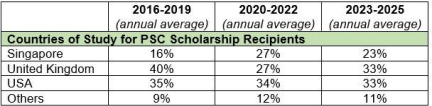
Mr Chan Chun Sing (for the Prime Minister): The breakdown by country of study for the Public Service Commission (PSC) scholarship recipients in the last decade since 2016 is in the following table:
66
Taking into account all Government scholarships (including PSC) over the last three years (i.e. 2023-2025), on an annual average basis, 49% of the recipients studied at our local Autonomous Universities, 30% in the United Kingdom, 15% in the United States of America and 6% in other countries.
PSC does not set annual targets for scholarship awards by country, as the numbers are dynamic and depend on the assessment of the scholarship recipients’ aptitude, the courses offered by various countries, and scholarship recipients’ areas of interest and course of studies. Scholarship recipients studying locally are also encouraged to participate in overseas exchanges and internships/work attachments, and to pursue their postgraduate studies in a different country. Overall, we aim for a diversified portfolio over the mid to long term, with our scholarship recipients bringing back a diversity of perspectives and connections from the various countries they go to.
Ms Sylvia Lim
Retention Of Face-To-Face Services At Neighbourhood Police Centres And Inclusive Accessibility Of Online Police Services For Elderly And Non-English Speakers
Ms Sylvia Lim asked the Coordinating Minister for National Security and Minister for Home Affairs (a) what thresholds or benchmark considerations does the Ministry apply when determining if the concentration of the elderly population in geographic areas necessitates the retention of face-to-face services at Neighbourhood Police Centres; and (b) how does the Ministry track the accessibility of online Police services to the elderly and non-English speaking population.
Mr K Shanmugam: Decisions on the deployment of unmanned Neighbourhood Police Centres (NPCs) or Neighbourhood Police Posts (NPPs) take into consideration multiple factors such as the Police’s operational needs and infrastructure plans. These deployments are necessary to allow the Police to focus their limited resources on their crime-fighting mandate, without affecting police presence or incident response.
Tracking the accessibility of online police services to the elderly and non-English speaking population is challenging because tracking indictors cannot easily differentiate between assisted and unassisted access. That said, Police engage these communities through various channels and are sensitive to their need to access essential policing services.
While more than 70% of all Police reports are already lodged through self-help options, those who require face-to-face assistance can be assisted at any of the 33 NPCs and 64 NPPs islandwide. Those who visit unmanned NPCs or NPPs can still speak with a Police officer through video-call if necessary, who can help guide the member of public through the process. The officer can also remotely lodge a police report on behalf of the individual.
ASEAN Extradition Treaty Ratification Status And Singapore's Preparatory Steps For Implementation Of Ratification
Ms Sylvia Lim asked the Minister for Law (a) how many ASEAN Member States have ratified the ASEAN Treaty on Extradition signed in November 2025; (b) what are the preparatory steps Singapore needs to undertake before being able to ratify the Treaty; and (c) whether there is an agreed timeframe within which the Treaty is to be brought into effect.
Mr Edwin Tong Chun Fai: The ASEAN Extradition Treaty was adopted on 14 November 2025. No ASEAN Member State has ratified the Treaty to date, and there is no agreed timeframe among ASEAN Member States on when to bring the Treaty into force.
To be able to ratify the ASEAN Treaty on Extradition, Singapore must update the Extradition Act notifications to extend its application to the ASEAN Treaty on Extradition, upon the entry into force of the Treaty.
Mr Low Wu Yang Andre
Independent Audits And Verification Of Algorithms Used In Third-Party Predictive Analytics Or Data-Fusion Software Utilised By Government Security Agencies
Mr Low Wu Yang Andre asked the Coordinating Minister for National Security and Minister for Home Affairs (a) whether Government security agencies that use third-party predictive analytics or data-fusion software conduct independent audits of the underlying algorithms; and (b) whether the Government is satisfied that it can independently verify the methodology of such software before relying on it for operational decisions.
Mr K Shanmugam: The Ministry of Home Affairs (MHA) has an AI governance framework on the development and use of AI tools. All predictive analytics and data fusion software, including underlying algorithms from third-party vendors, are evaluated on this framework. Risk assessment and mitigation measures are applied to manage risks in use cases as well. Independent assessments and audits are performed before and after deployment of the AI application to ensure compliance.
Study Of Affordability Levels In Punggol For Autonomous Vehicle Trial Pricing
Mr Low Wu Yang Andre asked the Acting Minister for Transport with regard to the $4 per ride fare for the autonomous vehicle trials in Punggol (a) how did the Ministry arrive at the $4 fare; (b) whether the Ministry has studied the affordability levels for the population in Punggol; and (c) if so, what percentage of the target ridership will find this fare affordable.
Mr Jeffrey Siow: The starting fares of the Punggol autonomous shuttles in this pilot phase were determined by the operators in consultation with the Ministry of Transport/Land Transport Authority. We expect the fares to be adjusted over time depending on ridership demand.
Mr Pritam Singh
Work-From-Home Contingency Plans For Businesses And Companies Amid Rising Global Energy Costs
Mr Pritam Singh asked the Minister for Manpower arising from the spike in global energy prices, whether the Government plans to direct businesses and companies in Singapore to review work-from-home contingency plans.
Dr Tan See Leng: The Government will elaborate on the fuel situation in the Ministerial Statements on 7 April 2026. We currently do not have plans to direct businesses and companies to review work-from-home requirements.
Mr Dennis Tan Lip Fong
Singapore's Comprehensive Response To US Section 301 Investigations On Overcapacity And Forced Labour
Mr Dennis Tan Lip Fong asked the Deputy Prime Minister and Minister for Trade and Industry (a) whether the Government will be represented at the upcoming public hearings for the United States Trade Representative’s investigations into overcapacity and forced labour under section 301 of the Trade Act of 1974; (b) whether any Singapore companies will be attending these hearings, and if so, what guidance is provided to such companies for the 15 April 2026 submission deadline.
Mr Dennis Tan Lip Fong asked the Deputy Prime Minister and Minister for Trade and Industry following the initiation of investigation into forced labour by the Office of the United States Trade Representative under section 301 of the Trade Act of 1974 on 12 March 2026, what specific steps the Ministry is taking to demonstrate the adequacy of Singapore's existing legal frameworks for prohibiting the importation
of goods produced with forced labour.
Mr Gan Kim Yong: These questions are addressed by the reply to Questions 64 to 69 for oral answers during the 7 April 2026 Parliament sitting.
Assoc Prof Jamus Jerome Lim
Effectiveness Of Tax Incentives Provided To Foreign Companies On Job Creation And Wage Enhancement In Past Five Years
Assoc Prof Jamus Jerome Lim asked the Deputy Prime Minister and Minister for Trade and Industry (a) what is the quantum of tax incentives provided to foreign companies in the past five years; (b) what methodology is used to calculate return on investment of the incentives with regard to job creation and wage enhancement; (c) what is the cost per Singaporean job created through tax incentives versus other schemes; and (d) whether cost effectiveness reviews are performed on alternative approaches.
Mr Gan Kim Yong: The value of incentives awarded is a fraction of the projected total value of the investment, and incentive recipients are required to achieve economic outcomes, such as job creation, local employment, business spending, or fixed asset investment. For example, the Economic Development Board’s investment commitments in 2025 are expected to create 15,700 new jobs when realised over the next five years, with about two-thirds paying a gross monthly wage above $5,000. Majority of these jobs are expected to go to locals.
The Government adopts a multi-pronged approach to create good jobs for Singaporeans. In addition to incentives to anchor foreign investments, we have various enterprise development grants to support local companies to transform, grow their business, and move into higher-value activities. When companies become more productive and competitive, they will be better able to create quality jobs and pay higher wages.
Mr Kenneth Tiong Boon Kiat
GLCs' R&D Contributions And Activities Under RIE2025/RIE2030 And Assessment Of Singapore’s National Innovation Performance
Mr Kenneth Tiong Boon Kiat asked the Deputy Prime Minister and Minister for Trade and Industry (a) what proportion of Business Expenditure on R&D (BERD) is attributable to Government-linked companies (GLCs); (b) whether any GLCs currently undertake significant R&D activities aligned with strategic domains identified under RIE2025 or RIE2030; (c) what is the Government's assessment of the implications for Singapore's innovation output when large domestic enterprises account for a relatively small share of national R&D activity.
Mr Gan Kim Yong: The R&D capacity of our firms has increased significantly over the years, with BERD growing by a CAGR of 7.8% from 2016 to 2023, reaching $9 billion. Within the same period, the BERD from local enterprises, including Government-linked Companies (GLCs), grew to $1.7 billion, contributing to about 20% of total BERD.
GLCs have undertaken R&D investments and innovation activities that are aligned with the RIE Domains. They are in line with Singapore’s decarbonisation goals, artificial intelligence (AI) push, and advanced manufacturing priorities. For example, ST Engineering will intensify its AI R&D efforts through its Artificial Intelligence Centre of Excellence (AI CoE) to scale up its core of AI-ready modules and solutions. With the AI CoE in Singapore, ST Engineering aims to grow its existing AI talent pool from 2,000 to 5,000 over the next five years, creating new high-value jobs for Singaporeans. Industry R&D collaborations in strategic areas such as healthcare and semiconductors are also fostered by our Research Institutes and National Platforms like Diagnostics Development Hub (DxD Hub) and National Semiconductor Translation and Innovation Centre (NSTIC).
We welcome innovation activities from both local and foreign enterprises as they lead to the creation of good jobs and strengthen Singapore’s competitiveness in technologically intensive sectors. Between 2016 and 2023, R&D jobs in the private sector grew by 36%, reaching more than 30,000, with locals filling more than 70% of these roles. Today, Singapore is the 6th largest exporter of high-tech goods globally according to the World Bank Group. We will continue supporting the innovation journey of local enterprises, including GLCs.
Quantum Research Coordination Between A*Star And NUS And Combined Annual Funding
Mr Kenneth Tiong Boon Kiat asked the Prime Minister and Minister for Finance in view that both A*STAR's Quantum Innovation Centre and the Centre for Quantum Technologies (CQT) at NUS claim alignment with the National Quantum Strategy, which designated CQT as the national flagship centre (a) what specific capabilities does the Quantum Innovation Centre provide that CQT does not; (b) what is their combined annual funding; and (c) what mechanisms prevent duplication between them.
Mr Gan Kim Yong (for the Prime Minister): The National Quantum Strategy (NQS) sets out the strategic framework to enable Singapore to strengthen its position as a leading hub in the development and deployment of quantum technologies, including through building our national quantum capabilities.
Under the NQS, the Centre for Quantum Technology (CQT) was designated as a flagship national research centre to coordinate research talent nationally and support investigator-led research and capability-building training schemes. These research efforts are carried out in a coordinated manner through a network of nodes in the universities and the Agency for Science, Technology and Research (A*STAR). A*STAR’s Quantum Innovation Centre (Q.InC) develops next-generation quantum technologies in strategic research pillars, such as quantum sensing and materials, with its researchers jointly appointed with CQT, and their research agendas coordinated by the CQT Director to ensure alignment and synergy with the broader CQT research programme.
In Research, Innovation and Enterprise 2025 (RIE2025), $295 million was set aside to fund quantum research efforts under the NQS, with implementation overseen by the National Quantum Steering Committee.
Mr Fadli Fawzi
Retention Rate Of Permanent Residents In Global Investor Programme Over Past 10 Years
Mr Fadli Fawzi asked the Deputy Prime Minister and Minister for Trade and Industry over the past 10 years (a) what is the retention rate of Permanent Residents admitted under the Global Investor Programme (GIP); (b) how many GIP Permanent Residents had their re-entry permits not renewed due to failure to meet the requisite business milestones; and (c) how many GIP Permanent Residents have subsequently applied for and been granted Singapore citizenship.
Mr Gan Kim Yong: The Global Investor Programme (GIP) accords Permanent Resident (PR) status to eligible global investors who make significant investments to drive business growth in Singapore.
From 2016 to 2025, around 85% of the individuals accorded permanent residency through the GIP remained a PR as of 31 December 2025. Fewer than 25 individuals did not have their re-entry permits renewed as they did not meet the prevailing criteria such as economic contribution and length of residency. Fewer than 20 individuals were granted Singapore citizenship.
Pre-Emptive Adjustments In Monetary Policy To Curb Energy Cost-Driven Inflation
Mr Fadli Fawzi asked the Prime Minister and Minister for Finance whether the MAS has any plans to make pre-emptive adjustments in its monetary policy to curb inflation driven by higher energy costs.
Mr Gan Kim Yong (for the Prime Minister): The Monetary Authority of Singapore is currently assessing its monetary policy stance and will release its upcoming Monetary Policy Statement next week as scheduled, on 14 April 2026. The inflation outlook for 2026 will be updated.
Mr Chua Kheng Wee Louis
Data On Appeals From Car Buyers Affected By Recent PARF Rebate Cuts And Transitional Support Offered To Affected Buyers
Mr Chua Kheng Wee Louis asked the Acting Minister for Transport (a) what is the number of appeals received from car buyers with committed purchases that are estimated to be affected by the recent Preferential Additional Registration Fee (PARF) rebate cuts; and (b) whether the Ministry is considering a transitional provision to support affected buyers.
Mr Jeffrey Siow: The recent changes to the Preferential Additional Registration Fee (PARF) rebate were implemented with immediate effect to avoid distorting the Certificate of Entitlement (COE) market. This is in line with our general approach on market sensitive tax changes and was the same approach taken in 2023 when the PARF rebate cap was implemented and the Additional Registration Fee (ARF) was raised.
Fewer than 2,000 car buyers with committed purchases are estimated to be affected. We have received under 30 appeals from car buyers with committed purchases who might be affected by the PARF changes.
The purchase of a car is a commercial arrangement between the dealer and buyer. We understand some dealers have already

