


Written Answers to WP's Oral Questions
Mr Fadli Fawzi
Regulating Fees Charged By Driving Centres
Mr Fadli Fawzi asked the Coordinating Minister for National Security and Minister for Home Affairs (a) whether the fees to learn to drive, such as enrolment and theory lesson fees, are regulated by Traffic Police or any other Government agency and (b) if not, whether the Ministry has conducted any assessment to determine if the recent increase in fees by the three driving centres represents anti competitive behaviour; and (c) whether the Government will take any action to manage costs of learning to drive.
Mr K Shanmugam: Driving schools are required under the Road Traffic Act to charge fees for instruction that the Traffic Police (TP) considers fair and reasonable. Such fees include enrolment, theory and driving lesson fees.
Recently, the three driving schools had submitted separate fee increase proposals to TP. TP had assessed each proposal on its own merit and noted that the intent of the fee increases was to keep up with rising operating costs and raise the wages of driving instructors to improve recruitment and retention. As part of the fee increase, the driving schools have committed to increase the wages of driving instructors. This is expected to increase the supply of driving lessons and reduce wait times.
Reasons For Increase In Lack Of Full-Time Employment Offers By Polytechnic Graduates
Mr Fadli Fawzi asked the Minister for Education in relation to the Polytechnic Graduate Employment Survey (a) what are the main reasons why the percentage of students who have applied for jobs but have not received any full-time permanent job offers has increased since 2023; (b) whether any courses of study are overrepresented among these students; and (c) what actions are being taken to help these students.
Mr Desmond Lee: My response will also address written Question No. 49 in the Order paper for the sitting on 3 February 2026.
Employment rates are affected by various factors, including economic and labour market conditions. Some fluctuations in employment rates year-on-year are to be expected. In the last ten years, Polytechnic graduate outcomes have remained stable, with around nine in 10 graduates securing employment within six months after graduation. The proportion of polytechnic graduates in involuntary part-time or temporary employment has also remained stable at about 3% over the past ten years.
That said, 2022-2023 marked a high in the employment rate for polytechnic graduates, in line with a post-pandemic surge in hiring. The number of job vacancies has moderated from the post-pandemic peak, driven by reduced churn and slower hiring, and reflects a more cautious hiring sentiment amid broader economic uncertainty and geopolitical developments.
While there continue to be entry-level job opportunities for fresh graduates, some outward-oriented sectors, such as Information & Communications, saw more subdued hiring compared to previous years due to the uncertain global economic environment. In comparison with other course clusters, the Information and Digital Technologies
and Engineering course clusters had a marginally higher percentage of students who applied for jobs but did not receive any full-time permanent job offers within six months after graduation.
The polytechnics will continue to support graduates who have difficulties securing employment through the provision of Education and Career Guidance (ECG) support services , such as career coaching and employment facilitation support. Graduates can also approach Workforce Singapore and NTUC’s Employment and Employability Institute (e2i) career centres for additional assistance. Sectoral initiatives, such as IMDA’s TechSkills Accelerator (TeSA) for ITE and Polytechnics (TIP) Alliance, will also provide graduates with industry-relevant training that will enhance their employability.
Ms He Ting Ru
Review Of IPS Study's Findings On Public Messaging Regarding Citizens' Versus Foreigners' Contributions To Economic Growth
Ms He Ting Ru asked the Minister for Digital Development and Information (a) whether the Ministry has reviewed the January 2026 Institute of Policy Studies (IPS) findings on public messaging regarding citizens' contributions and what insights it has drawn; (b) whether the whole-of-Government communication frameworks ensure balanced portrayal of locals' versus foreigners' contributions; and (c) whether the Ministry will review its communication strategies to better reflect Singaporeans' contributions.
Mrs Josephine Teo: The member refers to a study initiated by the Government, in partnership with the Institute of Policy Studies, to trial new public engagement modalities on challenging topics, including local-foreign integration. One of the study’s findings was that Singaporeans’ contributions be appropriately recognised. We agree this is important.
Where opportunities arise, the Government recognises Singaporeans’ contributions and accomplishments across multiple fields. National campaigns regularly spotlight local entrepreneurs, innovators, and community leaders. During the SG60 celebrations last year, we celebrated the achievements of Singaporeans who embodied SG60 values such as resilience, boldness, and multiculturalism. Another example is our “Together in the Lorongs” digital series which has featured ground-up community efforts in the community. The annual National Day Awards also honour Singaporeans from different walks of life, whilst our Pioneer Generation and Merdeka Generation packages explicitly recognised the foundational contributions of our senior citizens.
We always aim to do better and welcome suggestions from members as well as the public.
Guidelines For Proportion Of Work To Be Completed In School And At Home
Ms He Ting Ru asked the Minister for Education (a) whether the Ministry conducts assessments on implementing guidelines regarding the proportion of schoolwork and homework that should be completed (i) in-school and (ii) as take home assignments across pre-school, primary, secondary and tertiary levels; and (b) if so, what are the Ministry's findings.
Mr Desmond Lee: The Ministry of Education (MOE) does not dictate the proportion of schoolwork to be done in school or at home. Based on the teachers’ professional judgement and the students’ learning needs, teachers may include class work as part of a lesson, or assign work to be done at home to reinforce learning. Schools have homework guidelines to keep homework purposeful and manageable.
MOE monitors the implementation of these guidelines at the system level. Based on our findings, all schools have a homework policy which articulates the objectives of homework and how homework load is monitored and regulated. Schools review their homework guidelines regularly to calibrate homework load, with due consideration for student learning and well-being.
For pre-schools, the involvement of families in their children’s learning is key. As such, home-based activities, such as take-home activity kits, may be provided in preschools. This encourages families to extend their children's learning at home, and to foster family bonding and interactions.
Our Institutes of Higher Learning also have their respective academic policies and guidelines to ensure that student workload is appropriate and aligned to learning outcomes.
Mr Abdul Muhaimin Abdul Malik
Adequacy Of Grant To Help Smaller Importers In Beverage Container Return Scheme
Mr Abdul Muhaimin Abdul Malik asked the Minister for Sustainability and the Environment (a) whether the Ministry consulted smaller beverage producers on compliance costs before implementing the Beverage Container Return Scheme; (b) what was the basis of the $2,500 grant amount given that small importers face annual sticker costs exceeding $24,000; and (c) whether the Ministry will review the adequacy of the grant to prevent significant price increases and reduce the compliance burden on small businesses.
Ms Grace Fu Hai Yien: I thank the Member for his question. This question has been addressed in MSE’s answer to Question Nos 1 to 5 on 3 Feb 2026.
Plans For Alternative Stadium With Higher Capacity Than Jalan Besar Stadium
Mr Abdul Muhaimin Abdul Malik asked the Acting Minister for Culture, Community and Youth whether the Ministry has plans to construct or designate an alternative stadium with a capacity significantly higher than the 6,000-seater Jalan Besar Stadium to serve as a backup venue for major international football matches,
given that the National Stadium has been unavailable for regional tournaments due to scheduling conflicts.
Mr David Neo: The NS Square and Toa Payoh Integrated Development are currently undergoing construction and are due to be operational by 2027 and 2030 respectively. With stadium capacities of 30,000 and 10,000 respectively, we will have more options to host major international football matches and other major events.
In the meantime, we have and will continue to employ innovative solutions. One example is the Asian Football Confederation Champions League Two (ACL2) Final between the Lion City Sailors and Sharjah last year, when three spectator stands were added to Bishan Stadium, temporarily increasing its capacity to 10,000 and allowing more Singaporeans to cheer for our Singapore Premier League club.
Mr Pritam Singh
Criteria To Revise CPF Additional Withdrawal Limits For Integrated Shield Plans
Mr Pritam Singh asked the Coordinating Minister for Social Policies and Minister for Health what criteria determine the revision of the CPF Additional Withdrawal Limits (AWLs) threshold for Integrated Shield plans.
Mr Ong Ye Kung: Premiums of our national health insurance scheme such as MediShield Life are fully payable by MediSave. As Integrated Shield Plans (IP) are optional, commercial products that provide additional coverage for unsubsidised care, MediSave use for IP premiums are capped by the Additional Withdrawal Limits (AWLs).
In considering enhancements to the AWLs, we would need to strike a balance between allowing Singaporeans to use more of their MediSave for private insurance while ensuring that they preserve adequate MediSave for other basic healthcare needs in the future.
Cases Registered Through Healthcare Mediation Scheme And Mediation Agreements Signed
Mr Pritam Singh asked the Coordinating Minister for Social Policies and Minister for Health (a) how many cases were registered through the Healthcare Mediation Scheme from 2020 to 2025; and (b) for the same time period, how many mediation agreements were signed by consenting parties through the scheme.
Mr Ong Ye Kung: Between 2020 and 2025, 50 cases were processed under the Healthcare Mediation Scheme. 31 cases were successfully mediated.
Mr Dennis Tan Lip Fong
Statistics On Motorists Booked For Failing To Keep Left And Plans On Intensifying Public Education And Enforcement
Mr Dennis Tan Lip Fong asked the Coordinating Minister for National Security and Minister for Home Affairs (a) how many motorists were booked annually since 2021 for failing to keep left; and (b) whether the Traffic Police will intensify public education and enforcement efforts to ensure heavy and logistics vehicles and slower motorists occupy leftmost lanes when available, to improve road efficiency and address persistent road hogging despite speed limiter regulations.
Mr K Shanmugam: Between 2021 and 2025, the Traffic Police (TP) issued about 1,930 summonses on average annually for the offence of failing to keep left. TP will continue to enforce against such behaviour and educate motorists on the importance of maintaining lane discipline.
Additional Costs Incurred By Government And Public Waste Collectors To Transport, Sort And Incinerate Contaminated Recyclables
Mr Dennis Tan Lip Fong asked the Minister for Sustainability and the Environment (a) what is the estimated additional cost per tonne incurred by the Government and Public Waste Collectors to transport, sort, and subsequently incinerate contaminated recyclables from blue bins; and (b) for the tracking contamination rates, whether the Ministry will transit from aggregated national-level data to estate-level data for more targeted, community-specific interventions and accountability.
Ms Grace Fu Hai Yien: The National Environment Agency (NEA) appoints Public Waste Collectors (PWCs) through open tenders to provide refuse and recyclables collection services for domestic and trade premises. The Government does not incur additional cost for the collection and incineration of contaminated recyclables from blue bins as such costs are included in the overall fees paid to the PWC.
However, PWCs do incur additional costs to segregate the recyclables and channel the contaminated recyclables for incineration. These costs will vary depending on each PWC’s specific sorting processes and operational efficiency. Contaminated recyclables also contribute to additional demand on our waste management infrastructure and lost potential revenue from recycling.
Currently, sampling for contamination of recyclables is done at the Materials Recovery Facilities on an aggregated basis. NEA will continue to explore ways to strengthen our data collection to provide more targeted, community-specific interventions. We urge all residents to be mindful of depositing only recyclables in our blue bins to make a positive contribution to our sustainability effort.
Establishing Government-Operated Adult Disability Homes And Day Activity Centres To Complement Social Service Agency-Run Ones
Mr Dennis Tan Lip Fong asked the Minister for Social and Family Development (a) whether the Ministry has evaluated the feasibility of establishing Government-operated Adult Disability Homes and Day Activity Centres to complement the existing Social Service Agency-run model; and (b) how the Ministry plans to address the current waiting list durations for these facilities, particularly for adults with high support needs whose caregivers are ageing.
Mr Masagos Zulkifli B M M: The Ministry of Social and Family Development (MSF) appoints and funds Social Service Agencies to operate Adult Disability Homes and Day Activity Centres. We tap on these service providers’ specialised knowledge of disabilities, operational expertise and community networks, to deliver services tailored to the needs of persons with disabilities and their caregivers.
Appointed service providers are required to abide by service model requirements and standards. Additionally, the Social Residential Homes Act was passed in 2025, establishing a common regulatory framework for social residential homes, and codifying the good practices that have been established in raising the quality of care in our homes over the years. At this point in time, we do not have plans to establish government-operated Adult Disability Homes and Day Activity Centres.
MSF closely monitors the demand and supply across disability programmes to ensure needs continue to be met. For Adult Disability Homes, MSF will be adding a new facility by 2030 to expand capacity. SG Enable also works with the appointed Social Service Agencies running the homes to optimise placements and ensure cases with urgent needs are prioritised. In parallel, we are piloting community-based support services to provide alternatives to residential care, such as the Enabled Living Programme.
For Day Activity Centres, MSF is progressively increasing the capacity by 500 places by 2030, up from the current 1,800 places. For suitable individuals on the waitlist, SG Enable facilitates referrals to other facilities with available capacity, and supports continued engagement through activities at the Enabling Services Hubs, and the Supported Transition and Engagement Programme for graduates of special education schools.
Mr Kenneth Tiong Boon Kiat
Reference Data For Determining Baby Bonus Quantum
Mr Kenneth Tiong Boon Kiat asked the Prime Minister and Minister for Finance (a) whether the Ministry publishes official estimates of child-raising expenditures by age band, as the United States has since 1960; (b) what reference data determines Baby Bonus quantum; and (c) whether Baby Bonus cashflow fit has been evaluated against cost peaks in the first 36 months, particularly for lower-income households facing immediate infant care expenses.
Ms Indranee Rajah: The Government is strongly committed to supporting Singaporeans to realise their marriage and parenthood aspirations. We provide a suite of generous financial support for families with children, in the form of cash and cash like payouts, grants, education and healthcare subsidies, and tax benefits.
We do not publish estimates of child-raising expenditure. Such standalone estimates would not be useful as child-raising expenditure varies greatly depending on a family’s needs, parents’ expectations and choices.
Instead, in determining the quantum and cashflow for the Baby Bonus Scheme, we consider data such as household income and expenditure, including child-related expenditure, as well as feedback from parents. For example, in 2023, in response to parents’ feedback, we enhanced the Baby Bonus quantum and adjusted the payout structure to provide parents with sustained financial support until their child enters primary school.
We recognise that the costs incurred by parents is higher when the child is younger. Hence, a larger portion of the Baby Bonus Cash Gift is paid to parents upfront to support the higher initial costs at birth and infancy, with regular payouts thereafter until the child turns 6.5 years old.
Over and above the Baby Bonus Cash Gift, other support is provided within the first 36 months of a child’s birth. Families also receive support through the Child Development Account (CDA) First Step Grant given at the child’s birth, as well asGovernment co-matching of parents’ savings into the CDA. CDA moneys can be used for approved child-related expenses such as infant care, preschool and medical fees. The Government has also kept preschools affordable by providing subsidies to parents of Singapore Citizen children and imposing fee caps at Government-supported Anchor Operator (AOP) and Partner Operator (POP) preschools.
Currently, all Singapore Citizen children enrolled in a licensed preschool are eligible for a Basic Subsidy of up to $300 per month for childcare and up to $600 per month for infant care. To further lower costs, eligible families receive additional means-tested subsidies, with more for lower-income. We enhanced these additional subsidies in 2020, by raising the income ceiling from $7,500 to $12,000, and increasing subsidy amounts across all eligible income tiers.
We have also progressively reduced fee caps in AOP and POPs. Fee caps were lowered for both full-day infant care and full-day childcare in 2023. They were further reduced for full-day childcare last year and at the start of this year.
In addition, lower-income families benefit from further support through other targeted schemes such as Child Care Financial Assistance and Start-Up Grant. All these help defray the costs of the child at a younger age.
We will continue to review our measures to strengthen support for parents in managing the costs of raising children.
Issuing Implementation Directive Under Ocha To Detect And Remove Moneylending Advertisements On Social Media That Target Migrant Domestic Workers
Mr Kenneth Tiong Boon Kiat asked the Coordinating Minister for National Security and Minister for Home Affairs (a) whether the Ministry has considered issuing an Implementation Directive under the Online Criminal Harms Act requiring social media platforms to detect and remove unlicensed moneylending advertisements targeting migrant domestic workers; and (b) why the approach taken for impersonation scams has not been extended to illegal moneylending advertisements that facilitate harassment of workers and their employers.
Mr K Shanmugam: The Police work with online platforms like Meta and TikTok to strengthen upstream measures to prevent unlicensed moneylending through pre emptive detection and blocking of accounts. Between 2023 and 2025, the Police flagged more than 10,900 online accounts and advertisements involved in unlicensed moneylending to online platforms for termination.
Implementation Directives under the Online Criminal Harms Act are issued when there is an urgent need to put in place a specific measure to address the proliferation of an offence or possible immediate impact. The Ministry of Home Affairs (MHA) has issued Implementation Directives when there was limited cooperation from the platforms involved. In the context of unlicensed moneylending, the existing collaboration between the Police and online platforms is assessed to be adequate to deal with the issues.
Ms Eileen Chong Pei Shan
Day Activity Centre Clients With Primary Caregivers Aged Above 65
Ms Eileen Chong Pei Shan asked the Minister for Social and Family Development (a) how many clients of Day Activity Centre (DAC) have primary caregivers aged 65 or older; (b) what demand projections exist for Adult Disability Homes (ADH) as this caregiver cohort ages; (c) whether ADH capacity is adequate to meet projected demand; and (d) what support is available to families planning the transition to residential care.
Mr Masagos Zulkifli B M M: About one-third of individuals enrolled in Day Activity Centres, or around 500 individuals, have at least one caregiver aged 65 and above. Our aim is to enable persons with disabilities to live and age in the community for as long as they are able. Thus, we are piloting community-based support services to provide alternatives to residential care, such as the Enabled Living Programme pilot launched in 2025, and the upcoming Home Support Programme pilot. Through the Enabling Skills for Life Programme proof-of-concept, we also aim to support persons with disabilities to access living skills and vocational training, and build up skills for independence.
Admission into Adult Disability Homes is considered as a last resort for adults with disabilities who have no alternative accommodation. As of December 2025, over 1,000 persons with disabilities reside in 11 MSF-funded Adult Disability Homes, most of which operate at utilisation rates of over 80%. MSF continues to monitor and plan ahead with our partners to ensure that we have sufficient capacity to meet projected demand.
More information and support for future care planning can be accessed through SG Enable, including via the Enabling Guide, which serves as a first-stop online resource for information on disability in Singapore. Caregivers may also tap on community support networks such as CaringSG and a range of caregiver-led initiatives supported by SG Enable for peer support and practical guidance.
Dedicated Mental Health Support Services Beyond Helplines For Migrant Domestic Workers
Ms Eileen Chong Pei Shan asked the Minister for Manpower (a) what dedicated mental health support services beyond helplines are currently available for migrant domestic workers; (b) how many migrant domestic workers have utilised these services in each of the past five years; and (c) whether the Ministry will consider conducting a needs assessment directly with migrant domestic workers to understand their mental health needs and barriers to accessing support.
Dr Tan See Leng: The Ministry of Manpower (MOM) takes a multi-pronged approach towards mental health support for Migrant Domestic Workers (MDWs), starting with upstream touchpoints to pre-emptively identify and address mental health and well-being concerns. All first-time MDWs attend the settling-in programme on arrival, which provides guidance on stress management and the avenues to seek help. MDWs are also required to undergo the six-monthly medical examination, which serves as another channel for doctors to detect any signs of distress.
Employment agencies conduct welfare checks within three months of MDW’s placement while the Centre for Domestic Employees (CDE), a non-governmental organisation (NGO), conducts two interviews on behalf of MOM with all first-time MDWs in the first year of their employment. Besides these interviews, CDE also conducts recreational activities for MDWs on their rest days and runs a 24/7 helpline for MDWs in distress.
Beyond MOM’s MDW helpline, MDWs that require mental health support can contact NGOs such as CDE and Brahm Centre which also operate helplines and provide counselling services. Serious cases will be escalated for medical attention and treatment. Additionally, MOM partners Alliance of Domestic Employees (ADEO) to scale and train “Care Sisters”, who serve as a peer support network, in psychological first aid, suicide prevention and mental well-being support to fellow domestic workers. The Care Sisters network comprises MDWs of various nationalities, ensuring that peer support is delivered in their native language and in a manner suited to their cultural backgrounds.
MOM does not collect data on MDWs’ utilisation of mental health support services in Singapore. Nonetheless, a MOM-Saw Swee Hock School of Public Health and Institute of Mental Health study in 2024 showed that most MDWs were able to seek help when faced with emotional issues.
Mr Low Wu Yang Andre
Studying Correlation Between Lower-Income Households And Diet-Related Chronic Diseases
Mr Low Wu Yang Andre asked the Coordinating Minister for Social Policies and Minister for Health (a) whether the Ministry studies the correlation between lower-income households and diet-related chronic diseases; and (b) whether current subsidies for healthier food options are sufficient to ensure nutritional security for bottom-percentile income households.
Mr Ong Ye Kung: Studies around the world have consistently shown that lower income households have a higher risk of developing chronic diseases, which are associated with unhealthy diets.
To counter this, the most critical public policy is to ensure universal access to healthcare, education and housing, which are the key risk drivers of poor health. Healthier SG, in particular, ensure access to evidence-based preventive care to all Singaporeans aged 40 and above.
In addition, the Ministry of Health (MOH) and the Health Promotion Board (HPB) have implemented specific initiatives to improve access to healthier food options.
Under the Healthier Dining Programme, healthier meals are accessible across different settings, enabling availability for all, including at hawker centres, coffee shops and food courts. HPB also works with supermarket chains under the Healthier Choice Symbol Programme to increase the variety of healthier and more affordable house brand products.
Tracking Of Food Insecurity Prevalence In Singapore
Mr Low Wu Yang Andre asked the Minister for Social and Family Development (a) whether the Ministry tracks the prevalence of moderate to severe food insecurity in Singapore using the Food Insecurity Experience Scale or an equivalent metric; (b) if so, what is the trend over the last five years; and (c) if not, how is food insecurity officially quantified.
Mr Masagos Zulkifli B M M: The Ministry of Social and Family Development (MSF) does not systematically track the prevalence of food insecurity in Singapore. There are some occasional global publications, such as the Food Insecurity Experience Scale by the Food & Agriculture Organisation (FAO). The measured levels for Singapore are comparable to those of high-income economies, although like the experience of other economies, there has been an increase in recent years.
Our approach is to ensure the availability of financial support if households are in need. Social Service Offices (SSOs) provide ComCare assistance to support families to meet basic living needs, including food-related expenditures. SSOs may also link applicants up with other forms of support, including those that do not qualify for ComCare. There are also efforts by food charities, volunteer groups, grassroots organisations and corporates to provide food support to households in need.
That said, MSF regularly reviews the range of measurements it tracks, in order to better identify needs and groups that need more support. We will include food security as one of the possible areas to consider for more systematic measurement.
Assoc Prof Jamus Jerome Lim
Update On Negotiations With US On Tariffs And Economic Restrictions
Assoc Prof Jamus Jerome Lim asked the Deputy Prime Minister and Minister for Trade and Industry whether the Ministry can provide an update on the negotiations with the United States regarding tariffs and economic restrictions, including but not limited to semiconductors and pharmaceuticals.
Mr Gan Kim Yong: Singapore’s exports to the United States are currently subject to a ‘reciprocal’ tariff rate of 10%. The US has also imposed various Section 232 sectoral tariffs, such as on imports of steel and aluminium, copper, and lumber. There are other Section 232 investigations ongoing, including into semiconductors and pharmaceuticals which are currently exempt from the 10% ‘reciprocal’ tariff.
We are still in discussion with our US counterparts on the tariffs. We are also engaging industry, including the semiconductor and pharmaceutical sectors, to assess and manage the potential impact on Singapore. We will provide an update when ready.
Successful Applicants Of Phase 2B With No Prior School Affiliation And Proportion Of Children Of Alumni
Assoc Prof Jamus Jerome Lim asked the Minister for Education over the five years from 2020 to 2024, for schools that conducted Phase 2B balloting, (a) how many successful applicants in those schools had no prior school affiliation; (b) what proportion of applicants in those schools entered as children of alumni under Phase 2A; and (c) whether the Ministry will consider reserving at least 40 places for unaffiliated families under Phase 2B.
Mr Desmond Lee: The Primary One Registration Framework balances a number of factors, including the convenience of having the younger sibling attend the same school as the older sibling, ties that the parents have to the school, proximity to home, and providing access to those without ties to the school.
From 2020 to 2024, in schools that balloted at Phase 2B, on average about one third of their primary one cohort were admitted via Phase 1, one-third via Phase 2A, and the remaining one-third via Phases 2B and 2C.
As I had shared recently in an interview, MOE is reviewing the Primary One Registration Framework to enhance access to primary schools for students of different backgrounds.
Median Starting Salary For Engineering Graduates Compared With Those In Other Disciplines
Assoc Prof Jamus Jerome Lim asked the Minister for Education (a) what is the median starting salary for engineering graduates in 2023 compared to other competitive disciplines; (b) how many engineering graduates entered non-engineering roles within three years of graduation in the past five years; and (c) what measures have been implemented since 2020 to close remuneration and career progression gaps between engineering and other high-demand professions.
Mr Desmond Lee: Based on the Graduate Employment Survey (GES), the median starting salary for Engineering graduates was $4,400 and $2,800 for autonomous university and polytechnic graduates, respectively, in 2023. This is higher than the median starting salary of $4,295 for autonomous university graduates in general and comparable to the median starting salary of $2,800 for polytechnic graduates in the same year.
The Ministry of Education (MOE) does not track the number of Engineering graduates who entered non-engineering roles within three years of graduation. Remuneration and career progression opportunities in any sector reflect the market demand for specific skillsets. The respective sector agencies will continue to work with industry to build up their talent pipelines and address sector-specific manpower needs. Our institutes of higher learning (IHLs) will work with these agencies and industry to ensure that the curriculum remains industry relevant and support the upskilling initiatives.
Mr Gerald Giam Yean Song
Summonses Issued To Individuals Who Leave Refuse Bags At Hdb Void Decks Next To Refuse Bins
Mr Gerald Giam Yean Song asked the Minister for Sustainability and the Environment (a) how many summonses have been issued by NEA in 2025 to individuals specifically for leaving refuse bags at HDB void decks next to refuse bins; (b) whether enforcement against such littering is the responsibility of Town Councils or NEA; and (c) whether there are plans to deploy dedicated ground level surveillance cameras to identify these offenders.
Ms Grace Fu Hai Yien: Leaving refuse bags beside the litter bins constitutes a littering offence under the Environmental Public Health Act 1987, and it is enforced by the National Environment Agency (NEA). NEA does not track the number of enforcement actions taken for specific ground littering scenarios such as leaving refuse bags next to litter bins.
For persistent cases of litter being left beside litter bins in HDB void decks, NEA works with Town Councils, which manage cleaning of HDB estates, to educate residents on proper disposal practices. NEA also works with Town Councils to deploy or make use of existing surveillance camera systems to gather video evidence to facilitate NEA’s investigations and enforcement of the littering offences.
High Speed Pursuits Initiated By Police And Safety Protocols For Public Safety
Mr Gerald Giam Yean Song asked the Coordinating Minister for National Security and Minister for Home Affairs (a) in each of the last three years, (i) how many high speed pursuits on Singapore roads were initiated by the police and (ii) how many resulted in traffic accidents; (b) whether the Ministry will review the safety protocols for such pursuits to prioritise public safety; and (c) what methods are used to track fleeing vehicles as alternatives to high speed chases.
Mr K Shanmugam: The Police do not specifically track the number of high speed pursuits initiated by the Police, or the number resulting in traffic accidents. Safety is important in Police protocols on vehicle pursuits. There is specific training for officers on high-speed vehicle pursuits. As a general rule, only officers who have undergone such training engage in high-speed vehicle pursuits. Officers who have not undergone such training engage in vehicle pursuits with stricter safety limits. Officers will use sirens and blinkers to alert other road users during the pursuit and will terminate the pursuit if it becomes too dangerous.
We do not disclose details of the Police’s capabilities to track fleeing vehicles due to operational reasons.
Developments And Considerations For Assessing US Invitation To Join Board Of Peace
Mr Gerald Giam Yean Song asked the Minister for Foreign Affairs (a) what specific developments since October 2025 have prompted the formal assessment of the US invitation to join the Board of Peace; (b) whether the Ministry assesses this initiative as a shift toward an alternative US-led international order; and (c) whether Singapore will coordinate with ASEAN partners for a unified regional response.
Dr Vivian Balakrishnan: The Singapore Government is assessing the invitation from the US to join the Board of Peace.
Written Questions
Mr Kenneth Tiong Boon Kiat
Rate Of Commercial Viability Of RIE-Funded Deep Tech Projects And Implementing Outcome-Linked Grant Funding Models
Mr Kenneth Tiong Boon Kiat asked the Prime Minister and Minister for Finance (a) what proportion of Research, Innovation and Enterprise (RIE) funded deep tech projects achieve commercial viability; (b) whether the Ministry has studied Israel's model where innovation grants are repaid only upon commercialisation success; and (c) whether RIE2030 will introduce similar outcome-linked funding mechanisms.
Mr Gan Kim Yong (for the Prime Minister): Investing in deep tech is a complex endeavour that takes years. There is no single or simple metric of commercial viability that applies. The Government uses a range of indicators for RIE funded projects such as Intellectual Property (IP) licensing, capability and knowledge building, growing start-ups, and catalysing private sector investment. For example, in RIE2025, of the Corporate Laboratories that support partnerships between public researchers and companies to co-develop technologies for industry, about 80% are expected to generate licensing revenue from jointly-created IP.
Singapore keeps abreast of good practices in deep tech commercialisation from other countries, including Israel. The objectives behind our support schemes and mechanisms for deep tech commercialisation have broad similarities to those of other countries, but the governance and funding structures have been adapted to meet the needs of our RIE ecosystem.
We capture value from RIE through various means, including licensing revenue generated when commercial partners license IP from research institutions, or returns from equity stakes when startups built around these technologies achieve commercial success. In addition, research collaborations with both global and local industry partners help anchor them in Singapore, thereby contributing to a more dynamic and competitive economy.
Status Of Quantitative Noise Thresholds Review For Residential Boundary Noise
Mr Kenneth Tiong Boon Kiat asked the Minister for National Development (a) what is the status of the review on quantitative noise thresholds for residential boundary noise, which the Community Advisory Panel recommended in 2022; (b) whether the review has considered WHO guidelines of 50 to 55 decibels and lower thresholds in Germany, Korea and Japan; (c) whether the Ministry will clarify that NEA's industrial noise standards do not apply to household disputes.
Mr Chee Hong Tat: We had completed the review in May 2024 and replied to a similar Parliamentary Question in October 2024. The Member may also refer to the Municipal Services Office’s website, as well as the Second Reading of the Community Disputes Resolution (Amendment) Bill in 2024, for more details.
The National Environment Agency’s industrial noise standards are set for a different purpose, and do not apply to neighbour noise disputes.
Assoc Prof Jamus Jerome Lim
Breakdown Of Singapore’s Foreign Currency Reserves Protected Against Exchange Rate Fluctuations And Safeguards To Prevent Excessive Hedging Activity
Assoc Prof Jamus Jerome Lim asked the Prime Minister and Minister for Finance (a) what proportion of Singapore's Reserves invested in foreign currencies is currently hedged, disaggregated by the five main currencies; (b) how has the average cost of US-dollar hedges changed over the past five years; and (c) whether there exist internal thresholds beyond which state investment agencies must cease or scale back such hedging activity.
Mr Jeffrey Siow: Our investment entities, namely GIC and Temasek, invest their portfolios in accordance with their mandates, with the primary objective of achieving sustainable long-term returns. In doing so, they take a holistic view of portfolio risks, including foreign exchange risk, and will take the necessary measures to mitigate
these risks. Market pricing for hedging the US dollar to the Singapore dollar has increased steadily over the past five years. These costs are one of several factors that our entities consider when managing their portfolio risk exposures. Decisions on such risk mitigation strategies are made by GIC and Temasek in a dynamic manner, and may vary across asset classes and market conditions. For commercially and market sensitive reasons, they do not disclose details of their hedging positions or internal risk thresholds.
Unsubstantiated Complaints Lodged Against Healthcare Workers In Last Three Years And Enforcement Measures To Deter Repeat Offenders
Assoc Prof Jamus Jerome Lim asked the Coordinating Minister for Social Policies and Minister for Health (a) over the last three years, how many complaints lodged against healthcare workers, including nurses, are found to be frivolous and vexatious after investigations; (b) whether investigations are conducted against such complainants, especially in cases where the complaints are lodged anonymously; and (c) whether the Ministry will consider enhancing enforcement actions against repeat complainants to deter such behaviour.
Mr Ong Ye Kung: The Ministry of Health and Public Healthcare Institutions have established systems to process complaints appropriately. For complaints that are frivolous, a polite reply may be issued. Complaints that raise serious concerns are investigated even if they are submitted anonymously. In cases where complainants become abusive, we disengage from further communication. However, we do not specifically track the number of frivolous, vexatious or anonymous complaints.
For complaints lodged with the Professional Boards, there are procedures in place to investigate these complaints and dismiss those that are unsubstantiated. In the past three years, 32% of complaints were dismissed this way.
The Professional Boards do not initiate investigations against frivolous complainants. However, measures are in place to deter frivolous and vexatious complaints. For example, individuals making complaints against registered healthcare practitioners are generally required to make a statutory declaration concerning their complaint. Action may be taken against complainants who make false declarations.
Mr Pritam Singh
Usage Statistics Of AEDs In HDB Towns And Plans For Expansion To Private Developments
Mr Pritam Singh asked the Coordinating Minister for National Security and Minister for Home Affairs (a) since their installation, how many automated external defibrillators (AEDs) located in HDB towns have been used to assist individuals suffering from medical conditions; and (b) whether there are plans to expand the availability of AEDs to private developments.
Mr K Shanmugam: The Save-a-Life initiative was launched in August 2015 with the aim of installing one AED at the lift lobby of every two Housing and Development Board (HDB) blocks across Singapore. By end-2025, over 5,000 AEDs had been deployed under this programme. These AEDs have been used more than 4,500 times. The Singapore Civil Defence Force (SCDF) partners with community partners and Residents’ Networks on the installation of AEDs in private residential developments, including landed estates and condominiums. SCDF is also working with the Singapore Heart Foundation to maintain a registry for all publicly-accessible AEDs, engage businesses to install AEDs on their premises, and encourage registration of these devices on the national registry.
Breakdown Of Day-Surgery Bills Fully Covered By Medisave And Bills Requiring Out-Of-Pocket Payment From 2020 To 2025
Mr Pritam Singh asked the Coordinating Minister for Social Policies and Minister for Health for each year from 2020 to 2025 (a) what percentage of day surgery bills were fully covered by Medisave; and (b) for bills not fully covered, how much cash was needed to settle bills at the 25th, median, and 75th percentiles.
Mr Ong Ye Kung: Based on available data between 2020 and 2024, over eight in 10 Singapore Citizens did not pay cash out-of-pocket for their subsidised day surgeries after MediSave and MediShield Life. Among the minority who incurred cash out of pocket, the large majority paid less than $500.
MediFund is available to those who require help affording healthcare expenses after subsidies, MediSave and MediShield Life. No one will lose access to appropriate healthcare due to an inability to pay.
Mr Chua Kheng Wee Louis
Rationale For Singapore Citizen Minors’ Applications For New Or Replacement Passports Without Parental Consent
Mr Chua Kheng Wee Louis asked the Coordinating Minister for National Security and Minister for Home Affairs why Singapore Citizens aged 16 and above and are still considered minors can apply for a new or replacement passport on their own without parental consent.
Mr K Shanmugam: The Passports Regulations 2007 requires a passport application to be accompanied by parental consent only when the child is below 16 years of age.
The age cutoff is consistent with section 361 of the Penal Code which criminalises kidnapping from lawful guardianship, if a minor below 16 years of age is removed from a lawful guardian without the guardian’s consent.
This age cutoff seeks to strike a balance between requiring parents to consent (when applicant is below 16) and giving parents the discretion within family arrangements to allow their children to apply for a passport (when aged 16 and above).
Usage Of Blue And Orange CHAS Card For Discounted Products And Services At Non-Healthcare Retailers
Mr Chua Kheng Wee Louis asked the Coordinating Minister for Social Policies and Minister for Health whether the Government has conducted a study on the number of retailers and types of sectors outside of healthcare that have adopted the CHAS Blue and Orange cards as a basis to offer discounted products and services.
Mr Ong Ye Kung: Some retailers have chosen to use CHAS cards to offer special benefits or discounts to targeted customer segments. These are private initiatives and unrelated to Government subsidies for healthcare. As such, my Ministry does not collect data on such uses.
Assessment Of AI Technology Uptake Among Singaporean Smes Versus Mncs, And Individuals
Mr Chua Kheng Wee Louis asked the Minister for Digital Development and Information whether the Government has conducted studies on the adoption and active usage of artificial intelligence software by (i) companies with a breakdown between small and medium enterprises versus multinational corporations and (ii) individuals in Singapore.
Mrs Josephine Teo: The Government tracks AI adoption as part of broader efforts to develop the digital economy. Since 2023, the Infocomm Media Development Authority (IMDA) has been publishing the annual Singapore Digital Economy Report (SGDE), which contains data on AI adoption by companies of different sizes and workers in Singapore. The Member may wish to refer to it.
Ten-Year Statistics On Employment Pass Exception Approvals And Assessment Criteria
Mr Chua Kheng Wee Louis asked the Minister for Manpower (a) for each of the last ten years, what is the total number of Employment Pass applications that have been granted which do not meet the qualifying salary, broken down by industry sector respectively; and (b) what factors are considered when granting such flexibility.
Dr Tan See Leng: Over 2016 to 2025, the Employment Pass (EP) qualifying salary has increased from $3,300 to $5,600, while the number of EPs has increased from 192,300 to 202,100. Table 1 provides the number of EPs issued that did not meet the EP qualifying salary over this period.
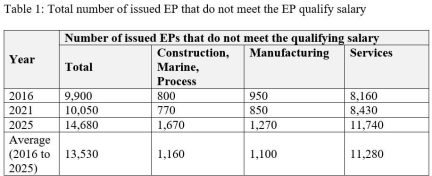
The Ministry of Manpower works with the Ministry of Trade and Industry and economic agencies to provide targeted flexibilities in support of our national priorities.
These flexibilities support Singapore’s economic growth and transformation and promote job creation for locals, such as in courting new investments and supporting research and innovation.
Data On Outcome Of SpexGLOW Grant Applications And Reasons For Rejections
Mr Chua Kheng Wee Louis asked the Acting Minister for Culture, Community and Youth since inception (a) how many applications for spexGLOW (Grant for Loss of Wages) have been (i) made and (ii) rejected respectively; (b) what are the reasons for these rejections; and (c) how many athletes under spexGLOW have gone on to medal at major games.
Mr David Neo: TeamSG athletes who aspire to train full-time and have performed well at major competitions or demonstrate the potential to do so are awarded SportSG’s spexScholarship or nurtured under the spexPotential programme and given monthly stipends to support their living expenses.
There are also TeamSG athletes under SportSG’s spexCarding programme pursuing non-sporting full-time careers and may wish to take no-pay leave before major competitions to train full-time. We support them through the spex Grant for Loss of Wages (spexGLOW) scheme.
SportSG works closely with athletes and their respective National Sports Associations (NSAs) on their training and competition plans. spexGLOW operates through this collaborative planning process to identify athletes who wish to take no pay leave to train and compete before each competition campaign, assess their eligibility and needs, and determine the support required. This approach ensures that all qualifying athletes who require support and apply receive spexGLOW assistance.
Since 2018, we have supported 216 applications for the spexGLOW programme. At the recent 2025 SEA Games, 39 athletes who received spexGLOW support won medals. Notable medallists include Calvin Quek, who won Singapore's first SEA Games gold in 60 years in the 400m hurdles, and Siti Khadijah, who won bronze to become Singapore's first woman's wushu sanda medallist. Members of the silver medal winning netball team also benefitted from the spexGLOW support.
Mr Dennis Tan Lip Fong
Breakdown Of Long-Term Accident And Health Insurance Premiums Collected And Claims Made By Hospital Plan Type
Mr Dennis Tan Lip Fong asked the Coordinating Minister for Social Policies and Minister for Health (a) whether the Ministry tracks gross premiums collected and claims settled for long-term accident and health insurance, disaggregated by (i) private hospital Integrated Shield Plans and (ii) public hospital Class A or B1 plans; and (b) if not, whether it will require insurers to provide this breakdown in regulatory submissions, rather than reporting only aggregate figures.
Mr Ong Ye Kung: Annually, insurers submit to the Ministry of Health the gross premiums collected and claims settled for Integrated Shield Plans (IPs), broken down by the ward class and type of the plan. The numbers reveal that loss ratios for private hospitals are higher than public non-subsidised wards. However, only aggregate numbers are publicly available.
Data On HDB Household Leaders Aged 65 And Older And Breakdown Of Seniors Living In HDB Households From 2018 To 2024
Mr Dennis Tan Lip Fong asked the Minister for National Development with regards to the HDB survey released in November 2025 (a) what is the actual number of HDB-dwelling households in 2024 whose principal flat decision-maker was aged 65 or older; (b) how many seniors aged 65 and above are in these households; and (c) how have both of these numbers changed in absolute terms since 2018.
Mr Chee Hong Tat: A senior household is one where the household decision maker is aged 65 years and above. For Housing and Development Board (HDB) sold flats, they must be the owner, co-owner or their spouse. For HDB rental flats, they must be the registered tenant or their spouse.
Based on the 2023/2024 HDB Sample Household Survey (SHS) findings, the estimated number of senior households rose from around 260,000 in 2018 to 340,000 in 2023/2024. HDB does not collect information on the total number of seniors in these households in the SHS.
Ms He Ting Ru
Update On Development Of Potential Dengue Vaccine And Patient Support Service For Dengvaxia Vaccine
Ms He Ting Ru asked the Coordinating Minister for Social Policies and Minister for Health (a) for an update on the development of potential dengue vaccines or drugs; and (b) what assistance or support is available to recovered dengue patients contemplating whether to take the Dengvaxia vaccine.
Mr Ong Ye Kung: Dengvaxia is currently the only licensed dengue vaccine in Singapore. The supplier has decided to discontinue it due to low global demand. It is therefore only available for individuals who have already initiated the three-dose series.
There are two other dengue vaccines approved in other countries — Qdenga and Butantan-Dengue Vaccine. These vaccines are however not approved for use in Singapore. One had withdrawn its application following a review by the Health Sciences Authority (HSA) on its submitted scientific data, and there is no application for the other. Another dengue vaccine candidate, V181, developed by MSD, is currently undergoing Phase 3 clinical trial.
The Ministry of Health and relevant agencies will continue to monitor the development of dengue vaccines and therapeutics as part of a multi-pronged approach to dengue control in Singapore.
Impact Of Defaults And Fleet Sales On COE Prices And Used Car Market And Measures To Control Problematic Financing Practices In Coordination With MAS
Ms He Ting Ru asked the Acting Minister for Transport in light of reports of high debt levels in the car-leasing sector (a) what stress-testing has been done on the impact of defaults or fleet sales on COE prices and the used-car market; and (b) whether, in coordination with MAS, steps will be taken to curb in-house financing or over-trade practices that circumvent loan-to-value limits.
Mr Jeffrey Siow: Private hire cars account for around 15% of the car population, and the five largest car-leasing companies own around 3%. The remaining private hire cars are owned by smaller car-leasing companies and individuals. Defaults or fleet sales are unlikely to have a significant effect on COE prices or the used car market over the long term.
Motor vehicle loans granted by financial institutions must abide by the Monetary Authority of Singapore’s (MAS's) motor vehicle financing restrictions. Alternative financing arrangements extended by car dealers are not regulated by the MAS. Buyers are strongly advised to obtain loans through regulated arrangements. The Government is monitoring the situation and will tighten regulations to manage the abuse of such regulations if necessary.
Impact Of Marginal Bidders In COE Auctions Disproportionately Influencing Clearing Prices Across Categories A And B
Ms He Ting Ru asked the Acting Minister for Transport (a) whether the Ministry has analysed the marginal bidder effect in COE auctions, including how a small number of relatively price-insensitive corporate bids, supported by tax treatment or in-house financing arrangements, may disproportionately influence clearing prices across Categories A and B; and (b) if so, whether further details will be shared.
Mr Jeffrey Siow: The COE bidding is a uniform price auction with the clearing price set at the highest unsuccessful bid plus $1. Across bidding exercises in 2025, three in four Category A and B COEs were won at bids within 5% of the eventual clearing price. This is also why a Pay-As-You-Bid (PAYB) bidding system, which is often suggested, will not bring down COE prices, as all bidders pay the clearing price regardless of what they bid.
There is evidence to suggest that corporates are in fact price sensitive when bidding for COEs. In the most recent bidding exercise that ended on 21 January 2026, the rise in COE prices for Category A and B saw a significant drop in the proportion of bids won by car-leasing companies to 4% in Category A and 5% in Category B. In 2025, car-leasing companies won around 10% of Category A and B bids.
Ms Eileen Chong Pei Shan
Data On Women In Elective Egg Freezing Programme By Participation Numbers And Age Since July 2023, And Average Cost Of One Complete Cycle At Public Hospitals
Ms Eileen Chong Pei Shan asked the Coordinating Minister for Social Policies and Minister for Health (a) how many women have undergone elective egg freezing since its implementation in July 2023; (b) what is the age breakdown of these women; and (c) what is the average total out-of-pocket cost for one complete cycle of elective egg freezing at public hospitals.
Mr Ong Ye Kung: Since the introduction of elective egg freezing (EEF) in June 2023, more than 800 women have undergone EEF (as of 31 December 2025). Approximately 57% of them are 35 years and above, 39% between 30 to 34 years and 4% below 30 years. An egg freezing cycle at public hospitals costs approximately $10,000.
Disqualification Criteria For Hiring Live-In Migrant Domestic Workers
Ms Eileen Chong Pei Shan asked the Minister for Manpower (a) what criteria currently disqualify individuals from hiring migrant domestic workers; and (b) whether individuals with criminal convictions for violent offenses are prohibited from hiring live-in migrant domestic workers.
Dr Tan See Leng: Employers can be debarred from hiring migrant domestic workers (MDWs) if they commit serious offences against an MDW. These include physical or sexual abuse, non-payment of salary, inadequate provision of food or rest and instructing their MDW to perform unsafe tasks. The debarment period varies with the severity of offences committed, and the Ministry of Manpower (MOM) will assess the suitability of the household to hire MDWs before lifting the debarment. Egregious offenders, such as those who inflict violent harm on their MDWs, will be permanently debarred.
Data On Migrant Domestic Workers' Assault Reports To MOM And/Or SPF, And Employer's Prosecution And Permanent Bans In Past Five Years
Ms Eileen Chong Pei Shan asked the Minister for Manpower in each of the past five years (a) how many migrant domestic workers have reported cases of (i) physical assault and (ii) sexual assault against their employers to MOM and/or SPF; and (b) of these cases, how many resulted in (i) prosecutions, (ii) convictions and (iii) permanent bans on the employer from hiring future domestic workers.
Dr Tan See Leng: All reports of Migrant Domestic Worker (MDW) abuse are referred to and investigated by the Police. From 2021 to September 2025, an average of around 300 reports of MDW abuse by employers or household members of the employers were made each year.
The majority of these cases were unsubstantiated. A total of 30 employers were prosecuted during this period, of which 14 were convicted and permanently debarred from hiring MDWs. In addition, an average of 70 employers were issued with warnings each year.
Mr Gerald Giam Yean Song
Impact Of US’ Withdrawal From International Organisations On Singapore And Resultant Contribution Changes
Mr Gerald Giam Yean Song asked the Minister for Foreign Affairs following the US’ withdrawal from certain international organisations in January 2026 (a) what is the assessment of the impact on Singapore; (b) whether Singapore’s annual financial contributions to these international organisations will increase as a result; and (c) whether the Government intends to deepen its investment in these organisations or adopt a more cautious approach.
Dr Vivian Balakrishnan: This question for written answer has been addressed by an earlier response to Question No. 1306 on the Order Paper for 3 February 2026.
Regulatory Measures Against Systematic Base Fare Cuts By Platform Companies After Implementation Of CPF Contribution Scheme
Mr Gerald Giam Yean Song asked the Minister for Manpower (a) what is the monthly median change in net take-home pay for platform workers who opted into the CPF contribution scheme since January 2025; (b) whether the Ministry has detected any systematic reduction in base fares or incentive premiums by platform operators that offsets the operator’s required share of contributions; and (c) what measures are implemented to prevent such practices.
Dr Tan See Leng: Between January and September 2025, the monthly median change in net-take home earnings1for platform workers who opted2 to increase their CPF contributions beyond the mandatory MediSave contributions ranged from a decrease of 12.7% to an increase of 8.2%. No consistent trend was observed, as monthly earnings fluctuate depending on factors such as hours worked and the seasonality of demand and supply.
We have not received any feedback from platform workers and Platform Work Associations that suggests systemic reduction in fares or incentive premiums due to CPF contributions. In September 2025, the Platform Workers Trilateral Group – comprising Ministry of Manpower (MOM), Ministry of Transport (MOT), the National Trades Union Congress (NTUC) and major platform operators – released a set of industry-wide principles that establish baseline expectations for platform operators when setting and reviewing their fares and incentives. These principles include fair and transparent earnings for platform workers, as well as visibility on structural changes to incentive schemes. Platform workers may seek assistance from their registered Platform Work Associations if they have concerns with the way fares and incentives are set.
Note(s) to Question No(s) 42:
1 Net take-home earnings are calculated by gross earnings minus the Fixed Expense Deduction Amount (FEDA) and platform workers’ share of the CPF contributions.
2 Based on opted-in platform workers who received increased CPF contributions in platform operators’ submissions for any of the months between January to September 2025. This does not include platform workers with no CPF contributions, as they earn below the respective income threshold, i.e. $50 or less in that month.
Mr Abdul Muhaimin Abdul Malik
Timeline Status For Multi-Agency Task Force On Invisible Disabilities In Justice System
Mr Abdul Muhaimin Abdul Malik asked the Minister for Law (a) whether the multi-agency task force to support persons with invisible disabilities in the justice system has been convened; (b) if not, what is the expected timeline for its formation; and (c) if it has been convened, when will the task force publish its findings and recommendations.
Mr Edwin Tong Chun Fai: On 26 March 2025, the Ministry first announced its commitment to a taskforce to better support persons with “invisible disabilities” in the criminal justice system at the inaugural Access to Justice Symposium hosted by Pro Bono SG. The organising committee for the Symposium was led by Ms Peggy Yee, Managing Director of PYLegal LLC and advocate for persons with “invisible disabilities”.
Since then, the Ministry has been working with Ms Yee and other key stakeholders and community partners on foundational steps for the taskforce’s work: bringing together representatives with the right expertise and experience, identifying the taskforce’s preliminary scope and the potential areas that it may study, and establishing the necessary administrative and support structures.
The formal launch of the Inclusive Justice Taskforce was announced on 8 January 2026.1
The taskforce is co-led by Senior Parliamentary Secretary for Law and Social and Family Development Mr Eric Chua and Ms Yee.
It comprises a multi-disciplinary group of representatives from across the private and public sector, including lawyers, policymakers, law enforcement officers, social service professionals, healthcare experts, community partners and caregiver representatives.
It will examine how our society can better support individuals with disabilities and mental health conditions who are at risk of offending or may interact with Singapore’s criminal justice system, including accused persons, victims and witnesses. A thorough and consultative review process will be undertaken to ensure that the taskforce’s recommendations are well-considered and practical.
The taskforce has started its work and will provide an update on its progress or recommendations in due course.
The Ministry looks forward to the taskforce’s contributions as part of our ongoing commitment to strengthen our legal system and advance access to justice to all, including those who are vulnerable.
This launch is the latest instalment in the Ministry’s extensive efforts to ensure that our legal system remains effective, accessible and inclusive. These include our efforts to make laws, legal processes and court procedures easier to understand and navigate, the provision of civil legal aid and criminal defence aid to lower-income
beneficiaries by the Legal Aid Bureau and the Public Defender’s Office, and our partnerships with Pro Bono SG, the legal fraternity and social service agencies to provide more holistic socio-legal support to those in need.
Note(s) to Question No(s) 37:
1 Link to the Ministry of Law’s Press Release on the launch of the Inclusive Justice Taskforce can be found here: https://www.mlaw.gov.sg/new-taskforce-launched-to-better-support-persons-with-disabilities-and mental-health-conditions-in-criminal-justice-system/
Expansion Of Legal Aid Scheme For Persons With Special Needs Ineligible For Pro Bono Legal Services
Mr Abdul Muhaimin Abdul Malik asked the Minister for Law whether the Ministry will consider expanding existing legal aid schemes or introducing new targeted legal support initiatives for persons with special needs who do not currently qualify for pro bono legal services.
Mr Edwin Tong Chun Fai: The Legal Aid Bureau (LAB) and the Public Defender’s Office (PDO) provide legal aid to Singapore Citizens and Permanent Residents, including those with special needs, who satisfy the means and merits tests.
Applicants with special needs who do not meet the means test criteria, but have extenuating circumstances will also have their applications reviewed by an independent Means Test Panel for possible support.
Pro Bono SG (PBSG) provides legal assistance at their Community Law Centres and various legal clinics across Singapore. They run schemes such as the Ad Hoc Pro Bono Scheme, which accepts referrals for needy or vulnerable individuals who do not qualify for other legal aid schemes but require legal help due to exceptional circumstances.
Mr Low Wu Yang Andre
Compliance Rate Of Mandatory CPF Contributions And Enforcement Actions Taken Against Non-Compliance
Mr Low Wu Yang Andre asked the Minister for Manpower (a) what is the compliance rate of platform operators regarding mandatory CPF contributions since the commencement of the Platform Workers Act; and (b) what is the total number of enforcement actions taken for non-compliance to date.
Dr Tan See Leng: Non-compliance cases are defined as instances of late or underpayment of Central Provident Fund (CPF) contributions. Since the implementation of the Platform Workers Act in January 2025, we have seen a high level of compliance where the vast majority of payments have been made on time. A small number of late payments cases were encountered, and they were resolved within two weeks after a reminder notice was issued.
On underpayment of CPF contributions, CPF Board has taken action against four platform operators by demanding payment and charging late payment interests. These cases were due to administrative lapses such as incorrect calculation of earnings. They have since been resolved.
To help familiarise platform operators with the new process of paying CPF contributions for platform workers, CPF Board has provided them with a guide on good practices. Platform workers also receive CPF contribution alerts when their CPF contributions are credited, which allow them to monitor and verify the accuracy of their CPF contributions.
Data On Platform Workers CPF Transition Support Scheme Uptake, Disbursement And Rejection
Mr Low Wu Yang Andre asked the Minister for Manpower (a) as of January 2026, how many platform workers have qualified for the Platform Workers CPF Transition Support (PCTS) scheme; (b) what is the total value of PCTS offsets disbursed to date; and (c) what percentage of applications were rejected and the primary reasons for these rejections.
Dr Tan See Leng: In 2025, close to 24,000 lower-income platform workers qualified for the Platform Workers CPF Transition Support (PCTS) scheme, and over $4 million was disbursed in total. Data for January 2026 is not yet available.
The Central Provident Fund Board automatically assesses platform workers’ eligibility for PCTS every month and no application is required from platform workers.
Mr Fadli Fawzi
Breakdown On Outcomes Of Mendaki Financial Assistance Applications For Muslims Of Non-Malay Descent In Last 10 Years
Mr Fadli Fawzi asked the Acting Minister-in-charge of Muslim Affairs in each of the last 10 years, how many Muslims of non-Malay descent have (i) applied for and (ii) successfully received financial assistance, respectively, from any of the financial assistance schemes under MENDAKI, broken down by the race listed on their NRIC.
Assoc Prof Dr Muhammad Faishal Ibrahim: As a self-help group for the Malay/Muslim community, MENDAKI offers various financial assistance schemes, including study loans and bursaries, to all Malay/Muslim students. These schemes ensure that no Malay/Muslim student will be denied higher education because of their financial difficulties.
Based on latest available data, an average of about seven in 10 non-Malay Muslims were successful in their application for MENDAKI’s financial assistance schemes from 2022 to 2025. This is comparable to the success rate for Malay-Muslim applicants.
Investigation Findings Of Accident Involving Autonomous Vehicle On 17 January 2026
Mr Fadli Fawzi asked the Acting Minister for Transport in an accident involving an autonomous vehicle on 17 January 2026 (a) whether the Ministry is aware of (i) the vehicle's response when it detected a small object on the road and (ii) whether the accident was caused by human error during the manual takeover or the vehicle's response; and (b) if so, what is this information.
Mr Jeffrey Siow: This question was addressed in the reply to Question 59 during the 4 February 2026 Parliament sitting.

