


Written Answers to WP's Oral Questions
Mr Chua Kheng Wee Louis
Number Of MOH Development Projects With Undeclared Savings Other Than That Highlighted In FY 2025/2026 Auditor General's Report
Mr Chua Kheng Wee Louis asked the Coordinating Minister for Social Policies and Minister for Health in light of the findings by the Auditor-General’s Office (a) beyond the audited project, how many other Ministry of Health development projects have undeclared savings; (b) what is the total quantum involved; and (c) whether these undeclared savings have been used to fund items from other projects.
Mr Ong Ye Kung: To provide background for members, the Auditor-General's Office (AGO) audited the development of the National Cancer Centre Singapore (NCCS), which was approved by the Development Planning Committee (DPC) in 2016. It was found that when major construction tenders closed, the Ministry of Health (MOH) did not declare project savings soon after, which is required under financial rules. It was a process lapse, albeit at a system level. NCCS was completed in 2022.
Savings at the point of tender award arise when the tender price is below budget, and is an early estimate of excess funds. As the project goes on, savings may be deployed for unforeseen uses, which is common for development projects. This includes variations to improve operational efficacy or user experience, adjustments for material price fluctuations post-Covid, compliance with new regulatory requirements, and loss and expense claims from contractors.
The adjustments will be within the approved project scope and with the necessary internal approvals. As such, not all the initial savings may be realised. Conversely, there could also be additional savings as projects progress, when requirements are simplified or budget set aside for contingencies are not used. What is more important is whether there are actual savings when the project is completed, and if yes, what happened to those monies. For NCCS, the eventual savings was $105 million.
Besides NCCS, there are eleven other development projects where savings were not declared after closing of major tenders. Six projects have been completed and accounts closed. The initial savings after award of main construction tenders for these projects were $165 million. Upon project completion, actual savings increased to around $436 million due to additional savings realised in other aspects. These funds, together with NCCS’ savings, were freed up for the Ministry of Finance's (MOF’s) reallocation.
The other five are ongoing projects, with initial savings totalling about $95 million after award of their respective main construction tenders. Similarly, after savings were redeployed for other approved in-project uses, the current estimated savings is about $48 million. MOH is following up on AGO’s observation and declaring them. But as I explained earlier, this will likely differ from the final actual savings, by the time the projects are completed and accounts finalised.
I wish to emphasise to members that where savings were tapped, they were used for works that eventually benefited the public, and these were done in good faith. In the case of NCCS, savings were also used to build a pedestrian bridge to the MRT station to enhance connectivity for patients and staff, and develop laboratories mainly to produce immunotherapies for cancer patients. These are not cases of funds going missing, or being inappropriately channelled to other projects.
Waiting Time And Capacity Surge Management Strategies At Public Hospitals In View Of New IP Rider Requirements
Mr Chua Kheng Wee Louis asked the Coordinating Minister for Social Policies and Minister for Health in view of the new Integrated Shield Plan rider requirements (a) what waiting-time thresholds is the Ministry monitoring across public hospitals for non-urgent procedures and elective scans; (b) whether significant
changes in waiting times have been recorded in the first three months since April 2026; and (c) what patient-volume threshold will trigger surge capacity activation and which procedures are prioritised.
Mr Ong Ye Kung: The change in Integrated Shield plan rider requirements to moderate private healthcare cost increases is not a key driver of wait times, and neither are wait times for non-urgent procedures and elective scans direct indicators of capacity in public hospitals. Between January and June 2026, public hospitals have reported stable median monthly wait times for non-urgent procedures and elective scans.
Patients who need more time-sensitive procedures or scans, based on their conditions, will be prioritised.
Mr Kenneth Tiong Boon Kiat
Probe Into Incident Of 15 July 2026 Where Preparation Prompt For O-Level English Language Oral Examination Differed From What Was Asked
Mr Kenneth Tiong Boon Kiat asked the Minister for Education regarding feedback that in the 15 July 2026 O-level English Language oral examination, the preparation prompt differed from what was asked (a) whether the Singapore Examinations and Assessment Board (SEAB) examined each candidate’s displayed prompt and contemporaneous planning notes, or only central logs; (b) how many reported the alleged discrepancy to SEAB; and (c) what assistance, if any, will be provided to candidates who gave such feedback.
Mr Desmond Lee: The Ministry of Education will provide an oral answer to these Questions, together with other Questions which have been filed on this topic, at the next available opportunity.
Assoc Prof Jamus Jerome Lim
Probe Into Incident Of 15 July 2026 Where Preparation Prompt For O-Level English Language Oral Examination Differed From What Was Asked
Assoc Prof Jamus Jerome Lim asked the Minister for Education regarding the Singapore Examinations and Assessment Board’s (SEAB) investigation into feedback that candidates in the 15 July 2026 GCE O-level English oral examination were asked a planned response question different from that displayed on candidates’ screens (a) what records and evidence were examined; (b) whether affected candidates and examiners were consulted; and (c) what evidence supported its conclusion that no error occurred.
Mr Desmond Lee: The Ministry of Education will provide an oral answer to these Questions, together with other Questions which have been filed on this topic, at the next available opportunity.
Prevalence Of Use Of AI-Assisted Clinical Notetaking Tools At Public Healthcare Institutions And Safeguards For Such Use
Assoc Prof Jamus Jerome Lim asked the Coordinating Minister for Social Policies and Minister for Health (a) which public healthcare institutions have deployed AI-assisted clinical note-taking tools; (b) whether such tools are classified as medical devices under the Health Products Act; and (c) if not, what mandatory safeguards exist to ensure the accuracy and safety of such tools.
Mr Ong Ye Kung: As AI-assisted clinical note-taking does not diagnose, manage or treat medical conditions, they are not medical devices regulated under the Health Products Act.
Healthcare professionals are required to go through the AI-generated notes before adding them to their clinical records. Ultimately, the notes are still from the healthcare professional, not the AI tool. This is the principle of keeping the human in the loop when we implement AI tools.
Basis For Reducing Vacancies In Primary Schools In Sengkang For Primary 1 Registration Exercise
Assoc Prof Jamus Jerome Lim asked the Minister for Education what was the basis for the decision to reduce available vacancies across almost all primary schools in Sengkang, despite a number of them still facing oversubscription in Phase 2C of the Primary 1 Registration Exercise.
Mr Desmond Lee: This question has been addressed by the Ministry of Education's answer to oral Parliamentary Question No 58 on 7 July 2026.
Ms He Ting Ru
Key Performance Indicators For Reducing Road Casualties
Ms He Ting Ru asked the Senior Minister, Coordinating Minister for National Security and Minister for Home Affairs (a) whether the Ministry and the LTA have set key performance indicators for reducing road casualties; and (b) if so, what these indicators are and how they benchmark against international frameworks.
Mr K Shanmugam: As set out in the oral reply to Mr Chua Kheng Wee Louis on 6 November 2025, the Ministry’s approach towards road casualties is one of zero tolerance. Every fatality and injury is one too many. Rather than setting numerical key performance indicators and targets, which risks normalising a level of casualties as acceptable, the Ministry aims to reduce road casualties as far as possible.
That said, the Ministry does track statistics including traffic injuries and fatalities, to assess how road safety is trending over time and to inform our policies.
Criteria Such As Defined Number Of Salary Claims Within Given Period That Would Escalate Government's Response From Individual Case-Handling To A Group-Level Investigation
Ms He Ting Ru asked the Acting Minister for Manpower (a) whether there is a formal threshold such as a defined number of salary claims within a given period that will trigger escalation from individual case handling to a group-level investigation of such cases within related entities; and (b) whether the Ministry will formalise and publish the criteria and process for such escalation rather than relying on case-by-case discretion.
Ms Jasmin Lau: Protecting all workers and ensuring they are paid their salaries in full and on time is a priority for the Ministry of Manpower (MOM). When investigating a case, the Ministry would consider its specific circumstances, including the quantum of arrears involved and the number of employees affected.
The Ministry will also investigate other companies with a common Director to assess whether similar practices have been occurring across those related entities. While MOM maintains an escalation and enforcement framework, we do not publish this as doing so will enable errant companies to game our framework and undermine our enforcement effectiveness.
Mr Fadli Fawzi
Revision Of CHAS Blue Card Subsidy Of $18.50 For GP Visits For Common Illnesses
Mr Fadli Fawzi asked the Coordinating Minister for Social Policies and Minister for Health (a) whether the CHAS Blue subsidy of $18.50 for GP visits for common illnesses will be revised upwards; and (b) if not, why not.
Mr Ong Ye Kung: The CHAS scheme is reviewed from time to time. Our most recent enhancements extended subsidies for vaccinations against shingles at GPs, increased the affordability of commonly-used chronic medications and significantly enhanced subsidies for dental care.
We will continue to monitor the overall affordability of primary care and review the scheme, where necessary.
Temasek Holdings' Investment In Indonesia's Efishery Which Is Linked To Fraud And Accounting Scandal
Mr Fadli Fawzi asked the Prime Minister and Minister for Finance (a) whether the Government is aware if Temasek Holdings had invested in eFishery; (b) if so, whether the Government has information on (i) the amount invested and (ii) measures taken by Temasek Holdings to prevent similar investments in the future; and (c) whether the Government intends to hold the Temasek Holdings management accountable for the approval and oversight of this investment.
Mr Jeffrey Siow: There are public reports regarding Temasek’s investment in eFishery, and Temasek has also publicly commented on the matter. The Government does not scrutinise or direct Temasek’s individual investment decisions. These are commercial decisions made independently by Temasek. As we have explained previously in this House, Temasek invests with a long-term perspective. This includes investments in start-ups, which are inherently higher risk but form a relatively small part of its overall portfolio.
The Government’s role is to ensure that Temasek has a sound governance framework. We hold the Temasek Board accountable for the company’s overall long term performance, including its governance and risk management.
Accordingly, we assess Temasek’s performance on an overall portfolio basis and over the long term, rather than on the outcome of any individual investment.
Mr Gerald Giam Yean Song
Thresholds Of Non-Payment Or Delayed CPF Contributions That Would Trigger Government Intervention Before Corporate Liquidation Proceedings Begin
Mr Gerald Giam Yean Song asked the Acting Minister for Manpower (a) what specific thresholds of non-payment or delayed Central Provident Fund contributions trigger an active, proactive investigation into an employer before corporate liquidation proceedings begin; and (b) how many such proactive investigations have been conducted by the Ministry in the past year.
Ms Jasmin Lau: The Central Provident Fund (CPF) Board has measures to detect non or late payment of CPF contributions.
In the past year, there was an average of about 2,600 employers per month, or 1.6% of all active employers, who failed to make timely CPF contributions within one month after the grace period. CPF Board followed up on all of these cases detected and took enforcement actions to recover arrears where necessary.
Proposal For Nationwide Use Of Source-Segregated Recycling Bins To Replace Existing Blue Bins Infrastructure
Mr Gerald Giam Yean Song asked the Minister for Sustainability and the Environment (a) whether the Ministry has assessed if the current blue bin infrastructure discourages recycling; (b) whether the capacity and clearance frequencies of existing blue recycling bins will be increased to resolve persistent issues of overflowing and contamination; and (c) whether the Ministry has considered introducing a nationwide use of source-segregated recycling bins to replace the blue recycling bins.
Ms Grace Fu Hai Yien: I thank the Member for his question. This question has been addressed in the Ministry of Sustainability and the Environment's (MSE’s) combined answer to Question Nos. 15 to 18 and written Question No. 33 on the Order Paper for 7 July 2026.
Members may refer to the Official Report for the full response. Thank you.
Mr Abdul Muhaimin Abdul Malik
Number And Seniority Of Roles In The Case Of Possible Falsified Approvals For Appointments Of Education Officers As Recorded In Fy2025/2026 Auditor-General's Report
Mr Abdul Muhaimin Abdul Malik asked the Minister for Education in respect of the Auditor-General's Office report on possible falsified approvals for appointment of officers (a) what roles or appointments had possible falsified approvals; (b) whether these appointments had any decision-making authority; (c) whether the appointed officers are still in their roles; and (d) whether the Ministry has separately conducted an investigation on the motivations behind such possible falsification.
Mr Desmond Lee: During the Auditor-General's Office (AGO) audit, the Ministry of Education (MOE) had identified possible falsified approval emails relating to the appointment of new officers. Following MOE’s internal investigations, a police report had been made. The officer responsible had also been dismissed from service.
As police investigations are ongoing, we are unable to share further details, including the roles affected or the motivations behind the falsification. MOE's recruitment process requires all candidates to go through a rigorous selection process, including being assessed by properly constituted formal selection panels. Only after the selection panels have duly verified and cleared the candidates for appointment, would they be submitted to the appropriate authority for approval. The falsification of approvals cited in the AGO report pertains to this final step after the candidates have been cleared by the selection panels. MOE has checked, and confirmed that all candidates listed in the falsification of approvals had been found suitable after going through the entire selection process, including clearing the selection panel.
Following this incident, we have strengthened internal controls for governance by introducing independent checks to verify that all appointments have received the required approvals and are working to automate staff appointment processes to reduce reliance on manual workflows.
MOE remains committed to upholding public trust.
Number Of Flats Wrongly Allocated And Subsequently Forfeited Under Married Child Priority Scheme In The Lapse Recorded In Fy2025/2026 Auditor-General’s Report
Mr Abdul Muhaimin Abdul Malik asked the Minister for National Development in respect of the 37 applications incorrectly allocated priority under the Married Child Priority Scheme reported in the latest Auditor-General’s Office report (a) how many applications resulted in flats being allotted and accepted; (b) whether any applicants had their leases forfeited after the errors were discovered; and (c) of those whose leases were forfeited, whether there were any other aggravating breaches involved.
Mr Chee Hong Tat: Out of 9,592 approved Married Child Priority Scheme applications, the Auditor-General’s Office identified 37 cases where there were differences between Housing and Development Board's (HDB’s) and the Immigration and Checkpoints Authority (ICA’s) records on residential addresses. None of the applicants had their leases forfeited.
HDB has since addressed the gaps identified, including introducing additional checks using ICA addresses alongside HDB’s records when assessing proximity scheme applications, to prevent similar lapses. HDB has also taken steps to rectify the discrepancies for grant and priority schemes.
Contractor In Case Where There Was Inadequate Oversight Of HDB Car Park Patrol And Enforcement As Recorded In Fy2025/2026 Auditor-General's Report
Mr Abdul Muhaimin Abdul Malik asked the Minister for National Development with reference to the Auditor-General's Office's finding on inadequate oversight of carpark patrol and enforcement by HDB (a) which contractor was found to have discrepancies in service performance; (b) whether the contract remains in force; (c) when the contract is expected to end; and (d) whether the deficiencies identified will lead to HDB selecting another contractor for future services required.
Mr Chee Hong Tat: As reported by the media, the contractor is Certis Cisco Auxiliary Police Force Pte Ltd. The affected contract ended on 31 January 2026. The Housing and Development Board (HDB) has commenced recovery of the administrative charges, which includes the full extent of payments made for works not rendered. The lapses will be taken into account in future tenders that Certis Cisco bids for.
Ms Eileen Chong Pei Shan
Number And Seniority Of Roles In The Case Of Possible Falsified Approvals For Appointments Of Education Officers As Recorded In Fy2025/2026 Auditor-General's Report
Ms Eileen Chong Pei Shan asked the Minister for Education regarding the possible falsified approvals for appointments of officers noted in the FY2025/2026 Auditor-General's Office Report (a) how many such appointments processed under the manual approval system were found to lack adequate scrutiny; (b) whether all such appointments have since been re-verified as properly approved; and (c) what independent checks now prevent recurrence.
Mr Desmond Lee: During the Auditor-General's Office (AGO) audit, the Ministry of Education (MOE) had identified possible falsified approval emails relating to the appointment of new officers. Following MOE’s internal investigations, a police report had been made. The officer responsible had also been dismissed from service.
As police investigations are ongoing, we are unable to share further details, including the roles affected or the motivations behind the falsification. MOE's recruitment process requires all candidates to go through a rigorous selection process, including being assessed by properly constituted formal selection panels. Only after the selection panels have duly verified and cleared the candidates for appointment, would they be submitted to the appropriate authority for approval. The falsification of approvals cited in the AGO report pertains to this final step after the candidates have been cleared by the selection panels. MOE has checked, and confirmed that all candidates listed in the falsification of approvals had been found suitable after going through the entire selection process, including clearing the selection panel.
Following this incident, we have strengthened internal controls for governance by introducing independent checks to verify that all appointments have received the required approvals and are working to automate staff appointment processes to reduce reliance on manual workflows.
MOE remains committed to upholding public trust.
Mr Dennis Tan Lip Fong
Projected Increase In Chronic Disease Caseloads For Gp Chas Clinics Due To Additional Conditions Covered And Measures To Meet Additional Manpower Requirements
Mr Dennis Tan Lip Fong asked the Coordinating Minister for Social Policies and Minister for Health (a) whether there will be a projected increase in chronic disease caseloads for general practitioner (GP) CHAS clinics arising from the additional conditions covered under the Chronic Disease Management Programme; (b) if so, what increase in GPs, nurses and care coordinators headcount is projected for the next five years; and (c) how the Ministry intends to meet these manpower requirements.
Mr Ong Ye Kung: This question has been addressed in the response to Question number 79 from the Parliament Sitting on 7 July 2026.
Written Questions
Mr Fadli Fawzi
Breakdown Of Public Service Officers By Employment Type, Hiring Trends And Managing Underperforming Officers
Mr Fadli Fawzi asked the Prime Minister and Minister for Finance (a) of the current public service officers, what percentage of them are employed on a contract and permanent basis respectively; (b) whether there is a trend of moving away from employing officers on a permanent basis; and (c) how does the Public Service manage
underperforming officers employed on a contract and permanent basis respectively. Mr Chan Chun Sing: Public agencies may appoint officers on permanent or contract terms, depending on operational and workforce requirements. Contract appointments may be used to assess an officer's suitability for a longer-term career in the Public Service, or to support specific projects over a defined period.
As at 31 December 2025, 15% of employed officers were on contract, excluding those on re-employment contracts. Permanent appointments continue to account for the majority of the Public Service workforce.
All public officers – regardless of whether they are appointed on permanent or contract terms – are expected to meet the required performance standards. Supervisors in turn are to support the officers’ development – through feedback, coaching, and support to help officers improve their performance. Where an officer's performance falls below expectations, the agency and supervisor will work with the officer to identify areas for improvement, set clear performance expectations, provide appropriate support and coaching, and review progress over an appropriate period. Officers who consistently are unable to perform at the required expectations may have their permanent or contract service terminated.
Rationale For Land Use Changes In Lim Chu Kang And Differential Relocation Timelines For Affected Farms
Mr Fadli Fawzi asked the Minister for Sustainability and the Environment (a) what is the rationale for land use changes in Lim Chu Kang; and (b) why is there a need for three of the affected farms to move out within the next year, given that two other farms in the affected area can operate for at least 10 more years.
Ms Grace Fu Hai Yien: The land-use changes in Lim Chu Kang are intended to optimise our scarce land to meet our growing and evolving needs. These changes will allow the Government to explore the physical co-location of food and non-food farms to the North of Lim Chu Kang, which could benefit from shared facilities and integrated infrastructure planning. It also enables the consolidation of contiguous training land for the Ministry of Defence (MINDEF) in the South of Lim Chu Kang.
The different timelines for the affected farms to move out are based on the expiry of their existing tenancies or leases and phased development timelines. There will be no early termination of tenancies or leases. The affected farms were informed early that no further lease renewals will be granted, to provide sufficient lead time to prepare for the transition.
Assoc Prof Jamus Jerome Lim
Data On Average Sentencing Outcomes For Drunk Driving Cases Over Past Three Years
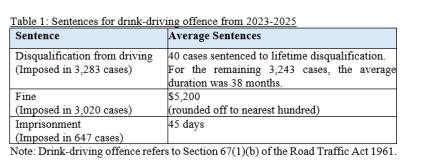
Assoc Prof Jamus Jerome Lim asked the Senior Minister, Coordinating Minister for National Security and Minister for Home Affairs of the more than 1,700 cases of arrest for drunk driving over the past three years, what have been the average (i) duration of driving ban (ii) fine and (iii) duration of incarceration among those who have been sentenced to jail time.
Mr K Shanmugam: Over the past three years, there were 5,176 persons arrested for drink-driving.
Arrest and sentencing statistics in a particular year are not directly comparable as persons arrested in a year may only be charged and/or sentenced in a later year, following investigations and court processes.
Between 2023 and 2025, the average sentences imposed by the Courts are set out in the table below.
Mandatory Data Security Requirements For Patient Data Processed By AI Tools Through Third-Party Cloud Services
Assoc Prof Jamus Jerome Lim asked the Coordinating Minister for Social Policies and Minister for Health whether mandatory data security requirements apply to AI tools that process patient data through third-party cloud services.
Mr Ong Ye Kung: Yes, data security requirements apply to AI tools that process patient data, whether hosted on third-party cloud services or on-premise. These are requirements under both the Healthcare Services Act and the Personal Data Protection Act.
Public healthcare institutions have also adopted additional practices to safeguard data. For example, AI model providers whom they work with must give legally binding commitments that all input and output data are not stored or retained. The AI tools also need to be accessed from secure environments.
Mr Low Wu Yang Andre
Gambling Regulatory Authority Of Singapore Investigation Outcomes And Regulatory Actions Taken On Excluded Persons Betting Through Singapore Pools Accounts
Mr Low Wu Yang Andre asked the Senior Minister, Coordinating Minister for National Security and Minister for Home Affairs following the Auditor-General’s Office's finding that 79 Singapore Pools accounts held by excluded persons were not closed and 32 holders placed 1,358 online bets totalling $75,800 during exclusion periods (a) what are the Gambling Regulatory Authority of Singapore’s investigation outcomes and regulatory actions; (b) which recurring data-matching, exception monitoring and independent-testing controls have been implemented; and (c) from when.
Mr K Shanmugam: The Gambling Regulatory Authority (GRA) and the Ministry of Social and Family Development (MSF), which oversees the National Council on Problem Gambling, found that the lapses arose from system-related issues that resulted in some excluded persons not being flagged. These issues were rectified in February 2026.
Investigations into possible offences committed by the 32 excluded persons who engaged in remote gambling are ongoing. Individuals found liable will be dealt with. The remaining 47 excluded persons did not engage in remote gambling.
MSF has enhanced its system controls and validation processes, including implementing more rigorous testing for new system enhancements since June 2026. MSF will extend these enhancements to existing systems and operational processes.
Addressing Foreign Worker Levy Overcharges On Marine Shipyard Firms, And Tracking Refunds And Adjustment Timelines Following Auditor-General's Office Findings
Mr Low Wu Yang Andre asked the Acting Minister for Manpower following the Auditor-General's Office's finding that foreign worker levies for marine shipyard firms in January and February 2026 exceeded prescribed rates by $4.82 million (a) what was the total excess before the 1 June 2026 amendment took effect; (b) how many firms were affected; (c) how much has been refunded or offset; and (d) when will adjustments be completed.
Ms Jasmin Lau: An excess of $8.3 million in foreign worker levy (FWL) was collected between January to May 2026. This includes the $4.82 million reported by the Auditor-General’s Office (AGO) related to levy charges for January and February 2026. We have refunded all the excess levies collected to all 1,018 affected employers either via levy bill offsets or credits to their levy accounts.
The Ministry of Manpower (MOM) has completed all necessary rectification measures and strengthened its internal processes.
Mr Dennis Tan Lip Fong
Inclusion Of Disposable Incontinence Sheets In Seniors’ Mobility And Enabling Fund Subsidies To Ensure Comprehensive Hygiene And Pressure Sore Protection
Mr Dennis Tan Lip Fong asked the Coordinating Minister for Social Policies and Minister for Health (a) whether the inclusion of underpads in the Seniors' Mobility and Enabling Fund (SMF) consumables subsidy from April 2026 covers full sized disposable incontinence sheets for bed-bound patients; and (b) if not, whether the Ministry will expand the subsidy to ensure comprehensive protection against hygiene issues and pressure sores.
Mr Ong Ye Kung: Yes.
Ms He Ting Ru
Alignment Of Clearance Of Maju Forest With Singapore's Climate Adaptation And Mitigation Plans In 2026
Ms He Ting Ru asked the Minister for Sustainability and the Environment given the designation of 2026 as the Year of Climate Adaptation and concerns about the impact of heat in Singapore, how does the clearing of Maju Forest fit into the Ministry's climate adaptation and mitigation plans.
Ms Grace Fu Hai Yien: We have designated 2026 as the Year of Climate Adaptation to raise awareness on the importance of adaptation, galvanise collective action to adapt to the effects of climate change, and co-create the development of our National Adaptation Plan with public, private and people stakeholders, including the Ministry of National Development and its agencies.
It is important for the co-creation process to consider and balance the needs for economic development, social services, and environmental protection. The Ministry of National Development has separately answered the specific questions related to the development of Sunset Way on 4 August 2026.
Yearly Lease Expiries For Arts And Culture Establishments In Gillman Barracks From 2026 To 2030, And Assistance For Relocation Efforts
Ms He Ting Ru asked the Minister for Law (a) how many arts and culture establishments currently leasing state properties in Gillman Barracks have tenancies expiring in each year from 2026 to 2030; and (b) what assistance will the Government render to help these establishments relocate their operations.
Mr Edwin Tong Chun Fai: As of July 2026, there are a total of 11 tenants renting the State properties in Gillman Barracks for arts uses. Their tenancies expire between 2026 and 2029. All tenants have been assured that the existing tenancy terms and tenure are unchanged. Tenants can continue to operate at their current location till the end of their tenancies. In addition, those whose tenancies expire before 2029 can also choose to extend their tenancies till end-2029.
The Singapore Land Authority (SLA) has engaged the tenants since 2023 and explained that Gillman Barracks is safeguarded for residential use in the longer term. SLA has also kept tenants informed of the environmental and heritage studies as well as upcoming development works.
SLA is working closely with the National Arts Council (NAC) to advise the tenants of available relocation options, and NAC can also help interested arts tenants connect with suitable alternative spaces and opportunities within Singapore’s arts ecosystem.
Mr Kenneth Tiong Boon Kiat
Existing Provisions And Expanding Eligibility Of Crisis And Transitional Shelters For Homeless Youths Under 21 With No History Of Family Violence
Mr Kenneth Tiong Boon Kiat asked the Minister for Social and Family Development given that homeless youths under 21 years of age with no family violence history fall between crisis shelters, which require family violence, and HDB public rental, which sets a minimum age of 21 years (a) what provision exists for them beyond Youth Crisis Homes; and (b) whether crisis-shelter or transitional-shelter criteria can be opened to such youths.
Mr Masagos Zulkifli B M M: The Ministry of Social and Family Development (MSF) is committed to ensuring that youth in need have access to safe accommodation and appropriate support. Homeless youths aged below 21 with no history of family violence can also seek support from Family Service Centres, drop-in centres operated by various Social Service Agencies (SSAs), and other SSA-operated temporary shelters. These agencies will work closely with them to address their root causes of homelessness, including the possibility of family reconciliation.
Youths aged below 21 can also be admitted into Crisis Shelters if there are immediate safety concerns or Transitional Shelters, on a case-by-case basis. We will continue to work with our SSA partners to ensure that the sector remains responsive to the needs of the vulnerable.
Additional Disruption History Of Bus Eta System, Financial Penalties For Vendors And Interim Safeguards Ahead Of Cloud-Based System Deployment
Mr Kenneth Tiong Boon Kiat asked the Minister for Transport (a) whether there are separate disruptions to the bus Expected Time of Arrival (ETA) system besides those reported in January and April 2026; (b) if so, how many shared a common root cause; (c) whether the financial penalties for third-party vendors have been imposed after the disruptions; and (d) what interim safeguards apply before the new cloud-based ETA system arrives in end-2027.
Mr Jeffrey Siow: Since January 2026, there have been four disruptions to the bus Expected Time of Arrival (ETA) system in January, April, June and July 2026, due to failures of unrelated components. The Land Transport Authority (LTA) has imposed financial penalties on the vendor for three out of four incidents.
To reduce the risk of further outages before the new ETA system is deployed by the end of 2027, LTA has put in place additional hardware redundancies, increased monitoring of system performance and strengthened incident response procedures.
Ms Eileen Chong Pei Shan
Monitoring Staff Salaries, Turnover And Retention Rates At Student Care Centres Administering Student Care Fee Assistance From 2021 To 2025
Ms Eileen Chong Pei Shan asked the Minister for Social and Family Development for student care centres that administer Student Care Fee Assistance (a) whether the Ministry (i) tracks staff salaries and turnover rates and (ii) monitors whether they are adequate to attract and retain suitably qualified staff; (b) if so, what is the median monthly salary of (i) supervisors (ii) teachers and (iii) assistant teachers, respectively; and (c) what is the average annual staff turnover rate from 2021 to 2025.
Mr Masagos Zulkifli B M M: This question has been addressed in the reply to Question No. 41 for written answer on the Order Paper for 7 July 2026.
Annual Rates Of DSA-Sec Talent Area Release Requests, Approval Rates, And School Transfer Or CCA Change Outcomes Over Past Decade
Ms Eileen Chong Pei Shan asked the Minister for Education for each year in the past decade (a) how many Direct School Admission for secondary schools (DSA Sec) students requested release from their committed talent area; (b) how many requests were approved; and (c) how many were allowed to change co-curricular activity within the same school versus those required to transfer schools.
Mr Desmond Lee: The Direct School Admission for secondary schools (DSA Sec) provides a pathway for students to gain admission to secondary schools based on their interests, aptitude and potential, beyond their performance at the Primary School Leaving Examination (PSLE). Students who accept a DSA-Sec place commit to participating in the relevant Co-Curricular Activities (CCA) or talent development programme in the school, and are expected to honour their commitment.
Schools may consider requests from students to be released from their DSA-Sec commitment on a case-by-case basis where there are valid reasons, such as injury, medical conditions or other extenuating circumstances. Depending on the circumstances, the school may allow the student to take up another suitable CCA or programme within the school, or facilitate a transfer to another school.
The Ministry of Education (MOE) does not track the number of such cases, as these requests are assessed and managed by individual schools.
Transparency Of Biodiversity Monitoring, Ecological Basis For Corridor Width Towards Habitat Connectivity, And Public Consultation Process For Gillman Barracks And Sunset Way Development
Ms Eileen Chong Pei Shan asked the Minister for National Development (a) why are the public consultations for the Sunset Way and Gillman Barracks sites based on development proposals with retention percentages already determined, rather than on environmental baseline data prior to a development scheme as was done for Dover Forest in December 2020; and (b) how does this affect the scope of the feedback sought.
Mr Chee Hong Tat: These questions were addressed in the Ministry of National Development's reply to the questions asked by Dr Charlene Chen, Mr Christopher de Souza, Mr Dennis Tan Lip Fong, Ms Eileen Chong Pei Shan, Ms Elysa Chen, Mr Fadli Fawzi, Ms He Ting Ru, Ms Joan Pereira, Mr Kenneth Tiong Boon Kiat, Ms Nadia Ahmad Samdin, Miss Rachel Ong, Ms Valerie Lee and Mr Low Wu Yang Andre on 4 August 2026.
Ms Sylvia Lim
Detection Of Simba Telecom's Alleged Unauthorised Radio Frequency Spectrum Use And Enhancement Of Monitoring Mechanisms To Ensure Fair Competition Among Telcos
Ms Sylvia Lim asked the Minister for Digital Development and Information (a) whether the alleged unauthorised use of radio frequency spectrum by Simba Telecom only came to light during the review of its proposed merger with M1; and (b) whether monitoring mechanisms should be enhanced to ensure fair competition among telcos.
Mrs Josephine Teo: This question has been addressed in the reply to a related Parliamentary Question by Associate Professor Terence Ho at the 7 July Parliament sitting. The Member may refer to that reply.
Mr Chua Kheng Wee Louis
Assessing Due Diligence Findings And Financial Commitments For The Marina South Wellness Attraction Winning Bid
Mr Chua Kheng Wee Louis asked the Minister for Trade and Industry (Energy and Industry) on the tender award for the Marina South Wellness Attraction (a) whether independent operational and financial due diligence was conducted on the winning bidder; (b) if so, what were the findings; and (c) what are the upfront and ongoing financial commitments or infrastructure costs the Government has undertaken or may be called upon for the project.
Dr Tan See Leng: Therme Group Singapore Pte. Ltd. was awarded the tender to develop and operate a wellness attraction at the Marina South Coastal site. As part of the tender evaluation process, Therme Group’s proposal was assessed against a set of criteria, including its development concept, quality of physical infrastructure plans,
track record and financial strength, and economic impact. Due diligence checks did not reveal any adverse findings. Details of the tender evaluation are confidential. The costs of developing the wellness attraction will be fully borne by the awarded bidder.
Reviewing Infrastructure Cost Sharing, Tender Evaluation Criteria And Master Developer Model Following Town Hall Link White Site Launch
Mr Chua Kheng Wee Louis asked the Minister for National Development following the Town Hall Link White site launch (a) what infrastructure costs will the Government bear directly versus the 2023 master developer tender; (b) whether it is evaluated on a price-only basis instead of the Concept and Price model used previously; (c) if so, why; and (d) whether the Government still intends to pursue a Master Developer model for sites.
Mr Chee Hong Tat: On 3 July 2026, the Urban Redevelopment Authority (URA) launched the tender for the White site at Town Hall Link under the Confirmed List of the second half 2026 Government Land Sales Programme. The new site is approximately half the gross floor area of the former Master Developer site and comprises a single plot of land.
To reduce development complexity and enhance the site’s attractiveness, the Government will undertake infrastructure works such as a Common Services Tunnel for utilities, underground and covered pedestrian links to nearby MRT stations, road construction and services diversions.
With the reduced scale and complexity of the development, URA has adopted a price-only tender for the site. Tenderers only need to submit their land bids based on a fixed set of parameters and requirements that are aligned with our vision and objectives for the district.
URA may adopt the Master Developer approach for future complex and large scale sites that need comprehensive master planning.
Mr Abdul Muhaimin Abdul Malik
Data On First-Generation Malay Graduates By Academic Year, Income Background And Mendaki Tertiary Tuition Fee Subsidy Recipients
Mr Abdul Muhaimin Abdul Malik asked the Acting Minister-in-charge of Muslim Affairs in light of the Intergenerational Mobility report by the Centre for Research on Islamic and Malay Affairs (a) whether MENDAKI tracks data on the number of first-generation Malay graduates per academic year; and (b) if so, how many come from lower income families or are recipients of MENDAKI Tertiary Tuition Fee Subsidy.
Mr Zaqy Mohamad: The Tertiary Tuition Fee Subsidy (TTFS) scheme supports around 10,000 Malay students annually over the past five years. Earlier this year, the income eligibility criteria have been revised across all tiers to provide greater support for lower-income households. MENDAKI does not track the number of first generation Malay graduates.
Occupational Profiles Of First-Generation Malay Graduates And Breakdown By Pmet Categories And Private Business Ownership
Mr Abdul Muhaimin Abdul Malik asked the Acting Minister-in-charge of Muslim Affairs in light of the Intergenerational Mobility report by the Centre for Research on Islamic and Malay Affairs (a) whether there is data on the type of professions that the first-generation Malay graduates normally enter into; and (b) if so, what is the percentage breakdown of Professionals, Managers, Executives and Technicians (PMETs) and private business owners.
Mr Zaqy Mohamad: The Government does not track the employment outcomes of graduates by which generation of their families they belong to (e.g., first-generation graduates). The General Household Survey provides data on the highest qualification attained, industry, occupation, employment status, usual hours worked and gross monthly income from employment.
Based on the General Household Survey 2025, for employed Malay graduates (i.e., with university as the highest qualification attained), more than nine in 10 were Professionals, Managers, Executives and Technicians (PMETs). Around nine in 10 employed Malay graduates were employees, with the rest being either employers or own account workers (i.e., individuals who operate their own business or trade without employing paid employees). These trends are comparable to the national population.
The top five industries that Malay graduates were employed in were Public Administration & Education, Health & Social Services, Professional Services, Financial & Insurance Services and Wholesale & Retail Trade. This largely mirrors the top industries that university graduates were employed in.
Mr Gerald Giam Yean Song
Improving Short-Term Relief Fund Outreach To Retrenched Low-Wage Workers And Expediting Emergency Payouts After Company Closure
Mr Gerald Giam Yean Song asked the Acting Minister for Manpower (a) whether the Ministry proactively informs retrenched local, low-wage workers about the Short-Term Relief Fund soon after employers submit retrenchment notifications or enter liquidation; and (b) whether it will consider an interim emergency payout within one week of company closure, given that current disbursements take one to two months after claim verification.
Ms Jasmin Lau: The Short-Term Relief Fund (STRF) provides financial relief as a last resort to eligible local lower income workers when their owed salaries, which their employers are legally obligated to pay, cannot be recovered. When employees file salary claims with the Tripartite Alliance for Dispute Management (TADM), TADM will first engage their employers, mediate and help to recover the owed salaries from the employers. If the salary cannot be recovered despite best efforts, TADM will process STRF disbursements for eligible claimants. The disbursement may take one to two months as TADM needs to establish that the claims are valid and the salaries owed genuinely cannot be recovered. For those with urgent financial needs, we will refer them to their respective Social Service Office for financial assistance to meet their basic needs.
Addressing Gaps In Wage Arrears Data From Corporate Liquidations And Improving Policy Reviews Through Better Data Tracking
Mr Gerald Giam Yean Song asked the Acting Minister for Manpower (a) why the Ministry does not track the total number of workers with unpaid wages due to corporate liquidations; (b) how it accurately assesses the full scale of the wage arrears problem and evaluates the adequacy of existing financial safety nets without this baseline data; and (c) whether the Ministry will begin tracking such data to improve policy reviews.
Ms Jasmin Lau: Salary arrears occur under different circumstances of which corporate liquidation is one. When corporate liquidation occurs, salary arrears are required to be filed to the company’s liquidator in accordance with the Insolvency, Restructuring and Dissolution Act and the Tripartite Alliance for Dispute Management (TADM) is no longer able to mediate with the liquidated company.
The Ministry of Manpower (MOM) tracks all salary claims filed with TADM. The resolution rates of claims depend on the specific circumstances of individual cases. MOM publishes the data in the annual Employment Standards Report. This data allows MOM to monitor the salary arrears situation and conduct regular reviews of our policies and programmes, including the Short-Term Relief Fund (STRF).

